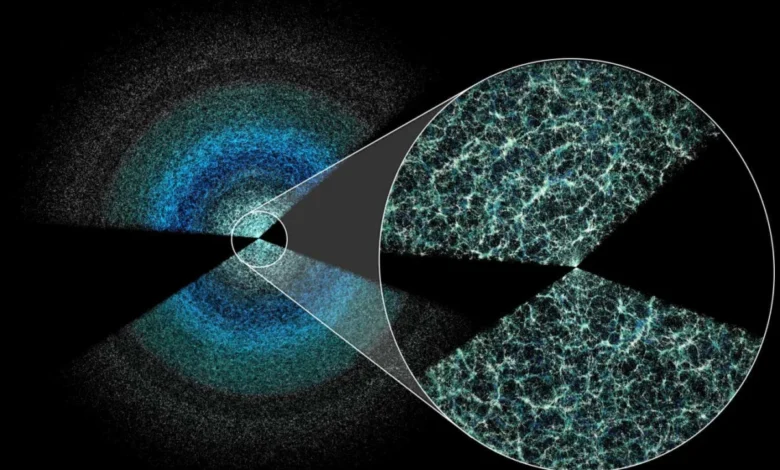
The completion of a monumental five-year sky survey by the Dark Energy Spectroscopic Instrument (DESI) marks a pivotal moment in our understanding of the universe. This ambitious project has meticulously cataloged over 47 million galaxies and quasars, constructing the most detailed three-dimensional map of the cosmos ever achieved. The sheer volume of data gathered promises to revolutionize cosmology, offering a critical lens through which to examine the enigmatic nature of dark energy, a force believed to constitute approximately 70 percent of the universe’s total mass-energy content. Early indications from DESI’s preliminary data have already sparked intense scientific debate, suggesting a potential weakening of dark energy over time—a finding that, if confirmed by the full dataset, could necessitate a significant revision of the prevailing standard model of cosmology.
A New Era of Cosmic Cartography
Since commencing its operations in 2021 at the Kitt Peak National Observatory in Arizona, DESI has exceeded all expectations. Originally anticipated to survey 34 million celestial objects, the instrument’s remarkable efficiency has allowed it to capture data on an additional 13 million galaxies and quasars. This feat is particularly astonishing given the immense distances involved; some of the most distant and faint galaxies observed have been detected through the capture of as few as 100 or 200 photons.
David Schlegel, a leading researcher at the Lawrence Berkeley National Laboratory in California, highlighted the transformative impact of DESI’s survey. "Our previous maps of the cosmos included a total of 5 million galaxies," Schlegel stated, emphasizing that the DESI data represents an almost tenfold increase in our cosmic inventory. He further elaborated on the historical trajectory of astronomical mapping, noting a consistent pattern of increasing survey scale. "We’ve actually been on this curve now for my whole career where, every 10 years, we’re making 10-times-larger maps," Schlegel observed. "You can ask the question, at what point have you mapped every observable galaxy within 10 billion light-years… and if we stayed on the curve, we would do that by 2061." This projection underscores the accelerating pace of discovery in observational cosmology, driven by technological advancements like DESI.
The DESI Survey: Scope and Timeline
The main observational phase of the DESI survey has now concluded, but the scientific journey is far from over. The vast trove of data collected will undergo a rigorous year-long analysis before being made accessible to the global research community. However, DESI’s contribution to our understanding of the universe is set to continue. The instrument is scheduled to keep collecting data for at least another two and a half years, with aspirations for its operational lifespan to extend well into the 2030s. "This is still the leading instrument like it in the world," Schlegel affirmed, underscoring its unique capabilities and importance.
The current DESI map encompasses an impressive 14,000 square degrees of the sky. The team is actively working to expand this coverage to 17,000 square degrees. For context, the entire celestial sphere spans over 41,000 square degrees. However, significant portions of the sky are obscured or difficult to observe due to the overwhelming brightness of nearby objects, most notably our own Milky Way galaxy, which lies directly in our line of sight. This galactic plane acts as a substantial barrier to deep-sky observations.
Unraveling the Mystery of Dark Energy
The primary scientific objective of DESI is to shed light on the nature of dark energy. This mysterious entity is responsible for the observed accelerated expansion of the universe. By mapping the distribution of galaxies and quasars across vast cosmic distances and through cosmic time, scientists can observe how the expansion rate has changed throughout the universe’s history. This historical record is crucial for understanding the behavior of dark energy.
A preliminary analysis of data released in 2024 hinted at a potentially groundbreaking discovery: dark energy might not be a constant force as predicted by the standard cosmological model, known as Lambda-CDM. Instead, there are indications that it may be weakening over time. This apparent weakening challenges fundamental assumptions about the universe’s ultimate fate and its underlying physics. If confirmed by the comprehensive dataset from the completed five-year survey, this finding would represent a profound crisis for the Lambda-CDM model, potentially requiring the development of entirely new theoretical frameworks to explain cosmic evolution.
Ofer Lahav, a distinguished cosmologist at University College London, reflected on the remarkable progress made in the field. "When I was a PhD student in Cambridge, 40 years ago, we had a sample of thousands of galaxies. The community was starving for data," Lahav recalled. He contrasted this scarcity with the current abundance, stating, "I think my students [today] may have the opposite problem; to have been flooded with data, and it’s very challenging to analyse it." This sentiment highlights the exponential growth in observational capacity, which has shifted the challenge from data acquisition to data interpretation.

Implications for the Standard Model of Cosmology
The Lambda-CDM model, which posits a universe dominated by dark energy (Lambda) and cold dark matter (CDM), has been the cornerstone of modern cosmology for decades. It successfully explains a wide range of cosmological observations, including the cosmic microwave background radiation and the large-scale structure of the universe. However, the potential weakening of dark energy introduces a significant wrinkle.
If dark energy’s influence is indeed diminishing, it implies that the expansion of the universe may not continue accelerating indefinitely, or at least not at the rate currently predicted. This could alter our understanding of the universe’s ultimate fate, potentially leading to scenarios other than the widely discussed "Big Freeze" or "Big Rip." Furthermore, it could open the door to exotic physics, such as the existence of extra dimensions or modifications to Einstein’s theory of general relativity on cosmic scales. The full DESI dataset will provide the statistical power necessary to either solidify or refute these early indications, offering crucial insights into whether our current cosmological paradigm is robust or requires substantial revision.
A Technological Marvel: The DESI Instrument
The Dark Energy Spectroscopic Instrument is a marvel of modern engineering and astronomical instrumentation. Located at the Kitt Peak National Observatory, it is designed to conduct spectroscopic surveys of the sky. This means that for each galaxy and quasar it observes, DESI measures the redshift of its light. Redshift is the stretching of light waves as the object moves away from us, and it directly correlates with the object’s distance and the expansion of the universe.
DESI utilizes a revolutionary system of 5,000 optical fibers, each no larger than a human hair. These fibers can be individually positioned by robots to target specific celestial objects identified in advance. This allows DESI to capture the spectra of thousands of objects simultaneously, dramatically increasing the speed and efficiency of spectroscopic surveys. The instrument’s wide field of view and its ability to precisely measure the positions and redshifts of millions of galaxies make it uniquely suited for mapping the large-scale structure of the universe and studying the subtle effects of dark energy.
The Long Road Ahead: Analysis and Future Prospects
While the data collection for the main survey is complete, the process of extracting scientific knowledge from this immense dataset will take time. The year dedicated to analysis will involve meticulous calibration, error checking, and the development of sophisticated statistical methods to tease out the subtle cosmological signals. This period is critical for ensuring the reliability and accuracy of the findings.
The ongoing data collection will further enhance the precision of the map, allowing researchers to probe even fainter and more distant regions of the universe. The prospect of extending DESI’s operational life into the 2030s, coupled with potential upgrades, holds the promise of even greater discoveries. The instrument’s continued operation could solidify the findings regarding dark energy, or perhaps reveal new mysteries that will drive the next generation of cosmological research.
Broader Scientific and Societal Impact
The scientific breakthroughs anticipated from DESI extend beyond the realm of dark energy. The detailed map of the universe will provide invaluable data for a wide range of cosmological studies, including investigations into the nature of dark matter, the evolution of galaxies, and the formation of cosmic structures. It will also serve as a crucial benchmark for theoretical cosmologists, guiding the development and refinement of models that seek to describe the universe from its earliest moments to its ultimate destiny.
Moreover, the project’s success exemplifies the power of international collaboration in scientific endeavor. The DESI collaboration involves hundreds of scientists and engineers from institutions across the globe, pooling their expertise and resources to tackle some of the most fundamental questions about our existence. The dissemination of this unprecedented dataset will empower researchers worldwide, fostering new avenues of inquiry and potentially leading to unexpected discoveries. As Ofer Lahav noted, "With so much data, there will be scientific breakthroughs about the nature of the universe, but we have also probably caught unusual one-off cosmological incidents that lead to exciting research." The DESI survey is not just about confirming existing theories; it’s about opening up entirely new frontiers of cosmic exploration.