KPMG Becomes OpenAI Elite Partner, Unveiling a "Headless" AI-Native Enterprise Software Vision

In a significant development poised to reshape enterprise technology, KPMG has been elevated to an OpenAI Elite Partner, the highest tier within OpenAI’s burgeoning partner ecosystem. This strategic alliance, announced recently, is not merely a partnership but a blueprint for a new era of AI-native enterprise solutions, forged initially through KPMG’s foundational work in building an internal Supply Chain & Fulfillment Orchestration platform for OpenAI itself. This "client-zero" deployment effectively transformed OpenAI into KPMG’s first customer for a model the consulting giant now intends to roll out broadly across the global enterprise landscape.
The genesis of this alliance lies in a unique collaboration where the frontier AI lab, OpenAI, entrusted KPMG to design and implement an AI-native workflow system for its own operational needs. This bespoke solution, centered on supply chain and fulfillment orchestration, served as a real-world crucible for KPMG’s innovative approach to enterprise AI. It demonstrates a powerful full-circle moment: the firm that traditionally advises on technology adoption was first tasked with building a cutting-edge AI system for one of the world’s leading AI developers. This hands-on experience has now become the cornerstone of KPMG’s go-to-market strategy, offering a validated model for enterprise clients grappling with the complexities of AI integration.
The Genesis of an Alliance: OpenAI’s Internal Transformation
The internal project for OpenAI, a Supply Chain & Fulfillment Orchestration platform, was more than just a software build; it was a testament to the practical application of AI in streamlining complex business operations. OpenAI, a company at the forefront of AI innovation, needed a robust, intelligent system to manage its own intricate supply chain – a critical component for any organization scaling rapidly, especially one dealing with the vast computational resources and logistical challenges inherent in AI development. By enlisting KPMG, OpenAI sought to leverage the consulting firm’s deep operational expertise and its emerging capabilities in AI deployment.
Colleen Kapase, Vice President of Strategic Global Partnerships and Ecosystems at OpenAI, emphasized the exclusivity of the Elite Partner status, noting it is reserved for a "limited group of global partners" possessing the requisite reach, scale, and delivery capabilities to drive enterprise AI adoption worldwide. This endorsement from OpenAI underscores the perceived value and proven track record of KPMG’s approach, particularly its ability to navigate the complexities of large-scale deployments in diverse organizational contexts. The "client-zero" project provided KPMG with an invaluable opportunity to refine its AI deployment model in a high-stakes, real-world environment, transforming theoretical concepts into tangible, operational systems.
Redefining Enterprise Workflows: The "Headless" Revolution
At the core of KPMG’s new offering is a profound "bet on how enterprise software changes from here," as articulated by Chad Seiler, KPMG’s U.S. industry leader for technology, media, and telecommunications. Seiler posits that the traditional mode of interacting with enterprise software – logging into applications, navigating screens, and clicking through modules – is rapidly nearing its end. Instead, KPMG envisions a "headless" future, where the user interface is decoupled from the underlying systems, transforming how employees engage with work.
"When we say headless, we’re really talking about decoupling the experience of work from the underlying systems and screens and modules while keeping those systems in place as a system of record," Seiler explained in an interview. This paradigm shift means employees will no longer be confined to learning the "geography of the software." Instead, they will describe what they want done in natural language, and sophisticated AI agents will interpret their intent, coordinate actions across various backend systems, and execute tasks. Human intervention will be reserved for situations requiring judgment, with AI agents intelligently escalating complex scenarios.
This vision culminates in voice as the primary interaction medium. Seiler predicts, "Over time, you’re going to be talking more than you’re typing." He elaborates on a future where conversations with systems replace clumsy UIs, enabling users to "take actions not only within that system, but connect that to other data sets and other systems all through an intelligent agentic layer." This represents a dramatic evolution from rigid, application-centric interactions to fluid, intent-driven conversations, promising unprecedented levels of efficiency and user experience. A KPMG blog post, co-authored by Swami Chandrasekaran and Matteo Colombo, further frames this evolution, stating that while "Tried and true SaaS isn’t going away. Its user interface is evolving. More precisely, a new work surface is emerging." The underlying databases and enterprise applications transition into invisible infrastructure, orchestrated by a layer of intelligent agents.
Navigating the AI Adoption Landscape: Insights from Industry Leaders
The move beyond mere experimentation to "large-scale enterprise deployment" is a critical milestone, according to Seiler. This signifies a maturation in the AI landscape, where the focus shifts from proof-of-concept projects to integrating AI into the core fabric of business operations. For enterprises, this means moving past pilot programs and investing in robust, scalable AI solutions that deliver tangible business outcomes.
KPMG’s decision to pursue such a deep alliance with OpenAI reflects a broader trend in the consulting industry, where firms are rapidly retooling to meet the escalating demand for AI strategy and implementation. The firm’s long-standing reputation for navigating complex organizational challenges, coupled with its newly solidified expertise in AI-native systems, positions it strongly in this evolving market. KPMG’s 2023 integration of OpenAI capabilities into its internal AI tool, aIQ Chat, for its Advisory and internal teams, further underscores its commitment to practicing what it preaches, building internal fluency before scaling externally. This internal deployment also enabled KPMG to identify Codex-related use cases, feeding directly into its client offerings.
The "Sandwich" Metaphor: Understanding AI’s Impact on Work
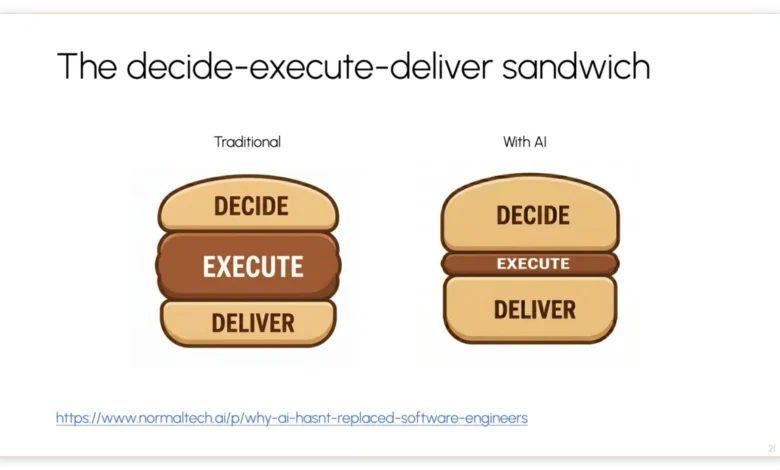
To conceptualize the impact of this "headless" revolution on human work, the discussion often turns to Princeton’s Arvind Narayanan’s "decide, execute, deliver sandwich" framework. Narayanan’s research, notably in his "AI as Normal Technology" series, breaks down work into three layers: a "decide" layer (top), an "execute" layer (middle), and a "deliver" layer (bottom). His argument is that AI primarily compresses the "execute" layer – the routine, procedural tasks – which historically constituted only about a third of the total work. The "decide" and "deliver" layers, encompassing judgment, strategy, accountability, and the human element, are expected to resist compression and potentially expand.

Seiler readily acknowledged the resonance of Narayanan’s framework, noting that the visual representation of a "skinny hamburger patty" accurately depicted KPMG’s observations in its deployments. However, he introduced a crucial nuance: the very speed and efficiency gained through AI-driven execution can create new verification burdens at the "deliver" layer. This, in turn, generates a new kind of overhead – "more talking about work rather than doing it" – that was not explicitly in Narayanan’s original thesis. Seiler suggested that the "decide" layer doesn’t merely hold steady; it can expand to absorb the coordination work that previously resided in the middle, shifting human effort towards higher-level strategic thinking, problem-solving, and oversight.
Narayanan, when reached for comment, reinforced his view that judgment and accountability inherently resist compression. He added that AI’s rapid advancements also "increase the ambition and complexity of projects," thereby raising "the ceiling of judgment and accountability," even as AI streamlines lower-level tasks. This suggests a continuous evolution of human roles towards more sophisticated cognitive demands.
However, Narayanan also raised a critical warning about potential "lock-in." He cautioned that an AI agent, deeply integrated into workflows and tacit knowledge, could become "the main queryable repository of all… tacit knowledge, creating dependence and stickiness." Such an agent, he argues, effectively becomes an indispensable "coworker that you can’t fire without every team losing workflows and know-how." This highlights the importance of careful architectural design and governance in enterprise AI deployments to mitigate risks associated with over-reliance on a single AI system.
Strategic Rationale and Market Positioning
KPMG’s unique value proposition in this AI-driven future lies not solely in its technological prowess but in its deep institutional knowledge of its clients. Seiler articulated this advantage compellingly: "We know their business models, their people, their culture, their systems, their data, their politics, their silos, in an intimate way at scale that some of these frontier models don’t." This bespoke understanding, accumulated over decades of consulting engagements, is crucial for tailoring generic AI capabilities to specific organizational contexts, navigating internal complexities, and ensuring successful adoption.
Kapase corroborated this, highlighting KPMG’s "deep enterprise transformation experience," particularly across highly regulated industries, the public sector, and cybersecurity. In these domains, governance, risk management, and meticulous implementation expertise are paramount. She specifically cited public-sector modernization and KPMG’s "Daybreak Cyber" product as key areas of collaboration, underscoring the partnership’s breadth beyond just supply chain optimization. OpenAI, she clarified, is committed to broad access across its ecosystem, ensuring KPMG does not receive exclusive access to unreleased capabilities, fostering a competitive yet collaborative environment.
KPMG’s strategy is additive rather than exclusive. Seiler confirmed that KPMG maintains parallel partnerships with other frontier labs, including Anthropic, and anticipates that large clients will not standardize on a single AI provider. This multi-vendor approach acknowledges the diverse needs of enterprises, the rapid evolution of AI technology, and the desire for resilience and cost optimization. Indeed, some clients are already leveraging cheaper alternatives, including open-source models, for narrower tasks, demonstrating a pragmatic approach to AI adoption.
Regarding the rise of open-source models, Kapase affirmed OpenAI’s focus on "helping customers get greater value from OpenAI." She highlighted advancements in GPT-5.6, noting its enhanced intelligence per token and stronger performance per dollar. Specifically, she mentioned "Sol 54% more token-efficient on agentic coding tasks," signaling continuous innovation in OpenAI’s offerings to maintain a competitive edge.
The "go-to-market" dimension is what truly distinguishes the OpenAI deal for KPMG. "It’s one thing to work with the labs, and then it’s another thing to also work with them and go to market with them," Seiler remarked. The "client-zero" deployment provides irrefutable proof: if KPMG could successfully build and implement this AI-native system for OpenAI, the world’s leading AI innovator, the pitch to other enterprise clients becomes significantly more compelling and credible. It moves the conversation from theoretical possibilities to demonstrated capabilities.
The Broader Implications for Enterprise Technology
The partnership between KPMG and OpenAI signals a pivotal moment for enterprise technology. It reinforces the idea that AI adoption is not an overnight disruption but a long-term, deliberate process, akin to historical technological shifts like factory electrification. Both Seiler and Narayanan align on this extended timeline, with Narayanan describing organizational adaptation to AI as a "decades-long process," though acknowledging it is "more urgent a shock than most organizations are used to dealing with."
KPMG’s message to its clients is a pragmatic one: "The most successful organizations will be deliberate about where they reinvent – and where they do not," recognizing that "the same workflows that have been in place for years may continue to be the best fit." This cautious yet progressive stance positions AI not as a mandate for wholesale reinvention, but as a strategic tool to be applied judiciously where it can deliver maximum impact.
For businesses, this means AI transformation is less a "technology migration" and more "a portfolio of business decisions to be made." This perspective underscores the critical role of management consulting firms like KPMG, which specialize in guiding large organizations through complex strategic choices. The firm’s value proposition is amplified in an era where technological choices are intertwined with profound organizational, cultural, and ethical considerations.
The implications extend to workforce development, requiring new skill sets focused on AI agent supervision, intent engineering, and ethical AI governance. Organizations will need to invest in retraining and upskilling their employees to thrive in a "headless" environment where human roles shift towards higher-order thinking, judgment, and oversight. The promise is not just greater efficiency but a fundamental reimagining of how work gets done, potentially freeing human creativity from the shackles of repetitive, low-value tasks.
In conclusion, the KPMG-OpenAI alliance is more than a commercial agreement; it’s a declarative statement on the future of enterprise software and the evolving role of AI. By leveraging its own successful internal deployment for OpenAI, KPMG is offering a validated, real-world blueprint for organizations seeking to navigate the complexities of AI-native transformation. This partnership marks a significant step towards a future where AI agents seamlessly orchestrate backend systems, human intent drives action, and the "decide, execute, deliver sandwich" of work is reimagined for unprecedented efficiency and strategic depth, albeit with careful consideration of the long-term implications and potential challenges.