Hilton Worldwide Repositions Itself as a Tech-Driven Enterprise with Nasdaq Listing and High-Profile Uber Hire

Hilton Worldwide is undergoing a profound strategic transformation, actively redefining its corporate identity from a traditional hospitality giant into a digitally empowered powerhouse. Under the leadership of President and Chief Executive Officer Christopher Nassetta, the multinational hospitality company is championing a new corporate ethos: "people-led, tech-powered." This paradigm shift is not merely a marketing pivot; it represents a comprehensive operational overhaul designed to capture the attention of modern investors, integrate cutting-edge artificial intelligence, and leverage the technological efficiencies required to dominate the global lodging market for decades to come.
The momentum behind this digital and financial evolution has accelerated dramatically over the past month. In a series of high-stakes announcements, Hilton revealed its decision to transition its stock listing to the Nasdaq exchange, appointed a seasoned technology veteran from ride-hailing titan Uber as its new chief technology officer, and assured stakeholders that its infrastructure is already compatible with the burgeoning ecosystem of travel-focused AI agents. By aligning itself with the exchange floor that hosts Silicon Valley heavyweights like Apple, Microsoft, and Nvidia, Hilton is signaling to Wall Street that its future growth is fundamentally intertwined with technological innovation.
A Strategic Stock Exchange Migration
The foundation of Hilton’s recent corporate maneuvering began when the company announced its impending stock listing move to the Nasdaq. While initial corporate disclosures emphasized that the transition would cause zero disruption to day-to-day operations or property-level management, the symbolic and strategic implications of the move are vast.
During Hilton’s third-quarter earnings call, CEO Christopher Nassetta elaborated extensively on the rationale behind the exchange switch. For years, hospitality stocks have been categorized tightly within traditional consumer discretionary or real estate ecosystems. By moving to the Nasdaq, Hilton is intentionally placing itself in a marketplace heavily populated by the world’s most innovative enterprises. The relocation is calculated to shift investor sentiment, encouraging institutional funds and market analysts to evaluate Hilton not just by rooms booked and RevPAR (Revenue Per Available Room), but by its technological scalability, proprietary software integrations, and digital distribution prowess.
The decision reflects a broader trend among legacy global brands seeking to shed old-economy labels. As software increasingly dictates customer acquisition, loyalty program engagement, and property management systems, Hilton wants its valuation multiples to reflect the high-margin, tech-enabled nature of its modern business model.
Bringing Silicon Valley DNA to Hospitality: The Appointment of Jeff Moore
To execute this vision, Hilton recognized the need for executive leadership with deep roots in hyper-growth technology sectors. Earlier in the month, the company appointed Jeff Moore as its new Chief Technology Officer. Moore brings an impressive pedigree to the hospitality sector, having most recently served at Uber, where he directed a massive global engineering organization comprising approximately 2,500 professionals. Prior to his tenure at Uber, Moore accumulated extensive experience leading complex, large-scale software engineering initiatives that required real-time data processing, seamless user interfaces, and robust backend infrastructures—skills that translate directly to the high-volume transactional environment of global hotel booking engines.
Moore’s mandate at Hilton is clear: to "give tech more oxygen" across the enterprise. This involves dismantling legacy tech silos, modernizing the proprietary property management systems that run thousands of franchised and managed hotels worldwide, and accelerating the deployment of cloud-native infrastructure. By embedding a Silicon Valley-style engineering culture into the corporate headquarters in McLean, Virginia, Hilton aims to reduce friction for both hotel owners and guests.
Embracing the Era of Autonomous Travel Agents
Perhaps the most forward-looking aspect of Hilton’s recent strategy is its aggressive positioning within the artificial intelligence landscape. During financial briefings and executive keynotes throughout the fall, Nassetta emphasized that Hilton is not waiting for the AI revolution to arrive; it is actively integrating with it.
The travel industry is currently on the cusp of a major disruption driven by autonomous AI agents—conversational assistants and software bots capable of planning, booking, and managing entire itineraries on behalf of travelers. Traditional online travel agencies (OTAs) and global distribution systems (GDS) have long acted as gatekeepers between consumers and hotels. However, the rise of decentralized, generative-AI-powered planning tools threatens to disintermediate traditional booking channels.

Hilton’s proactive response has been to ensure that its reservation systems, loyalty data pipelines, and inventory APIs are optimized for machine-to-machine communication. By ensuring the company is plugged into "each and every one" of the emerging AI agents, Hilton guarantees that its properties remain front-and-center when an AI traveler crafts a personalized trip. This technical readiness prevents third-party aggregators from owning the direct relationship with the consumer in an AI-dominated search environment, preserving valuable direct-booking margins.
Chronology of Hilton’s Transformation Strategy
The convergence of these strategic milestones illustrates a carefully orchestrated corporate timeline:
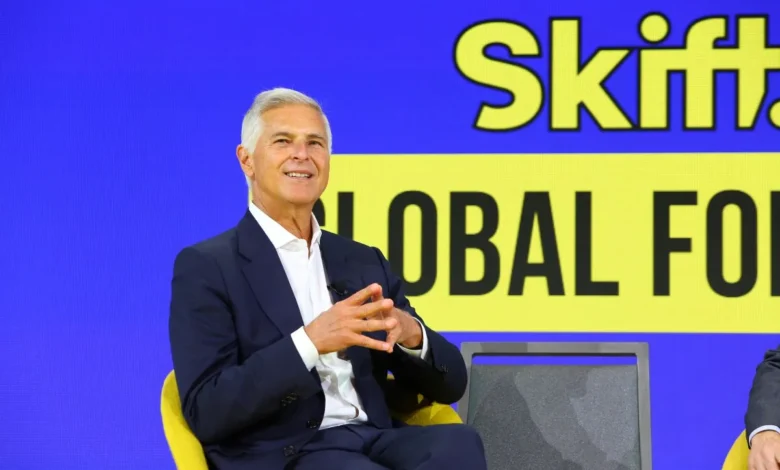
- September 2026: Christopher Nassetta takes the stage at the Skift Global Forum in New York City, outlining the strategic necessity for legacy hospitality brands to embrace artificial intelligence and digital dexterity.
- Early October 2026: Hilton officially announces the appointment of Jeff Moore, former Uber engineering leader, as its new Chief Technology Officer to scale its global digital infrastructure.
- Mid-October 2026: Hilton publicly discloses its plan to move its primary stock listing to the Nasdaq, aligning its corporate brand with the world’s leading technology innovators.
- Late October 2026: During the third-quarter earnings call, CEO Christopher Nassetta elaborates on the "people-led, tech-powered" corporate vision, highlighting readiness for the AI agent economy and reinforcing the rationale behind the Nasdaq transition.
Industry Implications and Market Analysis
Market analysts and hospitality experts have responded favorably to Hilton’s aggressive maneuvers, viewing them as a masterclass in preemptive adaptation. For decades, hotel chains competed primarily on real estate footprints, brand diversification, and loyalty program perks. While these remain critical pillars of the business model, the modern competitive landscape demands superior digital experiences.
By hiring elite engineering talent from outside the traditional hospitality ecosystem, Hilton is signaling that the future of hotel operations relies as much on algorithms, data science, and cloud architecture as it does on hospitality management and interior design. This cross-pollination of industries helps traditional brick-and-mortar giants avoid the stagnation that has historically plagued legacy retailers and service providers when confronted with digital disruption.
Furthermore, the strategic timing of the Nasdaq transition could yield tangible financial benefits. As institutional investors increasingly favor companies that demonstrate scalable, tech-enabled operating margins, Hilton’s public framing as a technology-forward enterprise may attract a broader pool of capital. This influx of investor interest can lower the cost of capital, funding further digital innovations and global expansion initiatives.
The Human Element in a Tech-Powered Future
Despite the heavy emphasis on software engineering, cloud migration, and artificial intelligence, Hilton’s leadership is careful to maintain its foundational commitment to human service. The phrase "people-led, tech-powered" is intentionally balanced.
Nassetta and his executive team understand that while artificial intelligence can streamline booking processes, optimize pricing algorithms, and personalize digital marketing, the core product of hospitality remains fundamentally human. A guest interacting with a mobile check-in app or an AI travel planner still ultimately expects a warm greeting from front-desk staff, immaculate housekeeping, and attentive personal service upon arrival.
By automating administrative burdens and operational friction through advanced technology, Hilton aims to free up its hotel staff to focus entirely on what they do best: delivering exceptional guest experiences. This synergy between advanced computing and genuine human hospitality forms the crux of Hilton’s competitive advantage as it navigates the latter half of the 2020s.
As the Nasdaq listing takes full effect and Jeff Moore’s engineering teams settle into their expansion roadmap, Hilton is setting a high benchmark for the global hospitality sector. The company’s decisive pivot proves that even the most established legacy brands can successfully reinvent themselves as agile, tech-forward market leaders in an era of unprecedented technological change.
Related posts: