The landscape of lower Fifth Avenue, a corridor traditionally defined by historic townhouses and restrictive zoning, is undergoing a profound structural evolution. A significant milestone in this transition occurred this week as a buyer entered into a contract for a triplex penthouse at 16 Fifth Avenue, a newly constructed luxury tower designed by Robert A.M. Stern Architects. With a closing price expected to shatter existing records for the Greenwich Village neighborhood, the sale signals a shift in the market for high-end residential real estate, suggesting that even the most protected historic enclaves are not immune to the demand for modern, ultra-luxury living.
A New Benchmark for Greenwich Village
The penthouse, initially brought to market with an ambitious $60 million asking price, saw a strategic reduction to $50 million earlier this month. According to Ryan Kaplan of the Corcoran Group, who is managing the sales effort alongside Tara King-Brown and the Corcoran Sunshine Marketing Group, the transaction is poised to surpass the neighborhood’s previous high-water mark. That record was established in 2017 when former Starbucks CEO Howard Schultz acquired a penthouse at the Greenwich Lane complex for $40 million.
The sale at 16 Fifth Avenue is particularly notable because it reflects a cooling of initial developer expectations—the $10 million price cut mirrors a broader adjustment in the project’s strategy. Earlier this year, a secondary penthouse in the building listed at $45 million ultimately closed for $32.5 million in April. By securing a buyer at the $50 million threshold, the developers, Madison Realty Capital, are successfully testing the upper limits of the Village’s pricing ceiling, which has historically been dominated by expansive, private townhouses rather than vertical luxury product.
The Evolution of Development in a Historic District
Greenwich Village has long been considered a difficult geography for large-scale development. The area’s status as a protected historic district places almost every architectural decision under the rigorous review of the Landmarks Preservation Commission (LPC). This regulatory environment often creates a “zero-sum” landscape for developers, where the scarcity of buildable land and the immense cost of acquiring historic tenements make new construction prohibitively expensive.
Wilson Parry, principal at the zoning-analysis firm PropertyScout, notes that the current supply of development-ready land in Manhattan is essentially exhausted. This lack of inventory has forced developers to look toward older, less architecturally significant rental structures that can be repurposed or replaced.
The story of 16 Fifth Avenue is a microcosm of this tension. The project was not built without significant opposition. During a contentious series of hearings in 2021, the building’s height became a flashpoint for local activists and elected officials. Manhattan Borough President Brad Hoylman-Sigal, then-City Council Speaker Corey Johnson, and Assemblymember Deborah Glick all provided testimony against the project. Critics famously compared the structure to the “supertall” towers of Billionaires’ Row, arguing that such developments threaten the historic character of the Village. One dissenting LPC member famously remarked that trimming the building’s height was like “giving Godzilla a haircut—it is still Godzilla.”
Despite this, the LPC approved the design in a narrow 6-5 vote. The deciding argument, supported by marketing agents, was that the previous mid-century rental building occupying the site was of such unremarkable architectural quality that its removal—and replacement with a Robert A.M. Stern design—constituted a net gain for the aesthetic integrity of the avenue.
Architectural Specifications and Layout
The 16 Fifth Avenue project comprises 14 ultra-luxury units, with only four remaining on the market. The building, which stands approximately 213 feet tall, features a design language consistent with Stern’s neo-traditional aesthetic, aiming to harmonize with the pre-war masonry of the surrounding blocks.
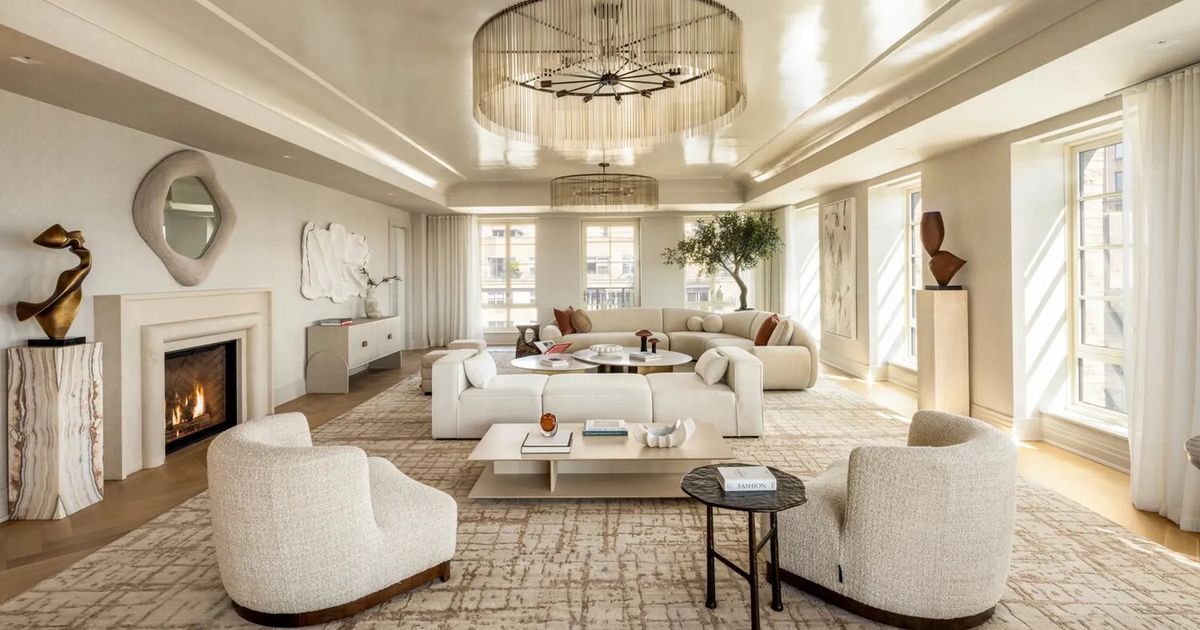
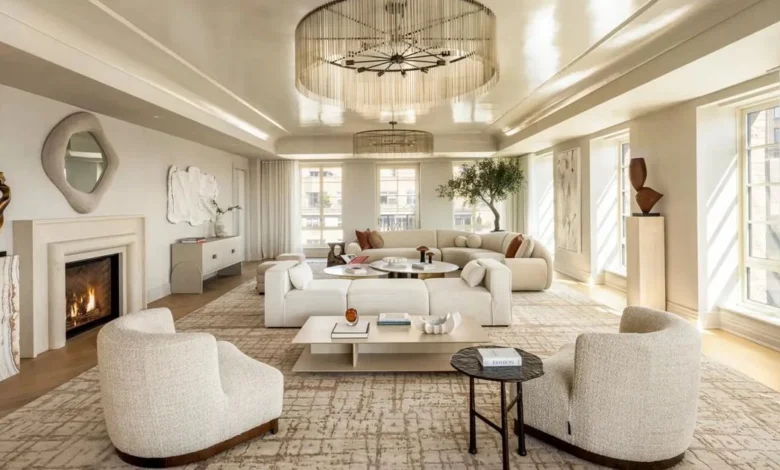
The flagship triplex penthouse spans roughly 8,300 square feet, utilizing an L-shaped floor plan across three levels. The lower floor houses the primary suite, which includes a dedicated dressing room, a double-vanity bathroom, and a private balcony overlooking the neighborhood. The middle floor is dedicated to communal life, featuring a library, a spacious great room, and a secondary bedroom. The top level is the crown of the residence, containing a final bedroom, a sunroom, and a large south-facing limestone terrace that offers unobstructed views of the city skyline—a rare commodity in the low-rise Village.
A Broader Shift in the Downtown Market
The success of 16 Fifth Avenue is part of a wider, if localized, boom in high-end condo development south of 14th Street. Within the last year, at least five new luxury projects have launched sales in the immediate vicinity of Fifth Avenue. This trend suggests that even with the persistence of a “pied-à-terre” tax and a shifting global economy, there remains a deep pool of capital willing to pay a premium for new construction in neighborhoods that were previously considered “locked” by preservation status.
Just half a block away on 9th Street, Lionheart Capital successfully converted a ten-story rental building into 45 high-end condos. Similarly, boutique projects near the corner of West 8th Street and MacDougal have seen rapid absorption rates.
Perhaps the most aggressive project currently challenging the neighborhood’s identity is the Greenwich Spire, located at 11 West 13th Street. Developed by the Legion Investment Group and EJS Group, the 538-foot-tall tower is situated just outside the boundaries of the local historic district, allowing it to bypass the height restrictions that constrained 16 Fifth Avenue. With 11 of its 34 units already under contract and an unlisted penthouse expected to ask $70 million, the Spire is positioned to redefine the price point for the area once again.
Implications for Preservation and Policy
The emergence of these towers has ignited a debate between the YIMBY (Yes In My Backyard) movement and traditional preservationists. Andrew Berman, a prominent voice for neighborhood preservation, has frequently cited projects like the Greenwich Spire as evidence of the erosion of community character. However, from a real estate perspective, the argument for these buildings is rooted in the "superlative" nature of the assets.
"It is the first building to go up on lower Fifth Avenue in decades, and it is the last that ever will," Ryan Kaplan noted, emphasizing the scarcity value of new construction in a highly regulated, high-demand neighborhood.
The shift toward ultra-luxury condos in Greenwich Village reflects a broader trend in Manhattan real estate: as prime sites on the Upper East Side and Billionaires’ Row reach saturation, developers are willing to endure the lengthy, expensive, and often politically charged process of securing approvals in protected districts. The fact that these developers are willing to navigate the gauntlet of the Landmarks Preservation Commission—and potentially reduce their building’s scale to gain approval—indicates that the profit margins for these “last-of-their-kind” projects remain high enough to justify the friction.
As 16 Fifth Avenue nears its final sell-out, it serves as a bellwether for the future of downtown Manhattan. The record-breaking sale of its penthouse suggests that the demand for trophy assets in historic neighborhoods is not diminishing, but rather becoming more discerning. Whether this trend leads to a further transformation of the Village’s skyline remains to be seen, but for now, the sale confirms that even in a city of strict preservation, the allure of the ultra-luxury, custom-built penthouse remains a powerful force in the local economy.