Navigating the New Frontier of AI Search Visibility and the Science of Attribution in the Era of Answer Engines

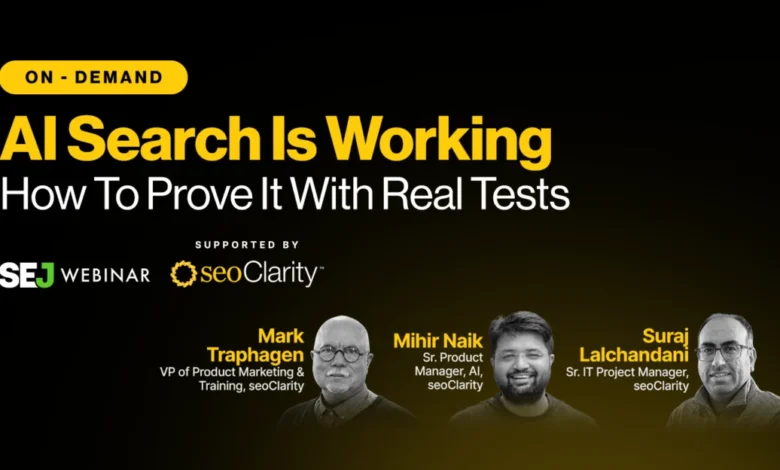
The digital marketing landscape is currently undergoing a seismic shift as traditional search engines transition into sophisticated answer engines, fundamentally changing how brands achieve visibility and measure success. In a recent high-level industry briefing hosted by Search Engine Journal, experts from seoClarity—including Mark Traphagen, Vice President of Product Marketing and Training; Mihir Naik, Senior Product Manager for AI; and Suraj Lalchandani, Senior IT Project Manager—presented a comprehensive framework for navigating this new reality. Their core thesis posits that while visibility scores confirm a brand’s presence in AI-generated responses, only rigorous page-level performance analysis and controlled split testing can determine if specific optimizations are truly driving those results. This distinction between mere correlation and verified causation has become the new gold standard for enterprise SEO teams attempting to master the intricacies of AI search surfaces like Google’s AI Overviews, ChatGPT, Claude, Perplexity, and Gemini.
The Breakthrough in AI Attribution: Proving Causation through Reversion
For years, search engine optimization has relied on observing upward trends following a site change, often leading to "correlation masquerading as causation." However, the seoClarity team demonstrated a methodology designed to eliminate this ambiguity. The most compelling evidence presented involved a large-scale test centered on the implementation of FAQ sections. By adding structured FAQ content to a specific set of test pages, the team observed a significant and immediate lift in AI citations—the links and mentions provided by the AI as sources for its answers.
To verify that the FAQ implementation was the direct cause of this lift, the team performed a "reversion test," removing the FAQs from the same pages. The subsequent drop in citations back to baseline levels provided the "second half of the proof" required for a scientific conclusion. This level of rigor is rarely seen in the current AI search landscape, where many teams are still guessing which content structures appeal most to Large Language Models (LLMs). The FAQ test proved that LLMs prioritize structured, direct question-and-answer formats because they provide clear, authoritative snippets that are easy for the model to parse and cite.
The Arrival of First-Party Data: Google’s Search Console Evolution
A pivotal moment in the chronology of AI search measurement occurred on June 3, 2024, when Google officially launched dedicated Search Console reports for AI Overviews and AI Mode. This update represents the most significant measurement upgrade since the inception of the Search Generative Experience (SGE). For the first time, a subset of site owners can see page-by-page data on how often their URLs appear within Google’s AI-driven features.
Suraj Lalchandani noted during the session that this development fundamentally changes the trust model for AI search data. Previously, SEO professionals were forced to rely on third-party tools that used sampling and inference to estimate AI visibility. While these tools remain essential for tracking platforms like ChatGPT and Perplexity—which do not provide first-party analytics—Google’s move to provide direct data removes the guesswork for its own ecosystem. However, the seoClarity team cautioned that these reports are not a complete solution. They cover only a portion of the AI search funnel and must be integrated into a broader testing program that accounts for the different crawling and rendering behaviors of various AI engines.
The Golden Set: Structuring Prompts for the AI Search Funnel
To effectively test AI search visibility, the seoClarity team advocates for the creation of a "Golden Set" of prompts. This is a curated list of search queries that spans the entire marketing funnel, from initial brand awareness to customer retention. Unlike traditional keyword lists, these prompts are designed to mimic how users actually interact with conversational AI.
The methodology involves tagging every prompt by its stage in the buyer’s journey and then sorting them into tiers based on current brand performance:
- Tier 1 Prompts: These are identified as "easy wins." In these instances, the brand is already deemed relevant by the AI, but the model has not yet been provided with a specific URL that is optimized enough to warrant a citation.
- Tier 2 Prompts: These represent a "heavier lift," where the brand may not be the primary focus of the AI’s response, requiring more significant content restructuring or authority-building.
- Excluded Prompts: Interestingly, the team revealed that certain buckets of prompts are dropped from testing entirely. These are queries where the AI’s intent is purely informational and unlikely to ever result in a brand citation, or where the competitive gap is too wide to bridge in the short term.
This tiered approach allows organizations to build "political capital" within their companies by securing early, measurable wins before tackling more complex, resource-intensive AI optimization projects.
Overcoming the Challenges of LLM Split Testing
One of the primary technical hurdles in AI search optimization is the inability to run traditional A/B tests. In a standard web environment, a developer can split live traffic 50-50 between two versions of a page. In the world of LLMs, however, the "user" is the AI model itself, and its output is non-deterministic, meaning it can change even if the input remains the same.
To solve this, the seoClarity methodology utilizes a control group of correlated pages. This group acts as a "noise filter" against model updates and algorithmic shifts. By comparing the performance of test pages against this stable control group, marketers can distinguish a genuine win from the background noise of the internet.
Timing is another critical factor. Traditional SEO changes can sometimes take weeks or months to manifest in rankings, but AI search engines can be even more volatile. The seoClarity framework establishes a specific baseline period before any change is implemented and a minimum test window afterward. Cutting this window short risks misinterpreting a temporary model "hallucination" or a minor update as a successful optimization strategy.
Analyzing the Failures: Why Meta Descriptions and Listicles Fell Short
While the FAQ test was a resounding success, the webinar also detailed two tests that did not produce the expected results: one involving meta descriptions and another focusing on listicle formatting. These "failures" provided equally valuable lessons.
In the case of meta descriptions, many SEOs hypothesized that LLMs might use these snippets as a primary source for generating summaries. However, the data suggested that modern AI models are sophisticated enough to crawl the full body content of a page, often ignoring the meta description in favor of more detailed information found within the H1, H2, and paragraph tags. Similarly, the listicle formatting test showed that simply changing the structure of a list does not guarantee an AI citation if the underlying information lacks the "authority" or "uniqueness" the model is looking for.
Mihir Naik emphasized that every test result is a win because it provides evidence-based direction. In an environment where many teams are chasing "hacks," having empirical data on what does not work allows a brand to reallocate resources toward proven tactics like structured schema and high-value template optimizations.
The Question of ROI in a Zero-Click Environment
One of the most pressing concerns for digital marketers is the "Zero-Click" phenomenon, where an AI engine provides a complete answer, leaving the user with no reason to click through to the source website. This raises a critical question: What is the ROI of an AI citation if it doesn’t drive referral traffic?
The seoClarity team argued that the value of a citation extends beyond the click. In the age of AI, brand representation is a form of "narrative control." If an AI engine provides a comparison between two products, the brand that is cited is the one that gets to shape the USPs (Unique Selling Propositions) presented to the user. Being omitted from an AI response is equivalent to being invisible in a traditional search result, but with the added risk that the AI may surface inaccurate or competitor-biased information about your brand if it cannot find a reliable source to cite.
Furthermore, the concept of "AI Authority" was defined as a "stackable signal." It is not a single metric like Domain Authority, but rather a combination of citation share, cross-engine consistency, and the model’s ability to render and parse a site’s content. Consistency across engines (e.g., being cited by both Gemini and ChatGPT for the same query) is a strong indicator that a brand has become the definitive authoritative source for that specific topic.
The Foundation of AI Success: Traditional SEO
Despite the focus on new AI-specific tactics, the overarching conclusion of the session was that traditional SEO remains the essential foundation for AI findability. Mark Traphagen noted that seoClarity’s clients who have historically maintained technically healthy sites and high-quality, well-optimized content are the ones performing best in AI search.
There is a symbiotic relationship between the two disciplines. Tactics that improve a site’s accessibility for traditional crawlers—such as clean HTML, fast load times, and clear internal linking—also make it easier for AI bots to ingest and understand the content. "We’ve rarely, if ever, found a situation where something works for SEO and does not work for AI search," Lalchandani added.
As AI search engines continue to evolve, the ability to move from guesswork to a rigorous, data-driven testing methodology will be the defining characteristic of successful marketing teams. By focusing on causation, leveraging first-party data where available, and maintaining a solid foundation of traditional SEO, brands can ensure they remain visible and authoritative in the rapidly changing landscape of the internet.