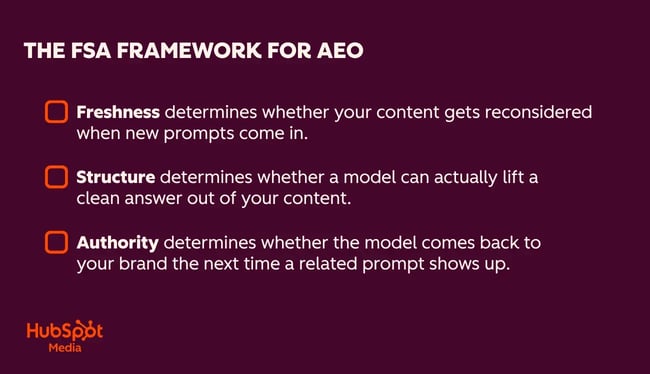
The digital marketing landscape is currently undergoing its most significant transformation since the advent of the modern search engine. For over two decades, Search Engine Optimization (SEO) served as the primary bridge between brands and their audiences, operating on a relatively stable set of rules: create quality content, build domain authority through backlinks, and optimize for specific keywords to secure a top position on a results page. However, the rise of "answer engines"—generative AI platforms like ChatGPT, Perplexity, Gemini, and Google’s AI Overviews—has rendered traditional SEO strategies insufficient. As users move away from clicking links and toward receiving synthesized, direct answers, a new methodology known as the FSA Framework (Freshness, Structure, and Authority) has emerged to address the growing invisibility of established brands in AI-generated responses.
This shift represents a fundamental change in the mechanics of information retrieval. While traditional search engines were designed to rank the best resource for a user to visit, answer engines are designed to provide the best answer for a user to consume. This distinction has created a visibility gap where brands that dominate traditional search results often find themselves completely excluded from AI citations. The FSA Framework serves as a diagnostic and strategic tool to help marketing teams transition from being a destination to becoming a primary input for Large Language Models (LLMs).
The Chronological Evolution of Search to Synthesis
The transition from traditional search to answer engine optimization (AEO) did not happen overnight, but rather through a series of technological leaps that redefined how machines interpret human language.
In late 2022, the public launch of ChatGPT by OpenAI marked the first major disruption, proving that users had a high appetite for conversational, direct answers over a list of blue links. By early 2023, Microsoft integrated GPT-4 into Bing, and Google responded by announcing its Search Generative Experience (SGE), later rebranded as AI Overviews. Throughout 2024, Perplexity AI gained significant market share by positioning itself as a "discovery engine," citing sources directly within synthesized text.
By 2025, the data revealed a stark reality for digital marketers: AI Share of Voice (SOV) was becoming a more critical metric than traditional organic rankings. Experiments conducted during this period highlighted a phenomenon known as "legacy displacement." In one documented case study, an independent marketing strategist, Cassie Clark, demonstrated that a single page optimized for AEO could displace a high-authority legacy publisher in AI citations within just 96 hours. By focusing on the FSA pillars, Clark moved her site’s AI Share of Voice from 27% to 72.7%, while the legacy competitor dropped to 0% visibility in the same window, despite having significantly higher domain authority and more backlinks. This experiment underscored that AI models prioritize the "extractability" of information over historical domain strength.
The Three Pillars of the FSA Framework
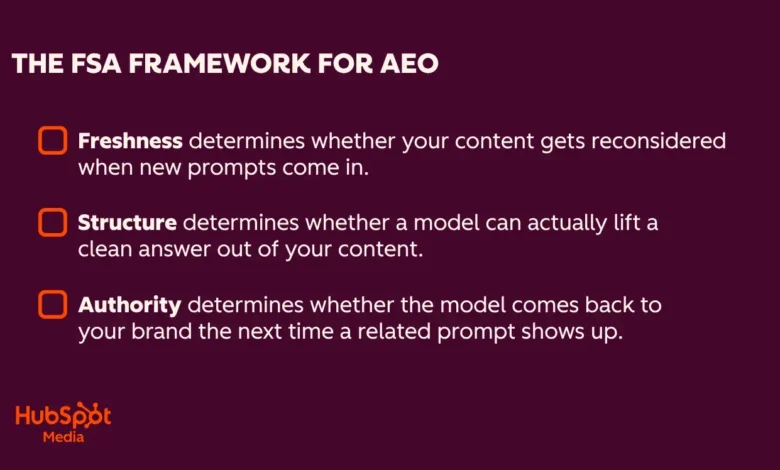
To understand why traditional SEO fails in the age of AI, it is necessary to break down the three signals—Freshness, Structure, and Authority—that govern how answer engines evaluate and cite sources.
Freshness: The Decay of Digital Relevance
In the context of AEO, freshness is not merely a "last updated" timestamp; it is a composite signal of recency, relevance, and reinforcement. AI models are trained on vast datasets but rely on real-time web retrieval (often through Retrieval-Augmented Generation, or RAG) to provide current information.
Industry data suggests that in fast-moving sectors such as software-as-a-service (SaaS), fintech, and artificial intelligence, content has a "relevance half-life" of approximately 90 days. After this period, if the content is not reinforced by new mentions or updated with current terminology, AI models begin to view it as stale. For evergreen topics, this window extends to roughly six months. When a model perceives content as outdated—either because it references defunct tools or uses language that no longer aligns with current discourse—it drops that source from its "candidate pool" for generated answers.
Structure: Optimizing for Machine Extraction
Traditional SEO structure focuses on navigability and crawlability for search engine bots. AEO structure, however, focuses on extractability. Because AI models "chunk" information to synthesize answers, content must be organized in a way that allows a model to lift a self-contained explanation without needing the surrounding context.

Successful AEO structure utilizes:
- Direct Answer Headers: Using H2 and H3 tags that mirror the exact phrasing of user prompts.
- The Inverted Pyramid: Placing the most critical, extractable information at the beginning of a section.
- Semantic Labeling: Using clear, descriptive language that defines entities and their relationships.
If a brand’s best insights are buried deep within a narrative paragraph, an AI model is likely to skip them in favor of a competitor’s content that is formatted in a clean, modular hierarchy.
Authority: From Domain Strength to Entity Recognition
Perhaps the most significant shift in the FSA Framework is the transition from "Domain Authority" to "Entity Authority." In the traditional model, authority was built through a centralized repository of backlinks to a specific website. In the AEO model, authority is determined by how consistently a brand is mentioned across the broader digital ecosystem.
AI models build "confidence" in a source by seeing it referenced across multiple surfaces, including social media, Reddit threads, podcasts, third-party articles, and industry forums. This cross-channel reinforcement creates a "Knowledge Graph" around a brand. Smaller, niche brands are currently winning visibility battles against massive publishers because they focus on building high entity authority within a specific topic, whereas legacy publishers often dilute their authority by covering too broad a range of subjects without deep, consistent reinforcement across the web.
Supporting Data and Technical Analysis
The shift toward AEO is supported by changing user behavior and technical requirements of LLMs. According to recent industry surveys, nearly 40% of younger users prefer using social media or AI platforms for search over traditional engines. Furthermore, technical analysis of RAG systems reveals that AI models prioritize sources with high "information gain"—content that provides new, unique, or more clearly structured data than what is already in the model’s training set.
The impact of "Zero-Click Search" also continues to rise. With AI Overviews appearing at the top of Google results, the click-through rate (CTR) for traditional top-ranked links has seen a measurable decline. This necessitates a strategy where being "cited" within the AI answer is the only way to maintain brand presence, even if it does not result in an immediate website visit. The goal of AEO is to ensure that when a buyer asks a "money prompt"—a query tied directly to a purchasing decision—the AI provides a confident recommendation of the brand.
Official Responses and Industry Sentiment
Major players in the marketing technology space have begun integrating AEO capabilities into their platforms to meet this demand. HubSpot, for instance, has introduced AEO-specific features that allow brands to track their mentions across ChatGPT, Perplexity, and Gemini. Marketing executives at these firms suggest that the "volume-based" content strategy of the last decade—where the goal was to publish as much as possible—is being replaced by a "maintenance-based" strategy.
Industry analysts emphasize that AEO is not a replacement for SEO, but a necessary evolution. While SEO helps a brand get "into the room" by making it discoverable to crawlers, AEO ensures the brand is "chosen" by the AI to be presented to the user. The consensus among digital strategists is that teams must pivot their editorial calendars to prioritize meaningful refreshes of high-performing pages over the constant production of net-new, low-value content.
Broader Impact and Strategic Implications
The long-term implications of the FSA Framework extend beyond simple search rankings. It signals a shift toward a more fragmented and conversational internet. For brands, this means that reputation management and content distribution are now inseparable from search strategy.
To implement the FSA Framework effectively, organizations are encouraged to:
- Identify "Money Prompts": Determine the specific questions buyers ask during the evaluation phase and audit how AI engines currently answer those questions.
- Restructure for Extraction: Audit top-performing assets to ensure they contain "liftable" summaries and clear hierarchies.
- Diversify Distribution: Move beyond the website to build entity authority on platforms where AI models "listen," such as industry-specific communities and social networks.
- Adopt New Metrics: Shift focus from keyword rankings to "AI Share of Voice," measuring how often the brand is cited relative to competitors in synthesized answers.
The brands that will thrive in the coming years are those that recognize the "destination web" is giving way to the "input web." By aligning their content with the three pillars of Freshness, Structure, and Authority, marketers can ensure their brand remains an authoritative voice in an increasingly AI-mediated world. The FSA Framework provides the necessary roadmap for this transition, offering a systematic way to diagnose visibility gaps and reclaim influence in the next generation of search.