TKO Group Holdings surges as UFC performance drives record-breaking third quarter financial results

TKO Group Holdings, the parent company of both the Ultimate Fighting Championship (UFC) and World Wrestling Entertainment (WWE), has reported a transformative third quarter, characterized by significant revenue growth and heightened operational efficiency. The financial results, which exceeded analyst expectations, underscore the rising global demand for premium live sports and entertainment experiences. Driven largely by a stellar performance from the UFC, TKO has officially raised its full-year guidance for the second time in 2024, signaling confidence in its long-term strategy and the durability of its core assets.
For the three-month period ending September 30, TKO reported total revenue of $1.36 billion, marking a robust 21% increase compared to the same period in the previous year. Even more impressive was the surge in adjusted EBITDA (earnings before interest, taxes, depreciation, and amortization), which climbed 54% to $555.7 million. This expansion reflects not only top-line growth but also the company’s ability to optimize its cost structure, with the adjusted EBITDA margin reaching 41%, up from 32% in the prior year.
The UFC Engine: A Catalyst for Growth
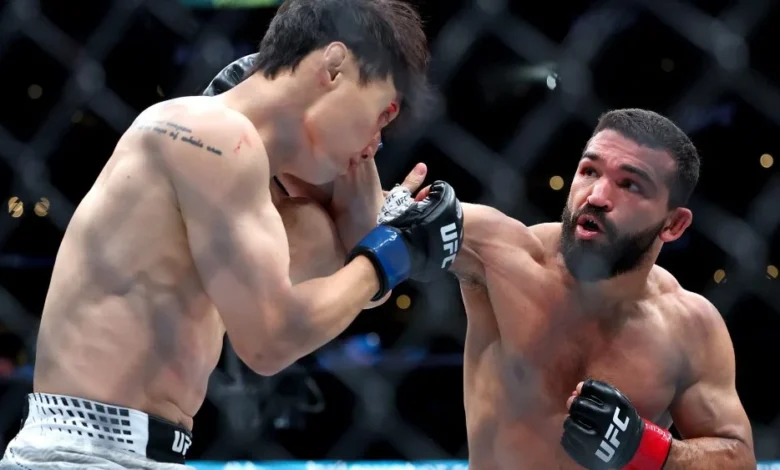
The UFC served as the primary engine for TKO’s growth during the quarter, delivering double-digit gains across every measurable category. The organization saw its revenue climb 60% year-over-year, reaching $519.2 million. This substantial increase was fueled by a $132.3 million boost in media rights, production, and content revenue, confirming that the UFC’s broadcast distribution model remains a potent financial asset.
Beyond broadcasting, the UFC’s physical footprint proved highly lucrative. Live events and hospitality revenue saw a $36 million spike, buoyed by a series of high-profile, sold-out events that drew significant fan attendance and premium ticket spending. Additionally, the organization saw a $20.5 million increase in partnerships and marketing—a testament to the league’s appeal to blue-chip advertisers—and a $5.2 million gain in consumer products and licensing.
The UFC’s success in the third quarter is consistent with the broader trajectory of mixed martial arts, which has evolved from a niche sport into a global cultural phenomenon. By leveraging a high-frequency event schedule and a deep roster of internationally recognized athletes, the UFC has effectively minimized the volatility often associated with live sports, creating a reliable stream of revenue that persists regardless of seasonal fluctuations.
WWE Performance and Portfolio Dynamics
While the UFC experienced explosive growth, the WWE’s performance was more measured, reflecting the inherent complexities of a global wrestling circuit. The company noted that its year-over-year comparison was impacted by a scheduling anomaly: there were three fewer major events on the WWE main roster compared to the third quarter of 2023.
Despite this, the wrestling giant remains a critical component of the TKO portfolio. The integration of WWE into the TKO ecosystem continues to yield synergies, particularly in areas like sponsorship sales and international market expansion. Furthermore, the broader "TKO" umbrella—which includes the IMG agency and the On Location premium events business—benefited from the global appetite for high-end sports tourism. On Location, in particular, saw a strong quarter, bolstered by its involvement in high-ticket events, including the recent World Cup, which served as a reminder of TKO’s ability to capture value at the intersection of sports and luxury hospitality.
Corporate Strategy: The Year of Execution
Mark Shapiro, president and COO of TKO, framed the third quarter results as the culmination of what the company has termed its "year of execution." Speaking to shareholders and industry analysts, Shapiro emphasized that TKO’s assets are uniquely positioned within a "premium ecosystem" that is currently benefiting from secular tailwinds in the live events sector.
"Our third quarter performance reflects the secular tailwinds powering live events and experiences around the world," Shapiro stated. "As we close out our year of execution, our decision to raise full-year guidance for the second time this year is the clearest expression of our conviction across the entire portfolio. Our business is durable and our fundamentals are solid, with the vast majority of our existing revenues locked in for the next five to seven years."
Shapiro’s comments highlight a critical aspect of TKO’s business model: predictability. By securing long-term media rights deals and multi-year corporate partnerships, TKO has insulated itself against short-term economic downturns. The company’s leadership maintains that macro trends in sports consumption—ranging from the rise of streaming platforms to the global professionalization of combat sports—are firmly in their favor.
Revised Outlook and Future Projections
Given the strong performance in the third quarter, TKO has adjusted its full-year financial targets upward. The company now expects full-year revenue to fall between $5.790 billion and $5.830 billion, with adjusted EBITDA projected to land between $2.295 billion and $2.315 billion.
This guidance reflects a company that is not merely reacting to market conditions but is actively shaping them. The synergy between UFC and WWE allows for cross-promotion and shared back-office efficiencies that were not possible when the two entities operated independently. Analysts suggest that the next phase of TKO’s growth will likely focus on international expansion, particularly in markets where both brands have yet to fully penetrate, such as parts of Asia and the Middle East.
Broader Implications for the Sports Industry
The success of TKO provides a blueprint for the future of sports conglomerates. In an era where traditional linear television is losing its grip on younger audiences, TKO has doubled down on "appointment viewing" events that are essentially immune to time-shifting. Whether it is a pay-per-view UFC title fight or a major WWE premium live event, these spectacles create a level of engagement that is highly prized by streaming services and global advertisers.
The implications for the industry are significant. As TKO continues to command higher fees for its media rights and higher prices for its live experiences, it sets a benchmark for other sports organizations. The company’s focus on "premium" experiences—offering fans everything from ringside seats to exclusive hospitality packages—has proven to be a resilient strategy even in an inflationary environment.
Furthermore, the integration of IMG into the TKO fold provides the company with an in-house agency that can leverage data across all its properties. By utilizing behavioral data from UFC fans and applying it to WWE’s massive global following, TKO can optimize its marketing spend and increase the lifetime value of its consumer base.
A Chronology of Growth
The current financial strength of TKO is the result of a deliberate, multi-year strategy to consolidate combat sports and entertainment.
- The Formation: TKO Group Holdings was formed in September 2023 following the merger of UFC and WWE, both of which were under the Endeavor umbrella.
- Early Integration: The first two quarters of 2024 were defined by the consolidation of back-office functions and the streamlining of sponsorship sales departments.
- Mid-Year Momentum: By the second quarter of 2024, the benefits of these integrations began to materialize, with the company raising its initial guidance for the first time.
- The Third Quarter Breakthrough: The current reporting period marks the first time that both the UFC and the broader TKO ecosystem have operated at full capacity, demonstrating the scalability of the model.
Conclusion and Future Outlook
As TKO enters the final quarter of the year, the company appears to be in a position of strength. With a solid foundation of long-term revenue contracts and a clear path toward further operational efficiency, the organization is well-prepared to navigate the evolving landscape of sports and entertainment.
The success of the third quarter is not just a statistical win for TKO; it is a validation of the thesis that in a fragmented media world, premium, live-event-based sports remain the most valuable currency in entertainment. As TKO looks ahead, the focus will undoubtedly shift to maintaining this momentum, expanding its global footprint, and continuing to capture the discretionary spending of sports fans who are increasingly willing to pay a premium for high-stakes, live-action experiences. Investors and industry observers alike will be watching closely as TKO moves into 2025, a year that will likely test whether the company can maintain these elevated margins while continuing to scale its global reach.