The digital marketing landscape is currently undergoing its most significant transformation since the advent of mobile search, as search engine optimization (SEO) professionals find their roles rapidly expanding into the realm of artificial intelligence (AI) authority. As platforms like ChatGPT, Google Gemini, and Perplexity reshape how consumers discover information, the traditional boundaries of organic search are dissolving, requiring a fundamental shift in how brands manage their online narratives. This evolution has moved beyond a mere trend, becoming a critical operational requirement for enterprises that wish to maintain visibility in an era dominated by generative AI and large language models (LLMs).
The Shifting Paradigm: From Keywords to Authority
For over two decades, the primary objective of SEO was to rank within the "top ten" blue links on a search engine results page. However, the emergence of generative AI has introduced a new layer of complexity: the synthesized answer. When a user queries an AI assistant about a brand, the model does not simply provide a list of links; it constructs a narrative. The core challenge facing modern marketing teams is ensuring that this narrative is derived from the brand’s own authoritative content rather than third-party interpretations, outdated reviews, or inaccurate datasets.
Industry experts observe that getting cited in AI outputs is now considered "table stakes"—the bare minimum for digital relevance. The more profound issue lies in the source of the AI’s knowledge. If an LLM synthesizes a brand’s identity based on external commentary rather than the brand’s primary assets, the company loses control over its messaging, pricing accuracy, and value proposition. This shift necessitates a coordinated effort that extends well beyond the SEO department, involving PR, legal, product, and C-suite executives.
A Chronology of the AI Search Revolution
The transition to AI-driven discovery has moved at an unprecedented pace, characterized by several key milestones that have redefined the industry:
- November 2022: The launch of ChatGPT by OpenAI marked the first time the general public interacted with a conversational interface capable of bypassing traditional search engines for informational queries.
- Early 2023: Microsoft integrated GPT-4 into Bing, signaling the start of the "AI Search Wars." Shortly thereafter, Google announced its Search Generative Experience (SGE), now known as AI Overviews.
- Late 2023: The rise of Perplexity AI introduced a "proactive" search model that prioritizes source citations, creating a hybrid between traditional search and generative synthesis.
- 2024-2025: Enterprises began experiencing a measurable shift in traffic patterns. Early data indicated that while top-of-funnel "informational" queries were increasingly handled by AI interfaces, "transactional" queries remained tethered to traditional search, albeit with heavy AI influence.
- Present Day: The role of the SEO has evolved into that of an "AI Search Authority," responsible for the brand’s footprint across various neural networks and ensuring data hygiene for LLM crawlers.
Supporting Data: The Impact of Generative Search
Recent industry research highlights the urgency of this transition. According to projections by Gartner, traditional search engine volume is expected to drop by 25% by 2026 as consumers migrate toward AI agents. Furthermore, studies on "Zero-Click" searches—queries that are resolved on the results page without a user clicking through to a website—have shown a steady increase, with some sectors seeing up to 60% of mobile searches ending without a site visit.
In the context of AI Overviews, data from SEO tracking platforms suggests that brands appearing in the "generative summary" see a significantly higher perceived authority, even if direct click-through rates (CTR) differ from traditional organic results. However, the risk of "hallucination"—where an AI provides false information about a company—remains a top concern. A 2024 survey of Chief Marketing Officers (CMOs) revealed that 72% consider "AI accuracy regarding brand facts" to be a high-priority risk factor for their digital strategy.
Establishing a Framework for AI Authority
To address these challenges, industry leaders like seoClarity have developed frameworks aimed at helping companies transition from traditional SEO to AI authority. Chris Sachs, Vice President of Client Success at seoClarity, and Tania German, Vice President of Marketing, have been at the forefront of this movement, advocating for a system-based approach to AI discovery.
The framework focuses on three primary pillars:
1. Data Hygiene and Structured Content
LLMs rely on structured data to parse information accurately. By utilizing advanced Schema markup and maintaining a "clean" knowledge graph, brands can increase the likelihood that an AI model will pull facts directly from the source. This involves treating every piece of content not just as a page for a human to read, but as a data point for a machine to ingest.
2. Entity-Based Optimization
Traditional keyword optimization is being replaced by entity-based optimization. AI models understand the world through "entities" (people, places, things, and brands) and the relationships between them. To become an AI search authority, a company must establish its brand as a clear, unambiguous entity within the digital ecosystem, ensuring that its relationship to specific products or services is explicitly defined across the web.
3. Narrative Control via Primary Sources
One of the most tactical shifts involves "feeding" the models. This includes ensuring that press releases, white papers, and official documentation are easily accessible to AI crawlers like GPTBot and CCBot. By dominating the share of voice in the datasets used to train or inform these models, brands can mitigate the influence of third-party synthesizers.
Official Responses and Industry Sentiment
The shift toward AI authority has drawn reactions from various sectors of the tech industry. Search engine representatives have maintained that their goal is to connect users with high-quality information, but they acknowledge that the format of that connection is changing.
"The goal isn’t just to rank anymore; it’s to be the definitive source that the AI trusts," says one senior growth director at a Fortune 500 tech firm. "If ChatGPT tells a user that our product doesn’t have a specific feature because it read an outdated blog post from 2019, that’s a failure of our modern SEO strategy. We have to be proactive in managing what these models ‘know’ about us."
CMOs are also recalibrating their budgets. Investment is shifting away from high-volume, low-intent content toward high-authority, technical assets that serve as "ground truth" for AI models. There is a growing consensus that the "SEO Manager" of the future will require a deeper understanding of data science and machine learning than ever before.
Broader Implications and Long-Term Outlook
The implications of becoming an AI search authority extend beyond marketing. It impacts reputation management, customer service, and even legal compliance. As AI agents begin to make purchasing decisions on behalf of users—a concept known as "agentic search"—the stakes for brand authority will only increase. If an AI assistant is tasked with "finding the best enterprise CRM for a mid-sized law firm," the brand that the AI perceives as the most authoritative and relevant will win the business, often without the user ever seeing a competitor’s website.
Furthermore, the rise of "Generative Engine Optimization" (GEO) is creating a new competitive landscape. Unlike traditional SEO, where competition was often localized to specific keywords, GEO is a battle for "probabilistic dominance." Brands must ensure that they are the most statistically probable answer to a given query within the model’s latent space.
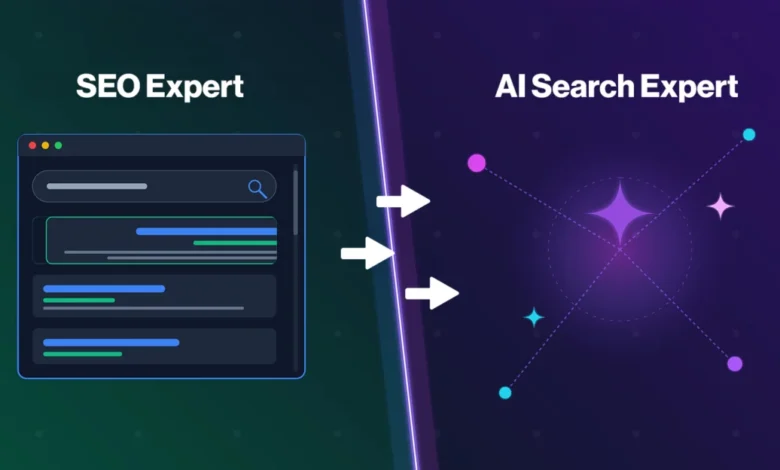
In conclusion, the transition from SEO expert to AI search authority is not merely a change in title but a fundamental reimagining of digital presence. By focusing on data accuracy, entity clarity, and proactive narrative management, companies can secure their place in the AI-driven future. The upcoming tactical sessions led by experts like Sachs and German represent a broader industry movement toward systemic solutions for a problem that can no longer be solved with traditional search tactics. As the AI landscape continues to evolve, the brands that prioritize their "AI authority" today will be the ones that define the market tomorrow.