The 2026 MTV Video Music Awards achieve historic viewership surge as industry analysts point to a broadcast renaissance

The 2026 MTV Video Music Awards have defied industry trends by delivering a massive audience, drawing 8.43 million viewers across CBS and MTV platforms on Sunday night. According to Nielsen Live+same day fast nationals, this performance marks the most-watched telecast for the franchise in 11 years, dating back to 2015. The total represents a striking 51% increase over the 2025 iteration of the awards, signaling a potential revitalization for televised music ceremonies in an era increasingly dominated by streaming-first consumption.
The Anatomy of a Ratings Success
The surge in viewership was bolstered by a combination of strategic scheduling and high-profile talent. A significant factor in the evening’s success was the accidental synergy provided by the NFL. A high-stakes football game between the Baltimore Ravens and the Dallas Cowboys ran into overtime, delaying the start of the awards show on CBS to 7:51 p.m. ET. While the ceremony officially began at 4:30 p.m. PT at the Peacock Theater in Los Angeles, the overrun on CBS forced a tape-delayed broadcast for the East Coast, effectively funneling a massive live-sports audience directly into the opening segments of the music awards.
The 8.43 million figure accounts for the combined reach of the CBS broadcast, the simultaneous airing on MTV, and the subsequent encore presentation on MTV. To ensure an accurate assessment of growth, analysts have utilized an "apples-to-apples" comparison against the 2025 show—which followed the same distribution model—proving that the growth is not merely a result of broader network availability but a genuine increase in audience engagement.
Broken down by network, the CBS broadcast secured the lion’s share of the audience with 7.61 million viewers, a 52% jump from the 5.00 million reported in 2025. MTV’s simulcast contributed 686,000 viewers, while the late-night encore drew an additional 142,000, both representing significant double-digit growth percentages compared to the previous year.
Demographic Deep Dive: Younger Audiences Return
Beyond the raw totals, the demographic breakdown offers perhaps the most encouraging data for MTV and its parent company, Paramount Global. Advertisers and network executives have long struggled to retain younger viewers, but the 2026 VMAs saw a decisive shift in momentum.
In the critical 18-34 age demographic, the show pulled in 1.09 million viewers, the highest total since 2020 and a massive 46% increase over the 751,000 recorded in 2025. The 18-49 demographic, the primary benchmark for entertainment advertising, reached 2.66 million viewers—the best performance for the awards show since 2018. Even in the slightly older 25-54 bracket, the show drew 3.11 million viewers, marking a 34% rise from the previous year.
These figures suggest that despite the fragmentation of the media landscape, the VMA "event" status remains intact. By leveraging high-impact social media integration, the show generated 31.1 million interactions and 159 million video views, an 8% increase over 2025. This digital footprint serves as a secondary revenue stream and a critical bridge between linear television and the Gen Z consumer base.
A Star-Studded Chronology and Production Triumphs
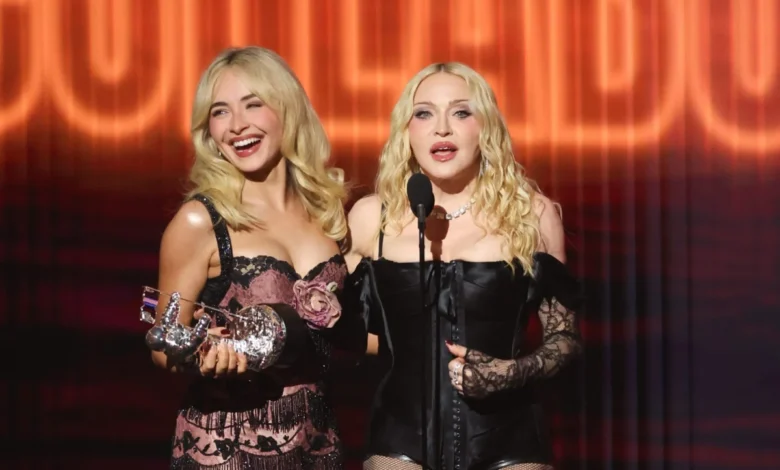
The 2026 broadcast was defined by its aggressive pursuit of cultural relevance, blending legacy icons with contemporary pop powerhouses. The evening opened with a landmark performance by Madonna, who returned to the VMA stage for the first time in 23 years. Her performance, featuring collaborations with Sabrina Carpenter and Charli XCX, set a high energy bar for the night and likely contributed to the strong early-show retention.
Throughout the evening, Taylor Swift continued her reign over the awards, winning Video of the Year and the MTV VMA Artist Director award. Her premiere of the music video for "Patient Zero" served as a "must-watch" moment that prevented channel flipping. The ceremony also honored the legacy of music history, bestowing the Video Vanguard Award upon Nirvana, and featuring poignant tributes to icons Dolly Parton and George Michael.
The performance lineup was equally eclectic, reflecting the diverse tastes of a global audience. The stage hosted acts ranging from established stars like Kacey Musgraves and Lisa to breakout talent like Raye, Shaboozey, and Teddy Swims. Other notable appearances included sets by Gunna, GENER8ION, Sombr, Sienna Spiro, and Yung Lean.
The logistics of such a sprawling production were managed by an extensive team of industry veterans. Snoop Dogg, acting as both host and executive producer, provided a central thread for the chaotic, high-energy event. Production duties were handled by Gunpowder & Sky, with Van Toffler serving as a primary producer. The executive producing team included Jesse Ignjatovic of Den of Thieves, Barb Bialkowski, and Bruce Gillmer, working alongside Barry Barclay and Floris Bauer. Melanie Block and Gary Lanvy rounded out the production management, with Jen Proctor serving as the executive talent producer.
Industry Implications and Future Outlook
The success of the 2026 VMAs carries significant implications for the future of award show broadcasts. In recent years, the "awards fatigue" narrative has dominated television criticism, with many ceremonies suffering from dwindling viewership as audiences migrate to streaming platforms or social media clips. The 2026 VMA performance challenges the notion that linear award shows are inherently obsolete.
Instead, the results suggest that the "event" model—when supported by the right mix of live-music spectacles, high-profile host curation, and multi-platform distribution—can still command a massive, synchronized audience. By securing 12.73 million viewers in 2015, the VMAs had a high ceiling, and while the 8.43 million reached in 2026 has not yet hit those historic highs, it represents a substantial recovery.
Analysts at major media research firms have suggested that this rebound was likely aided by a "return to form" for the VMAs, focusing less on overly curated segments and more on the raw, unpredictable nature of live music performances. Furthermore, the decision to maintain a simulcast on CBS—the most-watched network in the United States—ensured that the awards were accessible to a broader demographic than they would have been on a cable-only channel.
For MTV, the path forward appears clear: maintain the balance between legacy acts and social media-driven talent while ensuring that the broadcast remains deeply tethered to the social media conversation. As the network looks toward the 2027 cycle, the primary challenge will be replicating this year’s "perfect storm" of viral moments and favorable lead-ins.
The 2026 VMAs have provided a blueprint for how legacy networks can navigate the digital shift. By proving that the Moon Man still holds weight in a fragmented market, the event has reaffirmed its status as a cornerstone of American pop culture. While final Nielsen adjustments are still pending, the narrative has been set: the music industry’s biggest night has found its footing once again, providing a necessary jolt of energy to the traditional broadcast television landscape.