OpenAI Ventures into Hardware with ‘Micro’ Keypad Amidst Legal Challenges and Market Skepticism

OpenAI, the artificial intelligence research and deployment company renowned for its groundbreaking language models like ChatGPT, made its inaugural foray into the hardware market last week with the introduction of "Micro," a specialized keypad designed to seamlessly integrate with its flagship AI assistant. Developed in collaboration with specialty keyboard designer Work Louder, Micro represents a curious blend of artisanal craftsmanship and cutting-edge AI utility, positioned as a distinctive workplace novelty likely to captivate a segment of tech enthusiasts while potentially leaving a broader audience perplexed. This strategic pivot into physical products marks a significant, albeit contentious, expansion for the company, coming at a time when OpenAI is navigating complex legal challenges and persistent industry speculation regarding its broader hardware ambitions.
OpenAI’s Evolving Strategy: From Software Dominance to Hardware Exploration
For years, OpenAI has been synonymous with advancements in artificial intelligence, primarily focusing on the development and deployment of sophisticated AI models accessible through software interfaces. Its flagship product, ChatGPT, has revolutionized human-computer interaction, garnering millions of users and establishing OpenAI as a leader in the generative AI space. The move into hardware, therefore, signals a potentially transformative shift in the company’s long-term vision—one that seeks to extend AI’s reach beyond traditional screens and into more tangible, intuitive physical interfaces.
This strategic expansion is not entirely unique within the burgeoning AI ecosystem. Several other prominent AI companies have recently explored or launched their own hardware devices, driven by a shared vision of creating more direct and seamless interactions with AI. Startups like Humane with its AI Pin and Rabbit with its R1 device have emerged with similar aspirations, aiming to embed AI capabilities directly into everyday objects, thereby reducing reliance on smartphones and conventional computing paradigms. For OpenAI, venturing into hardware could represent an effort to create a more controlled and optimized environment for its AI, ensuring a superior user experience and potentially opening new revenue streams beyond its successful subscription services and API access. The company, backed by billions in investment from Microsoft, holds a formidable position in the AI race, and hardware could be seen as a natural next step in solidifying its ecosystem and fending off fierce competition from tech giants like Google and Meta, who are also investing heavily in both AI and hardware.
The "Micro" Keypad: Design, Functionality, and Target Audience
The Micro keypad, a collaboration with Work Louder, a company known for its niche, high-quality mechanical keyboards and macro pads, embodies a distinct design philosophy. Upon initial handling, reviewers noted its robust and sturdy construction, a characteristic that lends it a premium feel and suggests durability. Its packaging, an immaculate white box with a sleek, minimalist aesthetic, has drawn comparisons to Apple’s iconic product presentation, a detail not lost on industry observers given the broader context of OpenAI’s rumored hardware projects and ongoing legal entanglements.
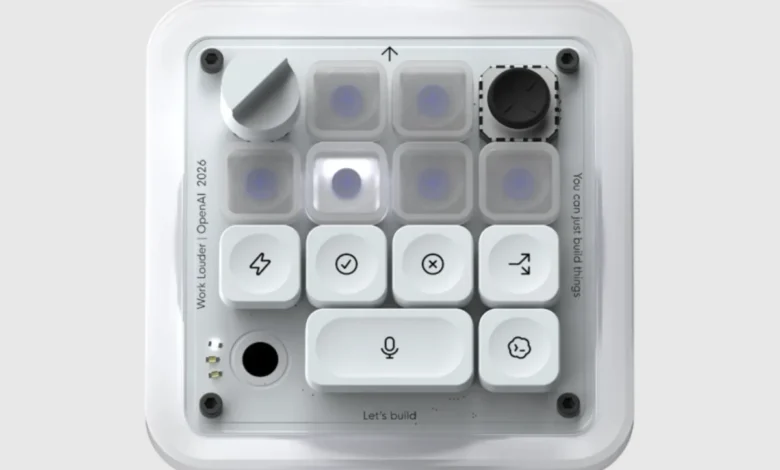
Functionally, Micro is engineered to streamline interactions with ChatGPT and its agentic coding tool, Codex. The device features a twelve-key layout, meticulously designed for efficiency. At the top, six frosted "agent" keys can be customized to execute specific, predefined tasks or initiate particular conversational threads within ChatGPT. Below these are six command keys, providing control over the active AI programs. Connectivity is versatile, offering both Bluetooth for wireless convenience and a USB cable for a stable wired connection. Perhaps its most immediately appealing feature is the dedicated voice dictation button, allowing users to vocalize their commands or queries directly to the AI, which then processes the request. A companion "send" button facilitates immediate submission.
Customization is a core tenet of the Micro experience. Users can tailor the keypad’s functionality directly within ChatGPT through a dedicated "Micro" tab. This interface allows for adjustments ranging from the brightness of the key backlighting to the precise commands and projects assigned to each key. The intention is to create a highly personalized and efficient workflow for power users, particularly those engaged in intensive coding, content generation, or data analysis tasks that frequently leverage AI. The device aims to reduce repetitive typing and mouse clicks, allowing for quicker context switching and command execution.
A Storm on the Horizon: Legal Battles and Unconfirmed Projects
OpenAI’s entrance into the hardware market has not been without significant drama and controversy, casting a shadow over the Micro’s launch. Just weeks prior, on July 10, 2026, tech behemoth Apple filed a lawsuit against OpenAI, alleging "trade secret theft." The lawsuit, details of which remain largely under wraps, is widely anticipated to ignite a protracted and complex legal battle, with profound implications for both companies and the broader intellectual property landscape in the rapidly evolving AI sector. Such lawsuits are not uncommon in the highly competitive technology industry, but the timing and the prominence of the parties involved elevate its significance. Apple, known for its fierce protection of its intellectual property and its strategic control over its ecosystem, views any perceived infringement as a serious threat.
Adding another layer of intrigue, just four days later, on July 14, 2026, reports surfaced detailing another smart home product reportedly in advanced development at OpenAI. This rumored device, described as a "screenless speaker" also designed to pair with ChatGPT, raised eyebrows not only for its conceptual similarity to existing smart home hubs but crucially because it was reportedly being developed by a team comprising former Apple engineers. This revelation fuels speculation about a deliberate strategy by OpenAI to leverage talent and perhaps design philosophies from its Cupertino rival, further exacerbating tensions between the two tech giants. The confluence of these events—a high-profile lawsuit from a major competitor and rumors of hardware developed by that competitor’s former employees—suggests that OpenAI’s hardware journey is set to be anything but smooth. It indicates a potential long-term play by OpenAI to move beyond software and establish a more comprehensive, vertically integrated ecosystem, mirroring Apple’s own successful strategy.

Initial Market Reception and User Feedback: A Divided Audience
The initial reception of the Micro keypad has been decidedly mixed, highlighting a clear divide between its intended niche audience and the broader tech community. While the device is clearly engineered to delight "code monkeys" and ChatGPT power users, the feedback from this very target demographic has been surprisingly lukewarm, even negative.
On platforms like Reddit, where developers and tech enthusiasts frequently congregate, early reviews have been largely critical. One Reddit user dismissively labeled Micro as "a prank and not a real product," while others asserted that "serious coders won’t touch it." These criticisms often center on the perceived necessity and value proposition of the device. Many argue that existing software shortcuts, customizable keyboards, and even integrated development environment (IDE) features already provide much of the functionality Micro offers, without the added cost or the need for a separate peripheral.
An even harsher critique came from the independent outlet Aftermath, whose review was titled, "OpenAI’s expensive macropad feels engineered to piss me off specifically." The review lambasted the Micro’s $230 price tag, deeming it unjustifiable when compared to numerous cheaper DIY and off-the-shelf macro pad alternatives already available in the market. Many macro pads, often costing a fraction of Micro’s price, offer similar levels of customization and functionality, albeit sometimes requiring more technical setup. The core argument against Micro’s value proposition is that it introduces a premium-priced, specialized tool for tasks that many users feel are already adequately, if not more efficiently, handled by their existing computer setups.
From a user experience perspective, there is a recognized learning curve associated with Micro. The reviewer from TechCrunch noted that new users will undoubtedly require time to familiarize themselves with its operation and programming. The keypad’s buttons utilize a color-coding system to indicate AI status: white for idle, blue for thinking, green for task completion, and red for errors. Memorizing these color codes, alongside the specific projects or commands tied to each of the twelve keys, adds an initial layer of cognitive load.
However, once this initial hurdle is overcome and the keypad is programmed to a user’s liking, the experience reportedly becomes "pretty fun" and "considerably more efficient and enjoyable." The ability to assign various ChatGPT sessions to specific keys, allowing for quick toggling between different projects, combined with the voice dictation feature, can significantly streamline workflow. For a user deeply embedded in the ChatGPT ecosystem, constantly switching between prompts, models, and tasks, Micro could indeed offer a tangible boost in productivity.
The fundamental question, however, remains: Is Micro functionally easier or more beneficial than simply continuing to interact with ChatGPT via a laptop’s native keyboard and mouse? For the average user, or even a semi-frequent AI user, the time investment required to learn and integrate Micro into their workflow might outweigh the perceived benefits. The reviewer candidly admitted that, as someone who doesn’t use AI extensively day-to-day, they are likely not the target audience. This reinforces the notion that Micro is a niche product, designed for the most dedicated ChatGPT power users who not only possess $230 to spare but also appreciate vintage-looking hardware with satisfyingly clicky buttons. For this specific demographic, Micro could potentially brighten their day and enhance their AI-driven tasks.
Broader Implications for OpenAI and the AI Ecosystem
OpenAI’s venture into hardware with Micro, despite its mixed initial reception, carries significant strategic implications for the company and the broader AI industry. For OpenAI, it represents a bold diversification strategy, moving beyond its core competency of AI model development into the more complex and capital-intensive world of consumer electronics. This could potentially open new revenue streams, foster deeper user engagement by creating a more integrated ecosystem, and give OpenAI greater control over the end-to-end user experience of its AI services. However, it also exposes the company to new risks, including manufacturing challenges, supply chain complexities, potential hardware failures, and the notoriously fickle nature of consumer tech markets. The legal battle with Apple further complicates this, potentially draining resources and diverting focus from core AI research and development.
For the AI industry, OpenAI’s hardware pivot, alongside similar moves by other startups, signals a growing trend towards the integration of AI directly into physical devices. This trend aims to make AI more ambient, intuitive, and accessible, moving away from explicit software interactions towards more natural, context-aware engagements. It suggests a future where AI is not just a tool on a screen but an active, responsive agent embedded in our physical environment. This could drive innovation in human-AI interface design, leading to new forms of interaction that prioritize efficiency, immediacy, and personalization.
The competitive landscape is also set to intensify. If OpenAI successfully carves out a niche in AI hardware, it could spur other major tech players, including Microsoft, Google, and Amazon, to accelerate their own hardware initiatives centered around their respective AI offerings. This could lead to a fragmented market of AI-specific devices, each vying for user attention and loyalty, potentially creating more silos rather than unified AI experiences.
Ultimately, Micro is more than just a keypad; it is a tangible statement of OpenAI’s expanding ambitions. It represents a commitment to exploring new modalities of human-AI interaction, even if the initial execution caters to a very specific, discerning audience. As the legal battles unfold and OpenAI’s broader hardware strategy materializes, the Micro keypad will serve as an early, albeit controversial, indicator of how one of the world’s leading AI companies envisions its future in a world increasingly shaped by intelligent machines.