AMD Unleashes Helios Rack System, Intensifying Rivalry with Nvidia for AI Dominance in a Trillion-Dollar Market

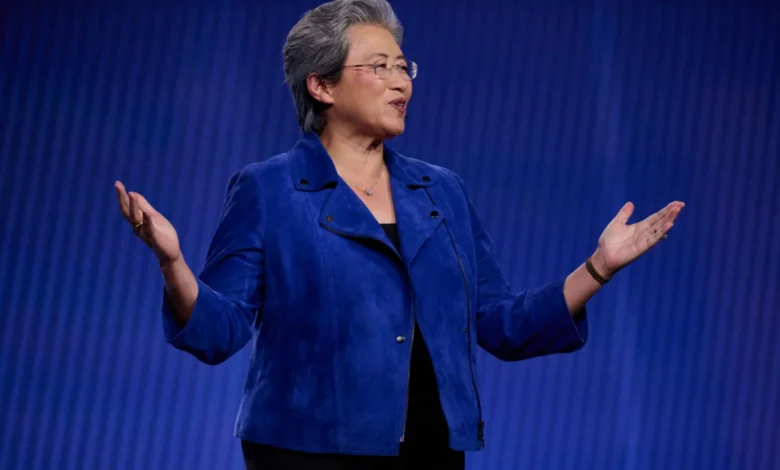
Advanced Micro Devices (AMD) has decisively escalated its challenge to market leader Nvidia, unveiling its latest flagship hardware — the Helios rack-scale system — meticulously engineered to power the burgeoning computational demands of the world’s most sophisticated artificial intelligence laboratories. The strategic move, showcased at AMD’s sold-out Advancing AI conference in San Francisco on Thursday, underscores the company’s ambitious drive to capture a significant share of the rapidly expanding AI infrastructure market, a sector projected to approach the size of the entire semiconductor industry by the end of the decade.
The conference served as a pivotal platform for AMD Chair and CEO Dr. Lisa Su, who not only championed the new Helios AI rack system but also highlighted its rapidly expanding roster of high-profile customers, including tech giants such as Microsoft. With shipments slated for later this year, Helios represents a formidable entry into a domain historically dominated by Nvidia’s powerful offerings. Dr. Su also took the opportunity to detail AMD’s newest generation of chips, specifically designed to satiate the insatiable compute hunger of the modern AI industry, signaling a comprehensive, full-stack approach to AI enablement.
Rack systems, at their core, are meticulously engineered architectures that integrate a multitude of processors into a singular, exceptionally high-powered unit. These robust configurations are the backbone of modern data centers, serving as the essential infrastructure for training and deploying advanced AI models, alongside other intensely compute-intensive workloads that define the frontier of digital innovation. The efficacy and performance of these systems are paramount, as they directly influence the speed, scale, and sophistication of AI development.
Dr. Su unequivocally positioned Helios as the tech industry’s "highest-performance AI rack," emphasizing its design ethos: "built to train and run the most demanding frontier models in the world at massive scale." This bold assertion is buttressed by the company’s announcement that the system is poised for deployment by leading AI companies at "gigawatt-scale," a testament to its immense processing capabilities and the anticipated demand from the industry’s top innovators. Such a scale of deployment signifies not just substantial individual installations but a collective, vast infrastructure commitment that speaks volumes about Helios’s potential impact.
The Dawn of Helios: A Strategic Unveiling and Market Context
The journey of the Helios system into the public consciousness began in 2025 with its initial reveal, culminating in a striking onstage appearance at CES 2026 in January, where its physical presence and substantial specifications garnered significant attention. This public debut set the stage for its current commercial push. AMD’s entry into the high-performance AI rack market is a direct challenge to Nvidia, which has historically commanded this segment with its formidable Vera Rubin and Grace Blackwell rack-scale systems. The long-standing rivalry between AMD and Nvidia, particularly in the GPU and data center sectors, is well-documented, with both companies consistently pushing the boundaries of silicon engineering and computational architecture.
For years, Nvidia has leveraged its CUDA software ecosystem and early lead in GPU development for AI to establish a near-monopoly in certain high-end AI compute segments. However, AMD has been steadily investing in its Instinct line of GPUs and ROCm software platform, aiming to provide a compelling alternative. The Helios system, reportedly outperforming Nvidia’s Vera Rubin in a number of key metrics according to reports from outlets like The Register, signifies a tangible breakthrough for AMD, offering a credible, high-performance option for customers seeking diversification and enhanced capabilities. These performance gains, though specific comparative benchmarks were not fully detailed in the initial announcement, are understood to relate to aspects such as throughput, latency, and power efficiency under demanding AI workloads, all critical factors for large-scale model training.
Further bolstering its comprehensive data center strategy, AMD also introduced its Venice-X CPU on Thursday. Designed specifically for data centers and optimized for handling high-computing workloads, the Venice-X, expected to launch in 2027, signifies AMD’s commitment to providing a full-stack solution, from GPUs to CPUs, that can seamlessly integrate and deliver maximum performance for complex AI and HPC (High-Performance Computing) environments. This dual-pronged approach with both advanced GPUs and CPUs ensures that AMD can cater to a wider array of computational requirements, reinforcing its position as a holistic provider of cutting-edge data center technology.
Industry Titans Endorse Helios: Customer Adoption and Strategic Partnerships
The credibility of AMD’s new offering is significantly bolstered by the immediate and substantial commitments from some of the most influential players in the AI landscape. Companies like OpenAI, Meta, Oracle, Anthropic, and Microsoft have all publicly announced plans to deploy the Helios system, signaling a strong vote of confidence in AMD’s technological prowess and strategic direction.
Microsoft CEO Satya Nadella’s statement on Monday, confirming the company’s intention to expand its Azure infrastructure with Helios, is particularly impactful. Microsoft, a behemoth in cloud computing and a major investor in AI, choosing Helios for its critical AI infrastructure underscores the system’s perceived reliability, scalability, and performance. This partnership provides AMD with a massive, high-profile deployment channel and validates Helios’s readiness for enterprise-grade, hyperscale environments.
Adding to this momentum, AMD and Anthropic, a leading AI safety and research company, unveiled a strategic partnership on Wednesday. This collaboration involves the deployment of an astounding "up to two gigawatts of AMD Instinct MI450 series GPUs" via the new rack system. To put "gigawatts" into perspective, it refers to the total power consumption required by these massive GPU clusters, indicating an enormous computational capacity. For context, one gigawatt is equivalent to one billion watts, a scale typically associated with power plants. The commitment of two gigawatts of GPU capacity signifies an unprecedented investment in AMD hardware by a frontier AI lab, highlighting Anthropic’s belief in the MI450 series and Helios’s ability to accelerate their advanced AI research and model development. This partnership is not merely a transaction but a strategic alliance, potentially leading to co-optimization efforts between AMD’s hardware and Anthropic’s cutting-edge AI models.
The adoption by these industry leaders is not just about performance; it’s also about strategic diversification. Relying solely on a single vendor, however dominant, can create supply chain vulnerabilities, limit negotiation power, and potentially stifle innovation. By embracing AMD’s Helios, these companies are likely seeking to build more resilient AI infrastructures, foster competition, and access a broader range of hardware options optimized for different workloads and cost structures. This shift is indicative of a maturing AI hardware market where demand outstrips the supply capabilities of any single provider, making multi-vendor strategies increasingly attractive.
The AI Accelerator Market: A Trillion-Dollar Horizon
During her remarks at the Advancing AI conference, Dr. Lisa Su offered a compelling vision for the future of the chip industry, asserting that by the year 2030, chips designed to power AI applications will constitute a colossal segment of the overall computing market. This transformative growth, she explained, is fundamentally driven by a "step change in compute demand," largely ignited by the emergent paradigm of agentic AI.
Agentic AI refers to intelligent systems capable of autonomous action, planning, and problem-solving through a series of iterative steps, often interacting with various tools and data sources. Dr. Su vividly illustrated the computational intensity of this new AI frontier: "When you ask the agent to do something, it actually has dozens of steps, and it has to reason, and it has to call tools, and it has to access data, and it has to keep doing it over and over until it solves the problem, and so you need lots of GPUs to do all that." This intricate, multi-stage process demands an exponential increase in processing power compared to earlier, more static AI models.
The financial implications of this demand are staggering. "We’re now expecting that by 2030, the AI accelerator market is going to reach about $1.4 trillion," Su declared. This projection is not merely significant; it represents a seismic shift in the semiconductor industry landscape. "What that means is, by the end of the decade, the AI accelerator market is going to approach the size of the entire semiconductor market today." This bold forecast underscores the unparalleled growth trajectory of AI hardware, transforming it from a niche segment into the dominant force within the broader computing ecosystem.
Furthermore, Dr. Su elucidated why GPUs are poised to command the lion’s share of this burgeoning market. "We do expect that GPUs are going to make up the vast majority of that market because the algorithms are still very much in their infancy, and we’re still continuing to see the workloads change, and that favors programmability in the overall silicon ecosystem," she added. The inherent flexibility and parallel processing capabilities of GPUs make them exceptionally well-suited for the dynamic and evolving nature of AI algorithms. As researchers continue to innovate and refine AI models, the ability to quickly adapt hardware to new computational patterns is paramount, a strength that GPUs inherently possess due to their programmable architecture. This adaptability ensures that GPUs remain at the forefront of AI innovation, driving demand and market growth for the foreseeable future.
The Future Landscape: Competition, Innovation, and Broader Implications
AMD’s aggressive push with Helios and its accompanying chip technologies signals a new, intensified phase in the competition for AI supremacy. While Nvidia has enjoyed a significant lead, AMD’s robust product roadmap, strategic partnerships, and compelling performance claims are positioning it as a formidable contender. This heightened rivalry is ultimately beneficial for the entire AI ecosystem. Increased competition typically drives faster innovation, better performance-to-cost ratios, and a more diverse range of solutions for AI developers and researchers. Customers, no longer confined to a single dominant supplier, gain greater leverage, potentially leading to more competitive pricing and improved supply chain resilience.
The implications extend beyond just hardware sales. The massive investment in AI infrastructure, as projected by Dr. Su, will ripple through the global economy. It will spur advancements in manufacturing, energy management (given the gigawatt-scale deployments), and software development. The sheer volume of compute power becoming available will unlock new possibilities for AI research, accelerating the development of more capable, versatile, and potentially transformative AI models across various industries, from healthcare to finance to scientific discovery.
However, challenges remain for AMD. Scaling production to meet the anticipated trillion-dollar market demand, continuously innovating to stay ahead of a rapidly evolving technological curve, and further developing its software ecosystem (like ROCm) to rival Nvidia’s established CUDA platform will be critical for sustained success. The "agentic AI era" described by Dr. Su demands not just raw compute power but also seamless integration, robust software tools, and a developer community that can fully leverage these advanced hardware capabilities.
In conclusion, AMD’s launch of the Helios rack system is more than just a product release; it’s a declaration of intent in the race for AI dominance. With powerful hardware, strategic customer endorsements, and a clear vision for the future of AI computing, AMD is poised to reshape the landscape of the AI accelerator market. As the industry hurtles towards a $1.4 trillion valuation, the intensified competition between tech giants like AMD and Nvidia promises to be a primary catalyst for unprecedented innovation, ultimately paving the way for the next generation of artificial intelligence.
Related posts: