Apple Unveils the iPhone 18 Pro and Pro Max: A Paradigm Shift in Mobile Photography and Optical Engineering

While the radical design of the iPhone Duo commanded much of the spotlight during Apple’s landmark September 2026 hardware event, the most consequential engineering marvel for working professionals and mobile enthusiasts alike was unveiled within the iPhone 18 Pro and Pro Max lineup. Marking the most substantial hardware overhaul to the iPhone camera system in years, Apple has introduced a genuine, physically adjustable variable aperture, accompanied by sophisticated manual controls, upgraded professional video features, and an innovative cryptographic approach to photo authenticity.
The announcement signals more than just a routine annual spec bump; it represents a fundamental shift in how Apple envisions the capabilities of the smartphone. By bridging the gap between pocket-sized convenience and professional-grade imaging hardware, the iPhone 18 Pro essentially functions as an entry-level digital single-lens reflex (DSLR) camera equipped with cellular connectivity. However, this leap in mechanical complexity raises critical questions regarding long-term hardware durability and industry-wide adoption, especially given the historical reluctance of competing manufacturers to maintain similar physical systems.
A Historic Leap: The Arrival of Variable Aperture Mechanics
At the heart of the iPhone 18 Pro and Pro Max camera system is a redesigned 48-megapixel main sensor built around a physically adjustable aperture—a first for the iOS ecosystem. Historically, mobile sensors have relied on fixed apertures, such as the ƒ/1.78 setup found on the preceding iPhone 17 Pro, forcing computational algorithms to compensate for varying lighting conditions and depth-of-field requirements.
An aperture acts as the mechanical opening in a lens through which light travels to reach the sensor. A wider aperture lets in significantly more light, which is ideal for low-light environments and creating a shallow depth of field with a softly blurred background. Conversely, a narrower aperture restricts light intake while keeping a greater portion of the frame in sharp focus, making it invaluable for expansive landscapes or group portraits where multiple subjects need to remain crisp.
To achieve this versatility, Apple engineered an aperture mechanism utilizing six hair-thin, laser-cut blades. These blades dynamically adjust between four distinct physical settings, shifting autonomously based on lighting conditions or under the direction of manual user input. According to preliminary testing and manufacturer specifications, this hardware modification delivers noticeably cleaner low-light imagery and dramatically sharper background detail in complex, multi-subject compositions.
Engineering Challenges and Industry Precedent
Despite the undeniable photographic advantages, the inclusion of moving mechanical parts inside a consumer smartphone introduces significant engineering hurdles. Smartphone internal architecture is tightly packed, and mobile devices are regularly subjected to accidental drops, extreme temperatures, and vibrations within pockets or bags. Even advanced sensor-shift optical image stabilization systems can experience calibration drift after severe impacts, meaning a mechanical aperture represents an entirely new point of structural vulnerability.

This engineering hurdle explains why variable aperture technology has struggled to find a permanent home in the broader smartphone market. Samsung previously experimented with variable apertures on the Galaxy S9 and S10 series before quietly abandoning the feature in subsequent generations. More recently, industry leaks suggested that Samsung considered implementing a variable aperture system for the anticipated Galaxy S27 line. However, supply chain reports indicated that those plans were ultimately scrapped because the mechanism increased device thickness and manufacturing costs for what Samsung reportedly evaluated as minimal real-world image-quality gains.
Whether Apple’s precision engineering can overcome the historical pitfalls of durability and structural wear remains one of the defining hardware questions of the 2026 product cycle. Industry analysts are closely monitoring teardown reports and early consumer durability testing to determine if mechanical apertures will become a permanent fixture of Apple’s Pro roadmap or quietly fade away within a generation or two.
Empowering Creators: Granular Manual Controls and Pro Toolsets
For professional photographers, videographers, and enthusiasts who prefer intentional creative control over algorithmic automation, Apple has introduced a comprehensive "Pro controls" panel integrated directly into the native Camera app.
This interface surfaces the newly minted aperture settings alongside precise adjustments for shutter speed—determining how long the sensor remains exposed to light to freeze fast action or introduce motion blur—and white balance, which neutralizes color casts caused by difficult indoor or shaded lighting.
Crucially, the interface now incorporates a live histogram. This real-time graphical representation plots the tonal distribution of light within the frame. While technical in appearance, the histogram offers an intuitive utility: a distribution skewed heavily to the left indicates underexposure, while a right-heavy distribution warns of blown-out highlights. By placing these tools natively within reach, Apple has significantly minimized the necessity for third-party camera applications.
Computational Advancements and Cinematic Video Upgrades
Beneath the physical improvements, Apple has substantially overhauled its computational imaging pipeline. While smartphone photography has long relied on algorithmic multi-frame stacking, noise reduction, and aggressive digital sharpening, the iPhone 18 Pro aims for a more natural, authentic baseline capture.
Photographic Styles—the toolset designed to apply consistent color grading and mood adjustments across an image portfolio—has been expanded to include granular texture and grain controls. This gives creators the ability to emulate the organic aesthetic of traditional analog film stocks directly at the point of capture.

Video capabilities have received an equally robust upgrade suite. Cinematic mode effects can now be rendered and applied post-capture on footage recorded at up to 60 frames per second. Furthermore, time-lapse recording has been expanded to support full 4K resolution paired with Dolby Vision HDR.
Audio fidelity has also been addressed through updated Audio Mix algorithms, which isolate human voices more effectively while cleanly suppressing ambient background noise. To assist creators filming dynamic subjects, a new artificial intelligence-powered smart focus system actively locks onto and tracks moving targets across the frame, simplifying the challenge of capturing unpredictable subjects such as children or pets.
Combating Synthetic Media with Apple Reference Image
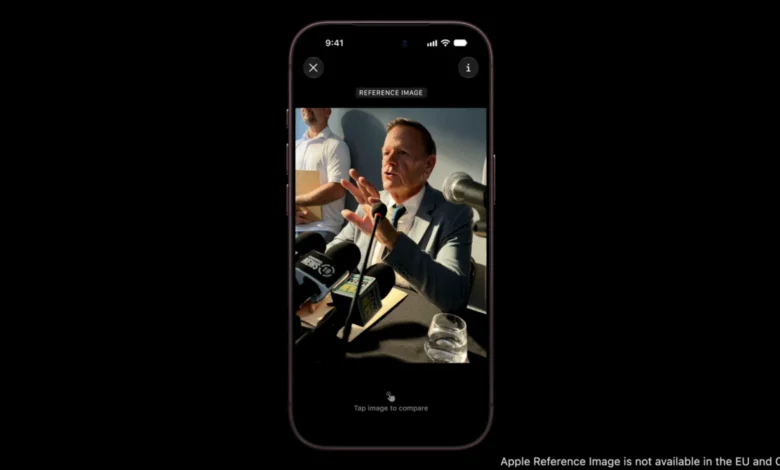
Beyond raw optical performance and creative control, the most socially significant addition to the iPhone 18 Pro lineup is the introduction of Apple Reference Image. Designed in direct response to the proliferation of hyper-realistic artificial intelligence-generated and AI-edited media, this authenticity feature leverages the redesigned main sensor to verify visual truth.
When capturing images in the dedicated "Reference" mode, sensor data is cryptographically signed at the hardware level and routed through Apple’s Private Cloud Compute infrastructure to generate an unalterable digital negative. This reference file is stored alongside the standard image within the Photos application, allowing users and verification platforms to compare the final output against the cryptographically secured baseline to detect unauthorized alterations or manipulations.
Combined with embedded metadata and upcoming native support for the SynthID watermarking standard—which flags AI-generated content—Apple is positioning the iPhone 18 Pro as a vital tool for photojournalists, legal professionals, and everyday consumers. In an era where digital deception is increasingly difficult to spot with the naked eye, the ability to establish cryptographic provenance may prove to be the most valuable feature Apple has ever introduced to mobile photography.
Related posts: