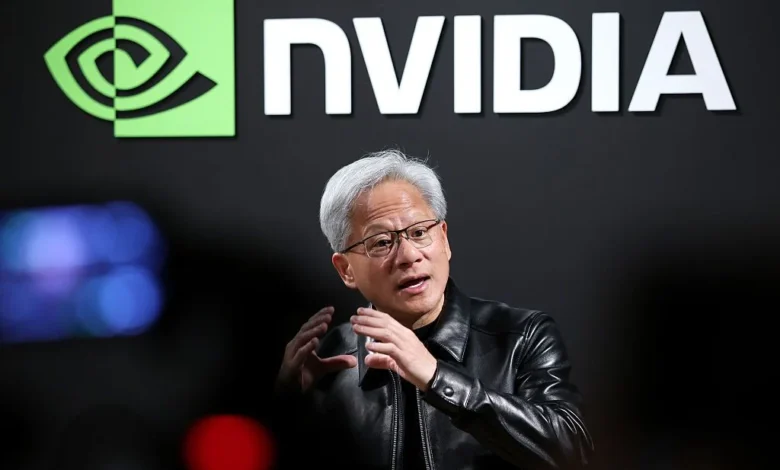
The global financial markets experienced a seismic shift on Monday as Nvidia Corporation (NVDA) announced the unexpected reinstatement of Jensen Huang as its Chief Executive Officer. The decision, which triggered a historic rally in the technology sector, effectively ends a period of profound corporate instability that had sent the broader market into a tailspin. Nvidia shares surged 31.5% during the trading session, marking the company’s most significant one-day percentage gain since May 9, 2003, and adding approximately $954 billion to its market capitalization—a figure that represents the largest single-day value increase for any publicly traded U.S. company in history.
This dramatic turnaround follows a tumultuous month for the semiconductor giant. Huang had stepped down from his leadership position earlier in November after internal investigations revealed evidence of multiple extramarital affairs, including an entanglement with a direct report and a separate relationship involving an individual suspected of being a Chinese intelligence operative. The departure of the visionary leader, who has been the face of the company’s explosive growth during the artificial intelligence boom, created a vacuum of confidence that rippled across global exchanges.
The Chronology of a Corporate Crisis
The sequence of events leading to Monday’s market surge began with the initial disclosure of Huang’s personal conduct. Upon his resignation, Nvidia’s stock price plummeted, dragging the Nasdaq Composite and the S&P 500 toward correction territory—defined as a decline of at least 10% from recent peaks. By the end of last week, the technology-heavy Nasdaq was flirting with the technical definition of a bear market, as investors scrambled to offload assets amid fears that the leadership crisis would paralyze Nvidia’s strategic dominance in the AI hardware space.
The market’s decline was not merely a reaction to a CEO’s personal scandal, but a reflection of the systemic reliance the tech industry has on Nvidia’s hardware. As the primary provider of the high-performance GPUs (graphics processing units) essential for training large language models and other generative AI applications, any disruption at the top of the Nvidia hierarchy was viewed as a direct threat to the broader AI infrastructure ecosystem.
The decision to reinstate Huang was reached after a series of high-level negotiations involving the board of directors and representatives from the United States government. In an official statement, Nvidia’s board emphasized that it had received explicit input from senior U.S. officials regarding the national security implications of the scandal. "Based on that input, the Board is confident that Mr. Huang’s reinstatement poses no national security risk," the company stated, providing the necessary regulatory and ethical assurance to stabilize shareholder confidence.
Market Reaction and Analytical Perspectives
The broader market responded with palpable relief. The Dow Jones Industrial Average climbed 3.0% to 49,595, while the S&P 500 gained 4.7%, closing at 7,237. Both indexes effectively exited their recent correction phases. The Nasdaq Composite, which bore the brunt of the recent sell-off, saw a robust 6.5% gain, closing at 24,089. Despite this surge, the Nasdaq remains approximately 750 points shy of its previous all-time high, highlighting the lingering recovery required for the tech sector to regain its full momentum.
Industry analysts suggest that the market’s extreme volatility during the past month underscores a broader vulnerability in the current economic landscape. Mark Hackett, chief market strategist at Nationwide, warned that while the rebound is significant, it should be interpreted with caution. "Nvidia lost $2.7 trillion in market value over six weeks, only to see shares surge roughly 30% on news of Jensen Huang’s reinstatement," Hackett noted. "Nvidia wasn’t worth that much less on Friday, and it isn’t suddenly worth 30% more today. These are trillions of dollars moving on emotion, not fundamentals."
Hackett further emphasized that the market’s rapid transition from panic to optimism serves as a cautionary tale regarding the dangers of emotional trading. He argued that reacting to every news cycle, particularly regarding high-profile leadership changes, can often be more detrimental to a portfolio’s long-term health than the market volatility itself.
Conversely, some institutional investors view the return of Huang as a restoration of foundational stability. David Miller, Chief Investment Officer and senior portfolio manager at Catalyst Funds, characterized the return as an "enormous positive." According to Miller, Huang’s leadership is synonymous with the development of the modern AI infrastructure ecosystem, and his presence is a prerequisite for the sustained growth of the broader technology sector.
Political Interventions and Strategic Implications
The reinstatement of Huang has also drawn attention to the intersection of corporate governance and national politics. President Donald Trump, in comments provided to CNBC, claimed a direct role in the resolution of the crisis. "I spoke to them, let me put it that way," Trump stated. "And I convinced them. I made the deal." This assertion suggests that the federal government remains deeply invested in the continuity of American semiconductor dominance, viewing Nvidia as a strategic asset that must be shielded from leadership-driven volatility.
The implications of this intervention are significant. By prioritizing the return of a proven leader despite a significant moral scandal, the board of directors has effectively signaled that Nvidia’s role in the national security architecture—particularly regarding the AI arms race—outweighs traditional corporate governance concerns.
Cybersecurity M&A: The CrowdStrike-Zscaler Deal
While the market was fixated on the return of Huang, the technology sector also saw a major consolidation move that would have otherwise dominated headlines. CrowdStrike, a leader in cybersecurity, announced a definitive agreement to acquire its rival, Zscaler, in an all-stock transaction valued at approximately $43.9 billion.
The deal is designed to expand CrowdStrike’s presence in the network security market, a segment it previously had limited reach into. Needham analyst Mike Cikos noted that the acquisition could expand CrowdStrike’s total addressable market by more than $185 billion by 2029. CrowdStrike CEO George Kurtz framed the deal as a necessary step in "building cybersecurity’s operating system," with the goal of creating a unified control plane for AI deployment and safety.
Despite the strategic logic of the merger, investors appeared skeptical of the deal’s price tag and dilution potential. CrowdStrike shares dropped 8.9% on Monday, contrasting with the rally in Zscaler, which surged 17.7%. This divergence suggests that while the acquisition has clear long-term industrial benefits, the immediate financial impact of the all-stock deal is being met with resistance from shareholders concerned about the valuation of the cybersecurity market.
Looking Ahead: Market Volatility and Investor Sentiment
As the dust settles on Monday’s trading, the focus shifts to whether the rally in AI-related stocks—such as Advanced Micro Devices (+6.9%), Broadcom (+3.0%), and Marvell Technology (+18.4%)—can be sustained without the backdrop of a leadership crisis. The performance of these companies, which are inherently linked to the success of Nvidia’s ecosystem, suggests that the market is attempting to re-price the entire sector based on the assumption that the "Huang era" at Nvidia will continue uninterrupted.
However, the events of the past few weeks have left an indelible mark on market sentiment. The realization that a single company’s leadership drama could trigger a multi-trillion-dollar fluctuation in global market cap serves as a stark reminder of the concentration risk inherent in the current market cycle. For the remainder of the year, investors are expected to closely monitor both the technical recovery of the Nasdaq and the evolving regulatory stance on corporate governance within the technology sector.
Ultimately, Monday’s session stands as a testament to the power of sentiment in modern financial markets. Whether the rapid valuation recovery of Nvidia proves to be a rational adjustment or an overcorrection remains a matter of debate. For now, the market has opted for stability over scrutiny, betting that the return of a familiar architect is the safest path forward in an increasingly complex and high-stakes technological landscape.