The financial markets staged a robust recovery on Monday, as investors aggressively bought the dip following a week of significant volatility that had rattled investor confidence across global exchanges. The broad-market surge marked a decisive reversal from the previous week’s sell-off, which had been driven by heightened concerns over regulatory headwinds and shifting political landscapes in the United States. Despite the optimism, the market’s path forward remains complicated by a high-profile scandal involving one of the most vital companies in the technology sector.
At the closing bell, the Dow Jones Industrial Average climbed 2.2% to finish at 52,389, while the S&P 500 posted a 2.4% gain, settling at 7,549. Perhaps most significantly, the tech-heavy Nasdaq Composite rose 2.7% to reach 25,253, successfully clawing its way out of correction territory—a threshold defined by a decline of at least 10% from recent highs. According to Dow Jones Market Data, this session was the first time since April 5 that all three major U.S. benchmarks recorded single-day gains exceeding 2%.
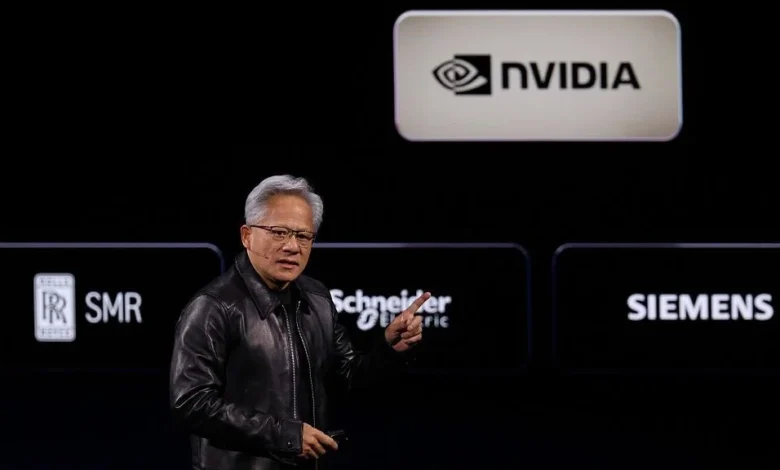
The market’s resilience was particularly noteworthy given the cloud hanging over Nvidia (NVDA). The AI chip giant, which has been the primary engine of the recent bull market, saw its shares slide 4.3% as news broke regarding a formal internal investigation into CEO Jensen Huang. The inquiry centers on allegations involving an extramarital relationship between Huang and a woman who U.S. intelligence officials have reportedly identified as a suspected Chinese spy.
A Weekend of Disclosures and Corporate Turmoil
The investigation, which has sent ripples of uncertainty through Silicon Valley and Wall Street, began after reports surfaced over the weekend regarding Huang’s personal conduct. In an unprecedented move for the tech titan, Huang addressed his staff directly via email, acknowledging the affair and admitting that he had failed to meet the standards expected of his position.
"Leading Nvidia is the privilege of my life," Huang wrote in the communication, which was later released publicly by the company. "My responsibility is to serve you and be worthy of your trust. I have fallen short of that responsibility. I am fully committed to Nvidia and will work to earn back your confidence."
The gravity of the situation is compounded by the geopolitical implications of the alleged contact. With Nvidia operating at the absolute center of the global artificial intelligence arms race, its access to sensitive U.S. technology is a matter of national security. The company’s board of directors issued a formal statement confirming that an independent investigation is currently underway to determine whether any proprietary information or corporate governance protocols were compromised. The board emphasized that Huang is cooperating fully with the inquiry.
Market analysts are now grappling with the potential fallout. Daniela Hathorn, a senior market analyst at Capital.com, noted that while the situation is inherently distracting, it does not immediately alter the fundamental demand for high-performance computing hardware. "Given Huang’s central role in Nvidia’s success and the wider AI investment narrative, even speculation about leadership uncertainty could unsettle investors," Hathorn explained. "However, there is currently no confirmed indication that he will step down, and the controversy does not necessarily change the company’s underlying demand outlook."
The Broad Market Recovery: A Sector-by-Sector Analysis
While Nvidia struggled, the broader tech and industrial sectors saw a massive influx of capital. Investors who had retreated to the sidelines last week returned to the market, viewing the previous price drops as an attractive entry point. This trend was evident in the performance of memory chip stocks and data center infrastructure providers.
Micron Technology (MU) rose 6.3% on the day, while SanDisk (SNDK) posted a similar gain of 6.2%. The surge in these stocks reflects a continued institutional belief in the long-term cycle of data center expansion, despite recent legislative concerns. Last week, fears that a new wave of Democratic leadership in states such as Texas and Ohio might impose stricter regulations or energy constraints on the construction of power-intensive data centers had caused a significant market rout. Monday’s trading suggests that the market may have overreacted to those political headwinds.
Advanced Micro Devices (AMD) emerged as a standout performer, jumping 13.3% after a bullish upgrade from Oppenheimer analyst Rick Schafer. Moving the stock from "Perform" to "Outperform," Schafer cited an incredibly optimistic outlook for the company’s future. "Management sees top line up over 80% next year despite supply constraints," Schafer noted. He further highlighted that he expects data center revenue to grow by a staggering 185% by 2027, driven by sustained, robust demand for high-performance compute architectures.
Caterpillar (CAT), which serves as a bellwether for the industrial and energy-infrastructure sectors, also saw a major recovery. After losing more than 10% of its value last week—largely due to its critical role in providing backup generators for data centers—the company surged 7.2% on Monday, becoming the top-performing component within the Dow Jones Industrial Average.
The Macroeconomic Horizon: CPI and the Fed
While individual corporate stories dominated headlines, the macro environment remains the primary driver of market direction. Traders are now shifting their focus toward Tuesday morning’s release of the Consumer Price Index (CPI) for October. This report is viewed as a pivotal data point that will dictate the Federal Reserve’s decision-making process at its December meeting.
Current data from the CME Group FedWatch tool suggests an 84% probability that the Fed will implement a quarter-percentage point interest rate hike next month. This anticipation is fueled by a resilient labor market and persistent inflationary pressures that have kept the central bank in a hawkish posture.
"In the wake of a blowout jobs report and other signs of a resilient economy, the Fed is going to have little patience with inflation," said BeiChen Lin, a senior investment strategist at Russell Investments. Lin noted that even a minor surprise in the CPI data could seal the deal on a December hike, further tightening financial conditions as the year draws to a close.
Beyond the headline inflation numbers, investors are closely watching the "breadth" of price increases across various services and goods. Because last year’s government shutdown has created a gap in year-over-year comparative data, analysts are focusing more on month-over-month trends to gauge how deeply inflation is embedded in the economy.
Implications and Long-Term Outlook
The events of the past few days have set the stage for a volatile end to the quarter. The market currently faces a dual-threat environment: the potential for a leadership crisis at a critical technology firm and the reality of a central bank that appears determined to keep rates high to suppress inflation.
The investigation into Jensen Huang serves as a reminder of the "key-man risk" that often accompanies companies that are fundamentally synonymous with their founders. Nvidia’s rise to become a global behemoth was largely architected by Huang’s vision, and any disruption to his tenure introduces a layer of risk that institutional investors generally despise.
However, the rapid rebound in sectors like industrial infrastructure (Caterpillar) and rival semiconductor firms (AMD) suggests that the underlying "AI trade" remains intact. Investors appear to be separating the specific governance risks at Nvidia from the broader, structural demand for AI-enabling technology. As long as the demand for high-performance compute remains as robust as analysts like Schafer predict, the market is likely to remain focused on growth, even while navigating the complexities of political regulation and individual corporate scandals.
Ultimately, the market’s performance over the coming days will depend on two things: the degree to which the Nvidia board can maintain institutional stability, and the degree to which tomorrow’s CPI report aligns with the Federal Reserve’s "higher-for-longer" interest rate narrative. For now, the sentiment is one of cautious optimism, characterized by a willingness to buy during dips, provided the fundamental economic indicators remain supportive.