The Strategic Imperative of Distinguishing Branded versus Unbranded Queries in AI Search Environments

The evolution of generative artificial intelligence and the rapid adoption of answer engines—such as ChatGPT, Gemini, and Perplexity—have fundamentally altered the digital discovery process. As consumer behavior shifts from traditional keyword-based search to conversational, intent-driven prompting, marketing professionals are faced with a critical data management challenge: the distinction between branded and unbranded search queries. Much like the transition in traditional search engine optimization (SEO), where the industry moved toward sophisticated attribution modeling, the era of Answer Engine Optimization (AEO) necessitates a granular approach to tracking how brands appear in AI-generated responses.
The Anatomy of AI-Driven Consumer Intent
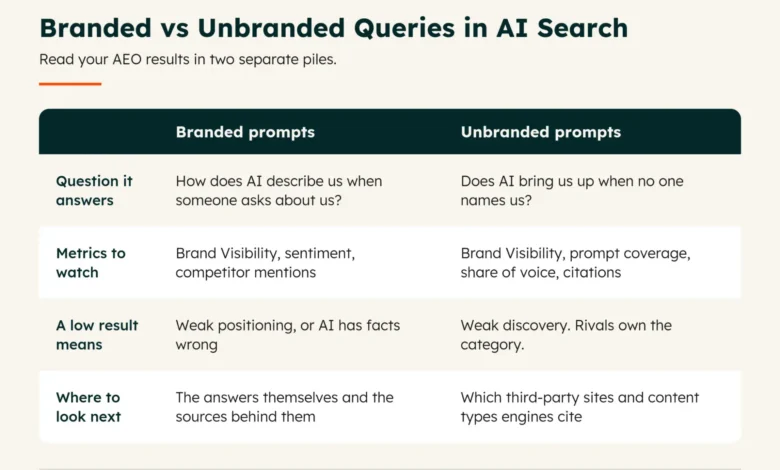
In the current digital landscape, the difference between a consumer’s query can be the difference between a conversion and a missed opportunity. Consider two hypothetical marathon runners. The first poses the question, "Are Nike shoes suitable for marathon training?" while the second asks, "What are the best running shoes for a marathon?"

The first user is conducting a high-intent, branded query. They have already entered the brand’s ecosystem, likely seeking validation, comparison, or specific product details. Their intent is focused on a known entity. Conversely, the second user is in the discovery phase of the buyer journey. They are seeking expert curation and objective recommendation. If an AI engine omits a brand from its response to an unbranded query, the brand effectively disappears from the potential customer’s consideration set.
This distinction is not merely academic; it represents two different psychological states of the consumer. Branded queries provide insight into brand health, customer loyalty, and reputation management. Unbranded queries, however, are the primary drivers of growth, market share expansion, and net-new customer acquisition. Failing to isolate these data points in analytical reporting results in a "blended-score trap," where overall visibility metrics mask the failure to attract new, unbranded traffic.
Chronology and the Shift in Search Standards
The necessity for this segmentation has been underscored by recent developments in industry standards. In November 2025, Google introduced a dedicated branded query filter within its Search Console. This update was a response to long-standing industry demand for clearer visibility into traffic sources, acknowledging that branded and unbranded traffic are governed by entirely different algorithms and user behaviors.

Before this update, many marketing teams relied on aggregated data that conflated the two types of traffic, leading to flawed strategic decisions. As AI search becomes more prevalent, the industry is witnessing a parallel movement. Platforms and AEO tools are now prioritizing the ability to split these data sets, recognizing that the "black box" nature of AI models requires a rigorous, consistent tracking methodology. The current industry trend is moving toward weekly auditing of AI visibility, as studies from organizations like SparkToro and research partners have confirmed the inherent volatility of AI-generated responses.
The Volatility of AI Responses and Data Integrity
The challenge for modern organizations lies in the probabilistic nature of Large Language Models (LLMs). Unlike traditional search, which yields a static list of links, generative engines synthesize answers dynamically. Research indicates that asking the same question twice can result in different brand recommendations, with some studies suggesting that the probability of receiving an identical list of brands in the same order is lower than 0.1%.
This instability makes longitudinal tracking essential. Organizations must move beyond point-in-time analysis. The current best practice involves a daily automated tracking cadence, with a weekly human review to identify trends. A raw count of appearances in AI responses is insufficient; instead, teams must calculate visibility rates by dividing the number of mentions by the total number of prompts tracked. This provides a normalized metric that remains valid even as the volume of tracked prompts grows or shrinks.

Strategic Implications for Marketing Infrastructure
The implications of these tracking methodologies are significant for resource allocation. When an organization identifies a weakness in its branded visibility, the solution is typically localized to product messaging, sentiment management, or factual accuracy in public-facing documentation. When the weakness is in unbranded visibility, the fix requires a broader strategy: creating educational content, improving third-party citations, and building an authoritative presence within the specific niche or category.
Data from recent case studies suggests that bridging these gaps is highly effective. For example, some firms have successfully increased their unbranded visibility by 30% or more after launching comprehensive FAQ glossaries or white papers that align with top-of-funnel terminology. This approach directly feeds the training data or search index that AI models draw upon to construct their answers.
The Role of AEO Tooling in Scalability
As companies expand their keyword libraries, manual tracking via spreadsheets becomes unsustainable. The emergence of AEO-specific software reflects this shift. These tools automate the daily prompt-running process, allowing marketers to focus on the interpretation of data rather than the acquisition of it.

Advanced AEO dashboards now allow for the segmentation of results by engine, geography, and consumer segment. This is particularly vital for global organizations, as an AI engine’s response to a query in Tokyo may differ significantly from its response to the same query in London. The ability to filter these results allows for a nuanced understanding of brand performance across diverse demographics.
Best Practices for Reporting and Analysis
To maintain an accurate view of brand performance, organizations should adopt a standard reporting checklist:
- Define and Label: Explicitly categorize all prompts as either "Branded" or "Unbranded" before any tracking begins.
- Normalize Data: Always report percentages rather than raw counts to account for variances in query volume.
- Maintain a Change Log: Document marketing campaigns, website updates, or external PR events alongside visibility data to correlate performance fluctuations with specific actions.
- Monitor the Ratio: Calculate the branded-to-unbranded visibility ratio regularly. A stagnant or falling ratio may indicate that while brand loyalty is strong, the brand is failing to penetrate new market segments.
- Quality Assurance: Periodically review the "why" behind the data. If a brand appears in an answer, analyze the quality of the surrounding context. Is the brand positioned as a leader, or merely listed among competitors?
Future Outlook and Conclusion
The transition to AI-mediated search is not a fleeting trend but a fundamental shift in the information economy. As consumers grow accustomed to the convenience of synthesized answers, the "zero-click" search environment will become the norm. In this environment, the brands that win will be those that have mastered the art of being cited as the authoritative answer to the consumer’s unbranded, category-level questions.

Organizations must prepare for a future where search is less about ranking for keywords and more about earning inclusion in a curated, machine-generated recommendation. By rigorously separating branded and unbranded performance, companies can gain the clarity needed to optimize their digital presence, ensuring they remain relevant to both the loyal customer seeking a specific product and the new prospect exploring a category for the first time.
The path forward requires a disciplined approach to prompt engineering and an unwavering commitment to data hygiene. By treating AI visibility as a measurable asset rather than a mysterious outcome, businesses can secure their place in the new architecture of digital discovery. The technology to track these interactions is available; the task for the coming year is to integrate these tools into the core of the marketing strategy, moving from reactive observation to proactive influence.