As the fall season brings the traditional peak of the housing calendar to a close, prospective buyers across the United States are confronting a uniquely stagnant market landscape. Following a sluggish year in 2025, the broader real estate ecosystem has persisted in a holding pattern characterized by subdued home sales, restricted inventory, and elevated monthly borrowing costs. Rather than experiencing a seasonal rebound, many regional housing sectors have remained virtually frozen, leaving both consumers and investors searching for definitive signals in an unpredictable economy.
Macroeconomic headwinds, particularly persistent geopolitical tensions and shifting monetary policies, continue to exert heavy pressure on the financial markets. For nearly two months, benchmark 30-year fixed mortgage rates have hovered comfortably above the 7% threshold. This stubborn elevation is largely tied to protracted conflicts in the Middle East, which have driven turbulence in global oil markets, reignited inflation anxieties, and compressed bond yields. Compounding these energy-sector pressures are broader global economic volatility, escalating anxieties surrounding artificial intelligence sector spending, and ongoing uncertainty regarding international trade tariffs. Together, these intersecting factors have kept borrowing costs high and sidelined a significant portion of would-be purchasers.
The Convergence of High Prices and Softening Demand
The national median home sale price currently stands at $393,895, representing a modest 1.3% increase year-over-year. While this growth rate indicates that price appreciation has cooled considerably compared to the rapid surges seen earlier in the decade, cumulative gains over the past five years mean housing costs remain roughly 20% higher than pre-pandemic baselines. This prolonged affordability squeeze has created an extensive stalemate between buyers and sellers. Many market participants have chosen to hold out for more favorable pricing adjustments, resulting in a gradual accumulation of unsold inventory in several regions.
Despite this standoff, the nature of price growth has fundamentally shifted. Following a period of aggressive annual increases that averaged around 7% from 2012 through early 2020, year-over-year price growth has moderated to a sluggish 1.5% range since 2025. Economists suggest that while current nominal prices remain high, long-term affordability is projected to improve incrementally as wage growth eventually outpaces home price appreciation and inflation stabilizes.
Mortgage Rates and the Geopolitical Connection
The trajectory of mortgage rates remains the single most influential variable dictating consumer behavior. As of late October, the weekly average for a 30-year fixed mortgage rests at 7.3%. While this marks a minor downward adjustment from previous weekly peaks, it remains drastically elevated compared to the historical averages observed prior to the spring of 2026, when rates fluctuated within a tighter 6.1% to 6.3% band.
Industry experts point directly to international disruptions as the catalyst for this upward shift. Chen Zhao, Head of Economics Research at Redfin, notes that mortgage rates have climbed sharply due to the ripple effects of Middle Eastern conflicts on global energy supplies, inflationary expectations, and bond market sentiment. As crude oil prices experienced sudden spikes, investor skittishness escalated in tandem, driving up benchmark yields and filtering directly into consumer loan products. Furthermore, heavy corporate investments in artificial intelligence infrastructure have introduced an additional layer of capital market competition, further straining liquidity.
Compounding these energy and technology-driven pressures is the ongoing volatility within the domestic labor market. Following soft employment reports throughout the third quarter, financial analysts anticipate that the Federal Reserve may maintain a cautious monetary stance—or contemplate further adjustments—by the close of 2027, potentially keeping borrowing costs elevated for the foreseeable future.
Shifting Power Dynamics: A Market of Regional Contrasts
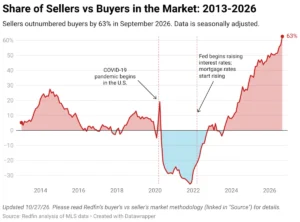
While the national housing market presents a uniform picture of high costs, localized conditions reveal a stark divergence in negotiating power. Across much of the country, declining buyer demand has tilted the scale in favor of those who remain active in the market. With pending home sales sinking to multi-year lows and a rising volume of contract cancellations, persistent sellers are increasingly forced to adjust their pricing expectations.

This buyer-friendly leverage is most pronounced in the Sun Belt, where sustained new construction has dramatically expanded housing inventory. Markets such as Austin, Texas, have experienced a notable deceleration in sales velocity, transforming into some of the slowest major housing markets in the nation. In these over-supplied regions, purchasers frequently secure meaningful seller concessions, ranging from closing cost assistance to direct price reductions.
Conversely, distinct pockets of high demand persist in the Midwest and the Northeast. Affordable metropolitan areas, such as Rochester and Buffalo in New York, continue to experience competitive bidding environments where strong buyer interest outpaces available supply. Similarly, specific submarkets in the San Francisco Bay Area have recorded surges in transactional activity, keeping local sellers firmly in control.
Inventory Expansion Amid Sluggish Sales
Total active housing inventory nationwide has climbed past the 1.5 million mark. While this figure remains historically low by pre-2020 standards, it represents the highest monthly inventory level recorded since the onset of the pandemic. This supply influx is primarily driven by a disparity between listing behavior and purchasing velocity: more homeowners are opting to test the resale market than there are qualified buyers equipped to close transactions.
This imbalance is particularly acute in disaster-prone regions, most notably Florida, where insurance market disruptions and climate risk reassessments have driven a record surge in active listings. Throughout the year, inventory metrics have fluctuated dynamically as sellers respond to shifting demand signals by either withdrawing properties or aggressively relisting them in pursuit of liquidity.
Evaluating Individual Readiness in an Unpredictable Climate
Given the intricate web of economic variables—ranging from trade tariffs and energy shocks to fluctuating borrowing costs—financial analysts emphasize that the decision to buy a home must be anchored in personal financial fundamentals rather than speculative market timing.
Daryl Fairweather, Chief Economist at Redfin, offers a pragmatic perspective for prospective buyers: "Now is a good time to buy a home, if you can afford it. High costs are keeping many home buyers on the sidelines, giving those who remain much more leverage to negotiate. At the same time, the conflict in the Middle East, elevated mortgage rates, and a volatile economy are making everyone wary, and conditions vary widely from one housing market to the next. Buyers who are serious about making an offer should talk to a local agent, understand their market dynamics, and make sure they’re confident in their finances and future income."
For individuals weighing whether to enter the market, financial advisors recommend a rigorous review of core stability metrics:
- Financial Health and Liquidity: Prospective buyers must evaluate their existing savings, credit profiles, and debt-to-income ratios. Establishing a robust emergency fund—ideally covering three to six months of living expenses—is critical to absorb unexpected property maintenance costs and economic shocks.
- Comprehensive Budgeting: Beyond the principal and interest components of a monthly mortgage payment, buyers must account for escalating property taxes, homeowners insurance premiums, and ongoing homeownership overhead. This is especially vital in regions impacted by shifting climate migration patterns, where property insurers have adjusted coverage availability and raised premiums significantly.
- Job and Geographic Stability: Because real estate is an illiquid asset designed for long-term habitation, buyers should ensure their employment income is secure and that they intend to remain in a specific location for several years. This mitigates the financial risk of having to sell prematurely in a potentially volatile pricing environment.
- Lifestyle and Maintenance Capacity: Homeownership requires an ongoing investment of time and capital for upkeep and repairs. Assessing personal bandwidth for property management is just as important as securing loan preapproval.
Conclusion: Strategic Preparedness Over Timing
Ultimately, the question of whether now is an opportune time to purchase a home depends heavily on individual circumstances rather than macroeconomic forecasts. While waiting for mortgage rates to decline remains a common strategy, analysts warn that any sudden drop in borrowing costs could rapidly unleash pent-up demand, sparking renewed buyer competition and driving home prices upward.
In a market defined by economic uncertainty and regional divergence, the most effective approach for prospective buyers is rigorous preparation. Securing mortgage preapproval, partnering with a knowledgeable local real estate agent, and defining a strict financial budget empower buyers to navigate localized conditions and capitalize on negotiating leverage before broader market dynamics shift once again.