The cinematic frontier of artificial intelligence hits a wall as China’s first fully AI-generated feature film fails to capture public imagination

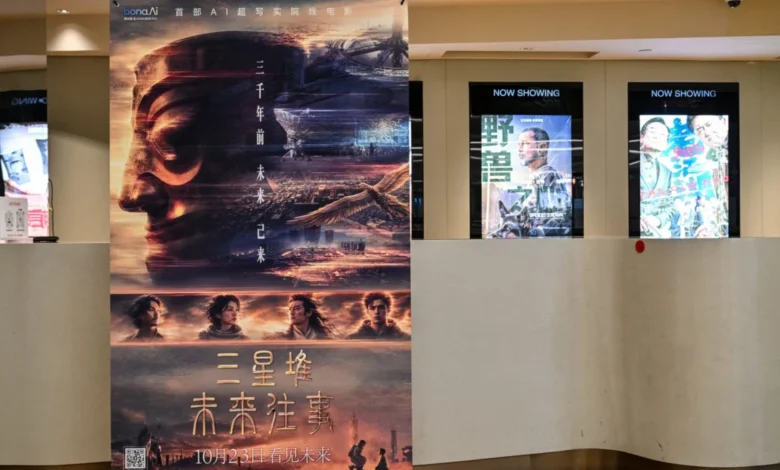
The recent theatrical release of the sci-fi thriller Sanxingdui: Future Past has served as a sobering reality check for the global film industry, signaling that while artificial intelligence may be rapidly revolutionizing content creation at the micro-scale, its application in feature-length storytelling remains a fraught endeavor. Produced by the Bona Film Group, the project was billed as a pioneering experiment in cinematic technology. However, its performance at the Chinese box office has been decidedly lackluster, casting doubt on the immediate commercial viability of AI-driven feature films in an industry already wrestling with the implications of automated creativity.
According to data from the Chinese ticketing platform Maoyan, the film generated a mere $180,000 in box office revenue through the early part of the week. This figure stands in stark contrast to the film’s reported $1.5 million production budget, as noted by Agence France-Presse. While these numbers might seem modest in the context of global blockbusters, in the hyper-competitive Chinese market, they represent a significant financial underperformance, particularly for a project that garnered substantial domestic media attention as a technological milestone.
A Chronology of the AI Film Experiment
The trajectory of Sanxingdui: Future Past began with high ambitions, aiming to align with China’s broader national push to lead in generative AI development. Throughout 2026, the Bona Film Group sought to position the film as a cultural and technical bridge, utilizing AI tools to handle visual effects, background generation, and, according to promotional materials, significant portions of the narrative structure.
The film, which depicts an archaeologist navigating a dystopian future under the thumb of an oppressive AI regime, faced a complex path to the screen. Unlike traditional productions that rely on massive human crews for rendering and post-production, the Bona Film Group leveraged generative models to streamline these processes. The film’s journey culminated in it becoming the first AI-generated feature to secure a formal theatrical release permit from Chinese regulators, a regulatory hurdle that the company heralded as a historic achievement.
Despite the regulatory victory, the consumer response upon release was markedly disjointed. The disparity between the industry’s excitement and the audience’s reception highlights a widening gap between technological capability and aesthetic demand. While industry insiders viewed the film as a necessary, if flawed, prototype, general viewers on platforms like Xiaohongshu expressed confusion and, in some instances, profound dissatisfaction. Comments ranged from claims of being "traumatized" by the film’s uncanny aesthetic to more measured observations about the creative freedom afforded by low-cost AI tools.
The Microdrama Revolution and the Scalability Gap
To understand why Sanxingdui: Future Past struggled, one must examine the vastly different landscape of China’s "microdrama" industry. The microdrama—short, punchy, narrative-driven content optimized for mobile viewing on platforms like TikTok and its Chinese counterpart, Douyin—has been the primary beneficiary of the AI boom.
Data from the financial news outlet Caixin provides a stark illustration of this shift: in the first quarter of 2026, more than 95% of the 120,000 microdramas released in China were generated, at least in part, by AI. This represents a seismic shift from the same period in 2025, when such content was virtually non-existent. The economic rationale is clear: production costs for these serials have plummeted to as low as $3,000 per title.
The success of these microdramas relies on rapid iteration, addictive pacing, and low barriers to entry. However, the logic of the microdrama does not translate easily to the feature-length format. Feature films require a level of sustained narrative coherence, character development, and visual fidelity that current generative models often fail to maintain over a 90-minute runtime. The audience’s willingness to consume AI-generated snippets on a smartphone screen does not necessarily extend to a high-priced ticket at a cinema, where the expectation of "cinematic quality" remains anchored in human-led craftsmanship.
Industry Perspectives and Official Responses
Jiang Defu, Chief Operating Officer of Bona Film Group, has adopted a defensive yet optimistic stance regarding the film’s lukewarm reception. In an interview with the film outlet Yuli, Jiang emphasized that the commercial outcome was secondary to the institutional milestone of the project.
"We are the first to try it, the first to get a theatrical release permit, and the first to be tested by the audience," Jiang stated. "I think that is not easy at all."
This sentiment underscores a broader strategy among production houses: treating early AI releases as "beta tests" for future infrastructure. While the company has not yet provided a detailed breakdown of its post-mortem analysis of the film, industry observers suggest that Bona Film Group views the project as a foundation for refining the workflows that will eventually replace traditional, labor-intensive CGI pipelines.
Fortune has reached out to Bona Film Group for further comment on whether the financial loss will impact the development of their future AI-integrated projects, but as of this writing, the studio has remained committed to the necessity of the experiment.
The Global Context: Hollywood’s Hesitant Integration
The tension surrounding AI in filmmaking is not unique to China. In the United States, the discourse is heavily colored by the labor disputes of 2023, during which screenwriters and actors secured contractual protections against the encroachment of AI into their creative domains. The fear that AI might devalue human labor remains the primary driver of resistance in Hollywood.
Despite this, the integration of AI tools is already underway in major studios. Notably, director Ben Affleck recently addressed the use of AI in his latest Netflix thriller, Animals. During a Bloomberg event, Affleck admitted to utilizing AI for various aspects of the production, though he remained cagey about the specifics. "I used it for lots of things in that movie," Affleck noted, acknowledging the industry’s ongoing debate regarding the "illusion of reality." He argued that filmmakers have a duty to maintain a certain level of transparency, yet admitted that the "magic" of cinema relies on keeping the audience immersed in the narrative rather than the production methodology.
Broader Implications for the Future of Cinema
The failure of Sanxingdui: Future Past suggests a pivotal conclusion for producers: the public is currently highly skeptical of AI in major feature films. According to Stanley Rosen, a professor at the University of Southern California specializing in Chinese film and society, the distinction between short-form and long-form media is critical.
"The public is highly skeptical about AI use in major feature films, despite their general acceptance of short-form films," Rosen explains. He posits that until AI can achieve a level of visual and narrative sophistication comparable to major tentpole franchises like Avatar or the homegrown Chinese animation giant Nezha 2, audiences will likely reject the "AI-first" branding.
The implications for the industry are two-fold:
- Strategic Pivot to Streaming: High-cost, AI-heavy experiments may migrate away from the box office and toward streaming platforms like Netflix and Amazon Prime Video, where the barrier for entry is lower and the "content-hungry" algorithm can better support niche or experimental formats.
- The "Human Premium": The financial loss of the Bona Film Group project will likely force other studios to tread more carefully. As the industry moves forward, a "human-made" label may become a marketing differentiator, similar to "hand-crafted" goods in other industries.
The takeaway from the performance of Sanxingdui: Future Past is not that AI has no place in cinema, but rather that the technology currently lacks the "soul" required to carry a two-hour theatrical experience. For now, the audience seems to demand the presence of human intent, error, and artistry that AI, in its current iteration, struggles to replicate. While the technology will undoubtedly continue to evolve, the box office results suggest that for the time being, the "future past" of AI cinema is still firmly rooted in the trial-and-error phase of development.