Seth Rogen and Lauren Miller Rogen Get Radically Personal With Their New Comedy-Drama Babies at the Toronto International Film Festival

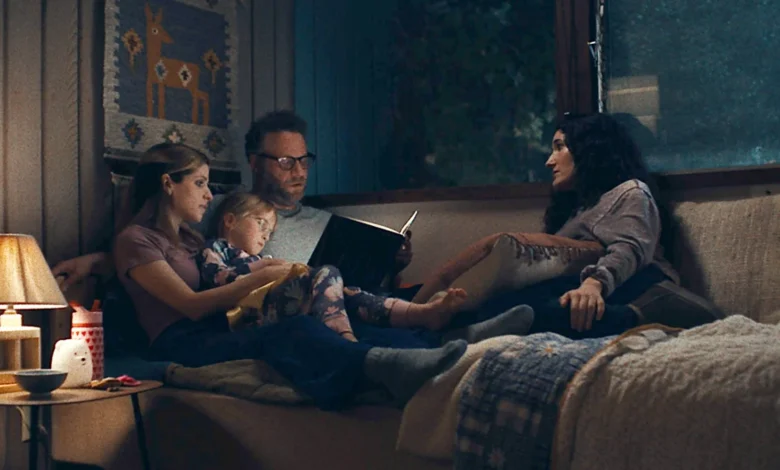
Throughout a celebrated career spanning more than two decades, actor, writer, and producer Seth Rogen has starred in numerous motion pictures that reflect various facets of his life, personal growth, and comedic sensibilities. However, none of his prior cinematic endeavors have matched the profound intimacy and autobiographical weight of his latest project, Babies.
Premiering to significant critical and audience interest at the Toronto International Film Festival (TIFF) on a Saturday at The Hollywood Reporter’s Studio at 1 Hotel—presented by official sponsor Canada Goose—Babies marks a bold creative triumph for writer and director Lauren Miller Rogen. The comedy-drama explores the nuanced, often unspoken complexities of modern adulthood, marriage, and the deliberate choice to lead a child-free lifestyle. Starring Seth Rogen alongside Academy Award-nominee Anna Kendrick, the film serves as a mirror to the filmmakers’ own life experiences, translating years of internal processing, private discussions, and existential realizations into a universally resonant narrative.
Main Facts and Narrative Premise
At its core, Babies follows a happily married couple, Annie and Aaron—whose names are directly derived from the middle names of Lauren Miller Rogen and Seth Rogen—as they grapple with one of life’s most fundamental crossroads: whether parenthood is genuinely the correct path for their future.
The narrative catalyst occurs when a close friend of the couple, portrayed by Kate Berlant, goes through a separation from her husband and moves into Annie and Aaron’s home alongside her young daughter. This unexpected living arrangement grants the child-free couple an unfiltered, up-close look at the unvarnished realities, daily chaos, and profound demands of raising a young child.
Simultaneously, the film weaves in heavy emotional layers as Annie navigates her mother’s harrowing battle with Alzheimer’s disease. This plot point is profoundly personal to Lauren Miller Rogen, whose own mother tragically passed away from complications related to early-onset Alzheimer’s disease in 2020. By intertwining the existential contemplation of legacy and family with the grief of losing a parent to cognitive decline, Babies expands beyond a standard marital comedy, establishing itself as a deeply reflective meditation on time, memory, and personal autonomy.
The Genesis and Chronology of a Decade-Long Project
The conceptual foundation of Babies was laid approximately a decade ago, sparked by a genuine life event that mirrored the film’s premise. At the time, a close friend of the Rogens—a divorced mother with a young child—moved in with the couple for the span of a year.
Initially, Lauren Miller Rogen viewed the domestic arrangement through the lens of television production. Recognizing the comedic and dramatic potential, she contemplated developing the premise into a serialized television project. She recalled thinking that a setup involving individuals uncertain about having children while living under the same roof with a young dependent made for an inherently compelling television dynamic.
However, the television concept stalled and ultimately failed to materialize for a crucial reason: Lauren did not yet know how her own real-life story would conclude. At that juncture, she and Seth had not yet reached a definitive, settled consensus regarding their own stance on parenthood. The project required something that television writing rooms rarely provide—time, lived experience, and emotional closure.
The chronology of the film shifted dramatically years later, following countless introspective conversations, psychological work, and the ultimate crystallization of their shared convictions. "I didn’t know the ending at that point," Lauren Miller Rogen explained during her interview at the TIFF studio. "Once we had the kajillion conversations and done all the work and sort of found our own conclusion, then I was like, ‘Oh, now it’s a movie because I know the ending of it.’"
Once the emotional destination became clear, the creative execution moved at an impressive velocity. Lauren began formal work on the feature-length script in January 2025. The screenplay was finalized by the spring of that same year, and production commenced with principal photography in the fall, culminating in the film’s high-profile festival debut.
Artistic Vulnerability and the Perspective of the Cast
Bringing such a deeply personal narrative to the screen required an extraordinary degree of emotional exposure, a reality that Seth Rogen openly acknowledged during his festival appearance.
"I think this movie is much more personal and much more reflective of my actual experiences," Seth stated during the TIFF panel. "I think Lauren has really made a very honest film in regards to her thought process and our thought process as a couple. When I look at it, it’s shocking how personal it is, honestly, and about very personal things in our lives. But, to me, it’s very brave to put yourself out there like that and to write about the things that are kind of the most personal things."
For Anna Kendrick, who stepped into the shoes of Annie, the proximity of the fiction to the creators’ real lives was almost dizzying. Kendrick admitted that channeling such raw emotional terrain would have pushed her creative boundaries to an uncomfortable degree.
"I don’t know how [Lauren] did it because some of it felt so close to reality and so intense," Kendrick remarked with a laugh. "I was like, ‘I think I’d be setting myself on fire on set.’"
Despite the heavy thematic undercurrents, the film maintains a sharp comedic wit and observational humor. Seth Rogen pointed out that the script captures the authentic vernacular and social dynamics of contemporary adulthood, including modern attitudes toward domestic labor. For instance, he highlighted phrases like "dad duty," which he humorously dismissed as "obnoxious," reflecting a broader cultural critique of how society frames parental roles and responsibilities.
Broader Impact and Cultural Implications: Validating the Child-Free Choice
Beyond its artistic merits, Babies tackles a profound cultural taboo: the validation of a conscious, deliberate choice to remain child-free, even when an individual possesses all the requisite resources, emotional stability, and affection for children to be an exemplary parent.
In contemporary society, cultural scripts heavily dictate that happiness and fulfillment are inextricably linked to procreation. Those who actively choose not to have children frequently face societal skepticism, unsolicited advice, or outdated assumptions regarding their capacity for empathy and responsibility. Babies directly challenges this narrative by presenting characters who are loving, highly responsible, deeply compatible, socially engaged, and entirely fond of children—yet simply choose not to have them.
"A lot of these are conversations we’ve had with our friends in real life," Seth noted, elaborating on the social context of the film. "We hang out with our friends and their kids a lot. An interesting perspective the film has is that you can like kids and be good with kids, and be very responsible people, and be in a very happy marriage, and tick every box that one would think you need to tick in order to be the perfect parent in many ways, and you could still just maybe not really want it. That’s a very under-shared perspective in a lot of ways."
At the same time, the filmmakers took meticulous care to ensure the movie does not alienate or disparage those who choose the path of parenthood. Lauren Miller Rogen emphasized that Babies was constructed to honor families and parents just as much as it champions autonomy for those who remain child-free.
"We’ve been around our friends who have had beautiful families. We have amazing relationships with their kids," Lauren explained. "I think that it was about not just making Babies feel real and grounded to us, but also sort of honoring what we’ve witnessed so many times, and how beautiful that relationship is."
Industry Outlook and Distribution Timeline
The premiere of Babies at the Toronto International Film Festival has positioned the film as one of the most anticipated dramatic comedies on the horizon. By blending independent-style emotional candor with mainstream comedic talent like Seth Rogen and Anna Kendrick, the project strikes a delicate balance between commercial accessibility and deeply arthouse-level introspection.
Following its well-received festival debut, Babies is slated for a theatrical release in 2027. Industry analysts anticipate that the film will spark widespread cultural dialogue regarding modern family structures, the destigmatization of the child-free lifestyle, and the evolving definitions of personal fulfillment in the 21st century. As audiences increasingly demand authentic storytelling that reflects the diverse realities of contemporary existence, Babies stands out as a fearless exploration of life’s most defining, complex personal decisions.