Donald Trump Delivers Marathon Speech at Rescheduled White House Correspondents’ Dinner, Met with Sparse Laughter

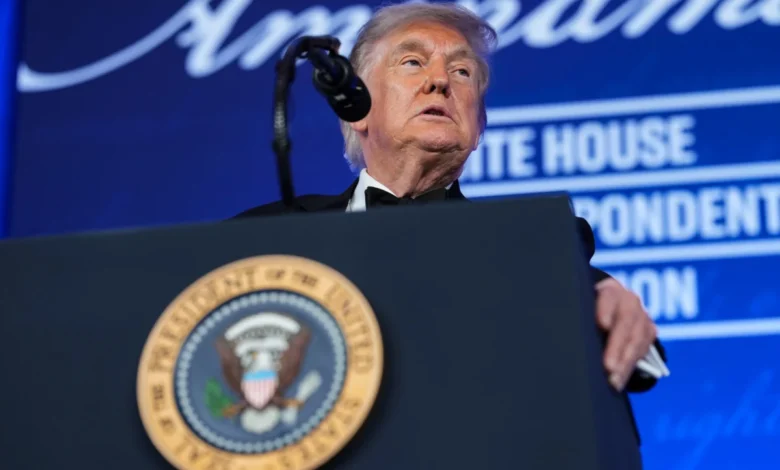
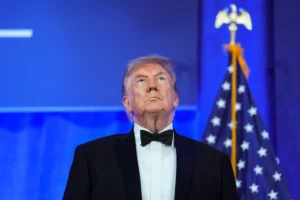
Donald Trump addressed the White House Correspondents’ Association Dinner on Friday evening, delivering a lengthy, hour-long address that blended familiar campaign rhetoric with a series of attempts at humor that largely failed to resonate with the audience. This marked his first appearance at the prestigious event as president, a dinner that had been postponed from its original April date due to a security incident.
A Tumultuous Evening and a President’s Address
The White House Correspondents’ Association Dinner, a long-standing tradition that brings together members of the press, government officials, and the President of the United States, has historically served as a platform for lighthearted roasting of political figures and the media. Presidents have traditionally used this occasion to engage in a degree of self-deprecation and to playfully jab at journalists. However, President Trump’s participation on Friday deviated significantly from this established norm. Instead of a balanced approach, his speech leaned heavily into the style of his political rallies, interspersed with personal criticisms directed at members of the press, often touching upon their physical appearance.
The rescheduling of the dinner itself underscored the unusual circumstances surrounding this year’s event. The original April gathering was abruptly halted and ultimately ended when an individual attempted to breach security and rush the ballroom at the Washington Hilton. The swift response of the Secret Service successfully subdued the assailant, preventing any immediate harm to attendees, but the incident cast a pall over the proceedings and led to its postponement. The rescheduled event took place at the Waldorf-Astoria, a venue with a personal connection to the President, having formerly operated under the Trump brand. This change in location also necessitated enhanced security measures, a palpable presence throughout the evening.
The Speech: A Contentious Blend of Rally Rhetoric and Failed Humor
Throughout his hour-long address, President Trump’s delivery seemed to acknowledge the muted reception his jokes were receiving. The expected bursts of laughter and engaged reactions from the audience were conspicuously absent, replaced by a pervasive atmosphere of unease and fidgeting. His remarks meandered through a series of disconnected topics, a stream-of-consciousness style that left many in attendance disengaged.
One particularly notable moment of awkward silence occurred when the President made a remark about the alleged sex life of an elderly U.S. senator. Following the unresponsiveness, Trump himself expressed his disappointment, stating, "Does anybody get that? I thought that was actually great. That was actually the only thing I thought was good in this whole frickin’ stupid speech. It was the only good one, and that went down with not exactly great laughter." This self-assessment highlighted the disconnect between the President’s intended humor and the audience’s perception.
Later in his speech, Trump attempted to inject a sense of levity by referencing CBS News CEO David Ellison, who had informed him, he claimed, that the dinner would be renamed the "Trump White House Correspondents’ Dinner" next year. Trump presented this as the sole condition for his future attendance, remarking, "Changing the name is the only way you’re going to get me back here." This statement, while intended as a quip, further underscored the President’s often adversarial relationship with the press corps.
The extended duration of the speech, stretching for a full hour, appeared to test the patience of many attendees, with only the most ardent of Trump’s supporters demonstrating significant enthusiasm. Periods of near-absolute silence punctuated the address, a stark contrast to the typical celebratory atmosphere of the event. The palpable relief when Trump finally concluded his remarks was evident, as a noticeable number of guests began to depart the venue even before the evening’s subsequent program, featuring mentalist Oz Pearlman, commenced.
A Glimpse into the Audience and the Evening’s Attendees
The Waldorf-Astoria ballroom, a more intimate setting than the Hilton where the dinner was originally scheduled, hosted a diverse group of individuals. Cabinet members were observed mingling with journalists in the vicinity of Paramount’s designated tables. Notably, Chief Legal Officer Makan Delrahim was in attendance just hours after a significant corporate development: the decision to postpone Paramount’s planned merger with Warner Bros. Discovery in response to an antitrust challenge.
Also seated at a Paramount table were Secretary Pete Hegseth and presidential advisor Stephen Miller, accompanied by his wife, Katie Miller. The guest list also included Secretary of Health and Human Services Robert Kennedy Jr. and his wife Cheryl Himes, Commerce Secretary Howard Lutnick, Department of Homeland Security Secretary Markwayne Mullin, and Acting Attorney General Todd Blanche. Blanche found himself in the spotlight as part of a mentalist act performed by Oz Pearlman.
Awards and Tensions: A Precedent for Presidential Displeasure
The evening began with the presentation of annual awards, a segment that was not without its own moments of tension. Several journalists were honored for their investigative work, including reporters from The Wall Street Journal whose reporting on the Jeffrey Epstein scandal was recognized. Upon their acceptance, President Trump shook their hands before raising his own in a gesture that seemed to convey both acknowledgment and perhaps a subtle critique. Wolf Blitzer, who was presenting the award, pointedly reminded the audience that President Trump had previously sued The Wall Street Journal for $20 billion over the same story.
This pre-existing animosity resurfaced when Trump directly addressed some of the award recipients. He singled out The Wall Street Journal reporter Josh Dawsey and CNN host Kaitlan Collins, launching into what were intended as personal barbs. However, these remarks were met with the same near-silence that characterized much of his speech, indicating a lack of audience buy-in for his aggressive approach. Weijia Jiang, the outgoing president of the White House Correspondents’ Association, maintained a stoic demeanor throughout these pointed digressions.
In response to the personal attacks directed at its journalists, CNN issued a public statement during the dinner, defending its reporting staff. This action highlighted the polarized environment and the clear divisions that the President’s rhetoric had fostered.
The President’s Prepared Remarks and Divergences
While President Trump appeared to have a set of prepared jokes, his delivery was marked by frequent departures from the script. These deviations often seemed to be triggered by associations or thoughts that arose as he spoke, leading to a rambling narrative. His speech traversed familiar political attacks, including criticisms of Adam Schiff’s appearance, and extended to elaborate descriptions of his envisioned plans for a White House ballroom. He even made a point of observing and commenting on the chandeliers at the Waldorf-Astoria, a venue he had previously owned and operated. The sheer length of the speech and the breadth of topics covered may have, in some ways, diluted the impact of his more pointed criticisms of the press, rendering them less sharp than they might have been in a more concise address.
A Tentative Promise for the Future
At the conclusion of his remarks, the mentalist Oz Pearlman humorously commented on the President’s announcement of his attendance at next year’s dinner, quipping, "I thought he was going to be speaking until next year, actually." This remark, while lighthearted, underscored the extraordinary length of Trump’s address.
Historical Context and the Shadow of Security Concerns
The White House Correspondents’ Dinner has a long history of presidential participation, but President Trump’s engagement has been notably inconsistent. He notably skipped the dinners during his first term, sometimes opting to hold counter-programming events. His decision to attend this year’s rescheduled dinner placed him at the center of an event that, by its very nature, celebrates the work of journalists, many of whom he has publicly criticized.
The incident that led to the dinner’s postponement in April cast a long shadow. The attempted breach of security, occurring just outside the main ballroom, sent a palpable wave of unease through the attendees. The sounds of possible gunfire, though distant, amplified the sense of alarm, prompting the Secret Service to swiftly escort President Trump and Vice President JD Vance from the dais. This event served as a stark reminder of the vulnerabilities that can exist even in highly secured environments.
The White House Correspondents’ Association had indeed urged for the dinner to be rescheduled, and the subsequent arrangements at the Waldorf-Astoria, coupled with the implementation of new security protocols, aimed to ensure a safe and successful event. However, the underlying tensions surrounding the relationship between the President and the press remained a dominant theme.
The Evolving Relationship Between the Presidency and the Press
Beyond the specific events of the evening, the broader context of President Trump’s administration has been characterized by a contentious relationship with news organizations. This has manifested in a barrage of lawsuits filed against media outlets and frequent public denouncements of the press as "fake news" or "enemies of the people." Furthermore, the President has, at times, threatened to revoke broadcast licenses for news networks.
A significant development in recent weeks, and one that adds another layer to this dynamic, involved the Department of Justice’s decision to withdraw subpoenas issued to New York Times reporters. These subpoenas were related to their reporting on the lack of security features in the new Air Force One. The withdrawal followed a critical hearing in federal court where government attorneys faced scrutiny for their methods in issuing the subpoenas. This action, while a reprieve for the targeted journalists, highlighted the administration’s willingness to pursue information from reporters, a tactic that has drawn widespread criticism from press freedom advocates.
The awards presented at the dinner, particularly those recognizing investigative journalism, often delve into subjects that are sensitive to the President. The recognition of The Wall Street Journal‘s reporting on a personal letter attributed to Trump and linked to Jeffrey Epstein exemplifies this. While Trump has denied the authenticity of the letter and initiated legal action against the publication and its owner, Rupert Murdoch, the very act of honoring such reporting at an event attended by the President underscores the ongoing tension between the pursuit of truth by the media and the executive branch’s desire for control over its public narrative.
The White House Correspondents’ Dinner, while intended as a forum for engagement and even a degree of convivial critique, served this year as a stark illustration of the deep divisions and profound challenges that characterize the relationship between the current presidency and the American press. The extended speech, the muted audience reactions, and the underlying security concerns all contributed to an evening that was memorable, but perhaps not for the reasons the organizers had initially envisioned. The event, once a symbol of mutual respect and playful sparring, has increasingly become a stage for the friction between the power of the presidency and the fundamental role of a free and independent press.
Related posts: