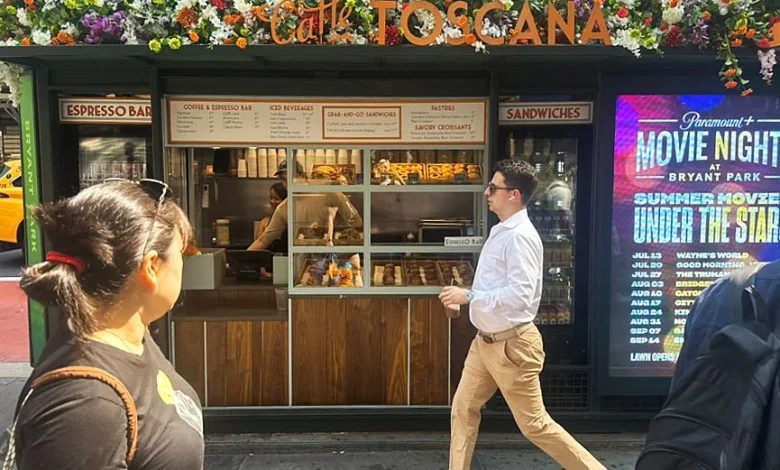
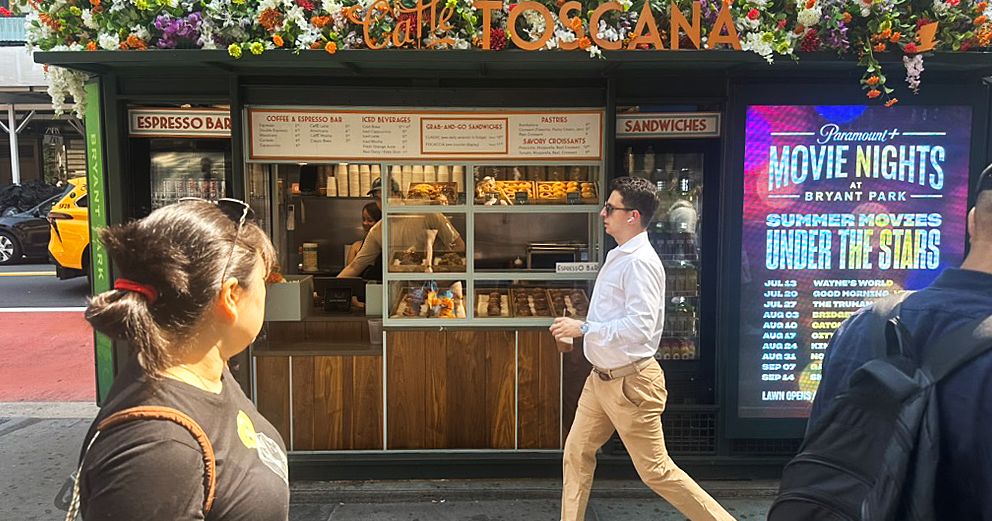
At the bustling intersection of Fifth Avenue and 42nd Street, a fixture of the New York City streetscape is undergoing a radical metamorphosis that challenges a century of retail tradition. The sidewalk newsstand, once a reliable source for the morning edition and a pack of gum, is being reimagined as a high-end culinary destination. Leading this vanguard is Caffè Toscana, a sleek Italian espresso bar operating out of a structure that, until recently, was indistinguishable from the hundreds of other green-and-glass kiosks dotting the Five Boroughs.
The transformation is the work of Luca Meacci, a 43-year-old Tuscan native who invested $150,000 to gut and renovate the small footprint. Where tabloid headlines once sat, customers now find pistachio bomboloni, prosciutto-mozzarella croissants, and expertly pulled cortados. The conversion represents more than just a change in inventory; it is a response to a profound shift in urban consumption habits and a desperate attempt by operators to survive an era where print media has all but vanished from the public square.
The Economic Necessity of Evolution
The traditional newsstand model is failing. For decades, these kiosks operated on a high-volume, low-margin strategy, selling newspapers, magazines, and tobacco. However, as digital media has supplanted physical print, the primary reason for a pedestrian to stop at a newsstand has evaporated. According to industry data, daily newspaper circulation in the United States has plummeted by over 70% since its peak in the late 20th century. In New York City, the impact is visible on every corner.
"It takes them a minute to understand," says Meacci, observing pedestrians who pause, confused by the lack of lottery tickets and the presence of high-end espresso machines. "But then they try it out."
The financial risk Meacci took is significant. A $150,000 renovation is a steep price for a few dozen square feet of sidewalk space. To make the venture viable, Meacci had to overhaul the internal infrastructure, installing a sink with a dedicated water hookup, an industrial air conditioner, beverage coolers, and custom-made display cases. The gamble appears to be paying off; since the transition to a café model, daily sales have increased fivefold. The stand now requires two clerks and a dedicated runner to manage the constant restocking of premade sandwiches and pastries.
Regulatory Hurdles and the JCDecaux Monopoly
The evolution of the newsstand is complicated by a web of city regulations and corporate contracts. Currently, New York’s approximately 300 sidewalk newsstands are largely controlled through a partnership with JCDecaux, the French outdoor-advertising giant. In a 20-year deal worth an estimated $1.4 billion, JCDecaux manages the structures primarily as street furniture for advertising. The revenue generated from the digital billboards on the sides of the kiosks often dwarfs the profit made by the individual operators inside.
For the independent operators, city laws last updated in 2013 create a stifling environment. Standard street-side newsstands are prohibited from selling clothing, jewelry, or fashion accessories. More critically, they are subject to a $10 price cap on most items—a figure that has not kept pace with inflation or the rising cost of living in Manhattan.
Max Bookman, counsel to the New York City Newsstand Operators Association, notes that the supply chain has also withered. "Twenty years ago there were seven different candy vendors; now there are two," Bookman says. This consolidation has led to a homogenization of inventory, where every stand carries the same selection of mass-produced snacks and sodas.
A Tale of Two Jurisdictions: Parks vs. Streets
The reason Caffè Toscana can sell an $11 sandwich while a newsstand three blocks away cannot lies in the nuances of New York City jurisdiction. Meacci’s stand is located on a site controlled by the Parks Department rather than the Department of Consumer and Worker Protection (DCWP). The Parks Department, often working with private non-profits like the Bryant Park Corporation (BPC), has more leeway to set its own rules for concessions.
Dan Pisark, the BPC’s Vice President of Retail Services, explains that the park became dissatisfied with the "candy-and-soda" trajectory of its previous tenants. Seeking "fresher fare," the BPC issued a call for proposals that attracted eight local businesses, ranging from macaron shops to souvlaki vendors. This shift is part of a broader strategy to curate the park’s perimeter as a premium retail experience.
Alexander Han, the Parks Department’s Chief of Concessions, confirms that this is not an isolated incident. Three additional newsstands—located at Verdi Square on the Upper West Side, West 4th Street in Greenwich Village, and Union Square Park—are slated for conversion into food-and-beverage hubs. Other locations in East New York and Grand Army Plaza are also under consideration for similar transformations.
The Health Trend and the "Ozempic Era"
Beyond the decline of print, newsstands are facing a new threat: the changing American diet. The "Coke and Snickers" model that sustained kiosks through the late 1990s and early 2000s is losing its appeal. As health consciousness grows and the use of GLP-1 medications like Ozempic alters consumer cravings for sugary snacks, newsstand operators are seeing a decline in their traditional best-sellers.
"People are buying less and less of those things now," says Bookman. "It’s not 2005 anymore."
In response, some operators are pivoting toward health-focused inventory. At Broadway and 94th Street, a stand named Express Essentials has attempted to bridge the gap between the traditional kiosk and a health food store. Owned by an entrepreneur named Rodney, the stand offers $4 Jamaican patties (including lentil and jerk plantain options), ginger shots, sorrel juice, and turmeric gummy chews.
However, the transition is not without its struggles. When Express Essentials first opened, it eschewed traditional newsstand fare, but a return visit a few months later showed the re-emergence of lottery tickets and soda. The reality of the New York sidewalk is that while consumers may want ginger shots, the reliable revenue of the New York Lottery remains a necessary safety net for small business owners.
Artistic and Niche Conversions
While some newsstands are becoming high-end cafés, others are finding a second life as cultural outposts. This trend is particularly visible in the subterranean newsstands managed by the Metropolitan Transportation Authority (MTA). Because these spaces are not subject to the same sidewalk regulations as above-ground kiosks, they have become laboratories for creative retail.
At the Grand Army Plaza station, Rex’s Dino Store has turned a vacant newsstand into a whimsical bodega-themed art installation. At 51st and Lexington, the Data Vandals space uses a former newsstand to display data-driven art. These "micro-retail" experiments suggest that when the requirement to sell newspapers is removed, the newsstand can serve as a vital incubator for small-scale entrepreneurship and local culture.
Even above ground, some operators are pushing the boundaries of what is legal. On the Upper West Side, a stand operated by an employee named Mustafa has effectively become an electronics boutique, doing a brisk business in $20 portable speakers and phone accessories, despite the $10 price cap. In Midtown, another stand has gained a following by selling independent zines and handmade ceramics, proving that "print" can still sell if it is curated as a collectible rather than a commodity.
Legislative Outlook and Future Implications
The future of the New York newsstand may depend on the success of a bill recently introduced in the City Council. The proposed legislation seeks to lift the $10 price cap and allow for the sale of a wider range of accessories, such as handbags and hair ornaments. However, the bill in its current form does not address the restriction on fresh food for street-side (non-Parks) kiosks.
"It’s not a huge imposition on the existing landscape for 300 newsstands to offer coffee and bagels," Bookman argues. Proponents of the bill suggest that allowing newsstands to evolve into "mini-cafés" would not only save the businesses but also improve public safety by ensuring more "eyes on the street" and active storefronts in high-traffic areas.
For Luca Meacci, the goal is expansion. He envisions a network of Caffè Toscana kiosks in locations like Herald Square, bringing a "Tuscan touch" to the grit of the New York sidewalk. As for the namesake of the industry—the newspaper—Meacci remains firm. When asked if he would ever consider stocking a few copies of the morning paper for the sake of tradition, his response was immediate and final.
"Oh no," he said. "Zero, zero, zero."
The rise of the everything-but-news newsstand marks a permanent shift in the urban fabric. As New York continues to adapt to the post-print, post-sugar era, the humble green kiosk is proving to be one of the city’s most resilient and adaptable structures. Whether selling Jamaican patties or Italian doughnuts, the newsstand of the future is no longer about the news; it is about the experience of the street.