Understanding Page Authority: The Role of Predictive Metrics in Modern Search Engine Optimization

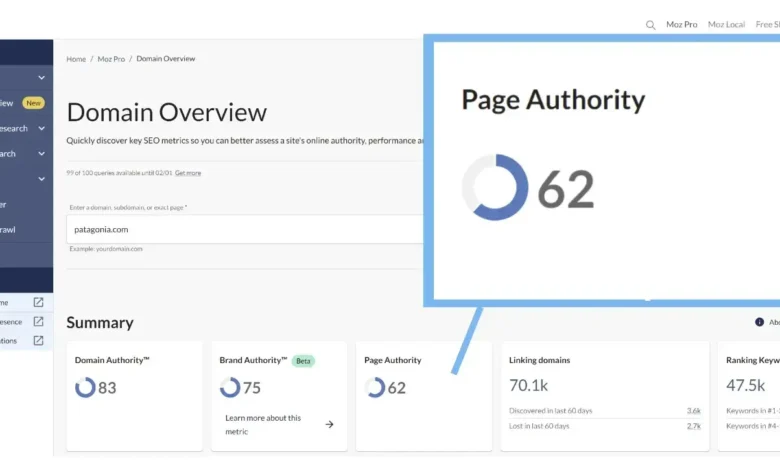
Page Authority (PA) serves as a critical, third-party predictive metric developed by the software company Moz to estimate the likelihood of a specific webpage ranking within search engine results pages (SERPs). Calculated on a logarithmic scale from 0 to 100, the metric provides digital marketers and search engine optimization (SEO) professionals with a comparative benchmark to assess the competitive strength of individual URLs. While often conflated with Google’s proprietary ranking factors, Page Authority is an independent calculation based on a machine learning model that analyzes a variety of signals, primarily centered on the quality and quantity of inbound links. In the contemporary digital landscape, where Google’s internal algorithms remain largely opaque, metrics like Page Authority have become essential proxies for understanding the "link equity" or "ranking power" a page possesses relative to its competitors.
The Evolution of Search Authority: A Chronological Overview
The concept of quantifying a page’s importance began in the late 1990s with the development of PageRank at Stanford University by Larry Page and Sergey Brin. This algorithm, which became the foundation of Google, treated links as "votes" of confidence, establishing the precedent that the web’s structure could be used to determine relevance and authority.
For over a decade, Google provided a public-facing PageRank toolbar, allowing users to see a score from 0 to 10 for any given page. However, as the SEO industry matured, this public score led to widespread manipulation, including the emergence of link farms and aggressive comment spamming. In response, Google began scaling back the frequency of PageRank updates before officially retiring the public-facing metric in 2016.
The vacuum left by the removal of public PageRank prompted SEO software providers to develop their own proprietary alternatives. Moz introduced Page Authority and Domain Authority (DA) to fill this analytical gap. Unlike the original PageRank, which was a direct reflection of Google’s internal data, Page Authority is a "best-guess" estimation based on Moz’s extensive web crawl, known as the Mozscape index. Over the years, this index has grown to encompass trillions of URLs, allowing the machine learning model to refine its predictions based on how closely its scores correlate with actual observed rankings in Google’s search results.
Technical Composition and Data Analysis
The calculation of Page Authority is multifaceted, relying on a machine learning model that processes dozens of factors. The most significant input is the link profile of the specific page. This includes "MozRank," which measures the raw quantity of links, and "MozTrust," which assesses the distance of a page from known "seed" sites of high trust (such as government or major educational domains).
A defining characteristic of Page Authority is its logarithmic scale. This mathematical structure implies that it is significantly easier for a page to grow its score from 20 to 30 than it is to move from 70 to 80. As a page climbs the authority ladder, the requirements for additional link equity become exponentially higher. This mirrors the reality of the competitive landscape, where the top-ranking positions for high-volume keywords are dominated by pages with thousands of high-quality backlinks, making it difficult for newer content to displace them.
Supporting data suggests that Page Authority is most effective when used as a relative rather than an absolute metric. Because Moz updates its index and machine learning model regularly, a page’s score may fluctuate even if its link profile remains static. These fluctuations often reflect changes in the broader web index or updates to the algorithm’s weighting of certain signals. Consequently, industry experts advise focusing on the "delta"—the gap between a page’s score and that of its direct competitors—rather than the raw number itself.

Comparative Framework: PA vs. DA vs. PageRank
To utilize Page Authority effectively, it must be distinguished from related but distinct metrics:
- Page Authority (PA): Focuses exclusively on the ranking potential of a single, specific URL. It is the most granular metric for assessing the strength of a particular piece of content.
- Domain Authority (DA): Measures the ranking strength of an entire root domain or subdomain. It is an aggregate score reflecting the combined link equity of all pages on a website.
- PageRank: Google’s internal, proprietary algorithm. While it remains a core component of how Google ranks content, it is no longer visible to the public.
Industry analysis indicates that while DA is useful for evaluating the overall "clout" of a website, PA is more accurate for predicting which specific page will win a keyword battle. For example, a new page on a high-DA site (like the New York Times) may start with a low PA but will likely gain authority faster than a page on a low-DA site due to the inherent trust and internal linking capabilities of the parent domain.
Professional Perspectives and Industry Responses
The SEO community’s relationship with Page Authority is nuanced. While many practitioners use it as a Key Performance Indicator (KPI), others caution against "metric obsession." Professional consensus suggests that treating Page Authority as a goal in itself can lead to suboptimal strategies.
"The danger lies in chasing the score rather than the underlying quality that the score is meant to represent," notes one digital strategy analyst. When marketing teams prioritize PA over user intent or technical health, they may engage in risky link-acquisition tactics that could eventually trigger Google penalties.
Official statements from Google representatives, including John Mueller and Gary Illyes, have consistently reminded the industry that Google does not use third-party metrics like PA or DA in its ranking algorithm. However, Google does acknowledge that the factors these metrics measure—such as high-quality backlinks—are indeed vital for visibility. Therefore, the industry views PA as a "proxy signal": it doesn’t cause rankings, but it correlates with them because it tracks what Google values.
Strategic Implementation: Improving Authority Without Manipulation
To increase Page Authority sustainably, organizations must focus on "white-hat" SEO practices that align with Google’s quality guidelines. Enrichment of a page’s authority involves a multi-pronged approach:
Link Acquisition and Diversity
The primary driver of PA is the acquisition of external backlinks. However, modern SEO emphasizes quality over quantity. A single link from a high-authority, topically relevant domain is often more valuable than dozens of links from unrelated, low-quality sites. Data-driven content, such as original research, white papers, and proprietary surveys, remains the most effective "link bait" for earning these high-value citations.
Internal Linking Architecture
Page Authority can be influenced by the internal distribution of link equity. By linking from high-authority "pillar" pages to newer or lower-authority "cluster" pages, webmasters can guide search crawlers and transfer "link juice" across the site. This helps search engines discover new content and understand the hierarchical importance of different pages.

Content Freshness and Intent Matching
While PA is a link-centric metric, the "staying power" of a page in the SERPs is often determined by user signals. Content that fails to satisfy search intent—even if it has a high PA—will eventually see its rankings decline as Google’s AI-driven algorithms (such as RankBrain) observe poor user engagement. Regularly updating content with new data and insights ensures that it remains a relevant target for new backlinks.
Technical Optimization
A page’s authority is effectively nullified if it suffers from critical technical failures. Slow load times, poor mobile responsiveness, and crawl errors prevent search engines from properly indexing and valuing a page. Ensuring a high "Core Web Vitals" score is a prerequisite for any page intended to hold high authority.
Broader Impact and the Future of Authority Metrics
The role of Page Authority is evolving as the search landscape shifts toward Artificial Intelligence (AI) and Answer Engine Optimization (AEO). With the introduction of Google’s Search Generative Experience (SGE), the engine is increasingly focusing on "E-E-A-T" (Experience, Expertise, Authoritativeness, and Trustworthiness).
In this new era, Page Authority remains a vital diagnostic tool, but its context is widening. It is no longer just about the number of links, but about the "topical authority" a page commands. Analysts predict that future iterations of authority metrics will need to account for "brand mentions" and "entity associations"—signals that indicate a page is an authority on a subject even in the absence of a direct hyperlink.
Furthermore, the rise of AI-generated content has led to a "noise" problem on the web. As the volume of low-quality content increases, the value of high-authority pages—those with verified, human-earned links—is expected to rise. Page Authority will likely remain a cornerstone of SEO strategy, serving as a lighthouse for marketers navigating an increasingly complex and crowded digital ecosystem.
In conclusion, Page Authority is a sophisticated tool for benchmarking and strategy, but it is not a substitute for a holistic SEO approach. By understanding its logarithmic nature, its role as a proxy for link equity, and its relationship to broader domain-level signals, digital marketers can use PA to identify competitive gaps and build more resilient online presences. The ultimate goal remains unchanged: creating high-quality content that earns the trust of both users and the algorithms that serve them.
Related posts: