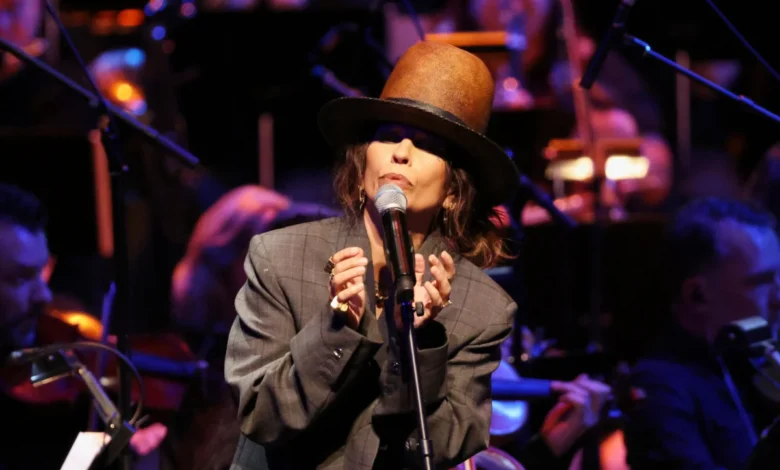
At Deadline’s recent Sound & Screen Film event, the five-time Grammy-nominated artist and songwriter took to the stage to perform "What Lies with You," a poignant track from her fourth solo album, also titled Let It Die Here. The performance served as a centerpiece for a deeper discussion regarding the genesis of the film and the emotional exhaustion that fueled her recent creative output.
The Genesis of an Unplanned Documentary
The origins of Linda Perry: Let It Die Here were far from a calculated branding exercise. According to Perry, the project began with a casual offer from director Don Hardy Jr., with whom she had previously collaborated on the 2020 documentary Citizen Penn, which chronicled Sean Penn’s humanitarian efforts in Haiti.
"Don and I worked on a film called Citizen Penn for Sean Penn, and then we just kind of became friends," Perry recounted to the Sound & Screen audience. "He asked me, ‘You know, you’re super interesting. Can I just come in your studio and film your process?’ And I was like, ‘Yeah!’"
At the time, Perry’s expectations were modest, if not entirely utilitarian. She admitted that she viewed the cameras primarily as a source of social media material. "I thought I would just get some good Instagram content, because I’m terrible at it," she joked. However, the presence of the film crew quickly transcended a promotional exercise. As is often the case when a camera is introduced into a private creative space, the dynamic shifted. Perry noted that she was, at that specific juncture, struggling significantly with her identity as a solo artist.
A Chronology of Artistic Vulnerability
The documentary captures a pivotal, difficult period in Perry’s life. Following the death of her mother, Perry found herself mired in what she described as "one long meltdown." This emotional state became the bedrock for her latest album. The songwriting process, as depicted in the film, was not a linear or easy path.
The documentary highlights a specific four-hour jam session—filmed spontaneously by Hardy—that serves as the birth of the song "What Lies with You." Perry had written the lyrics the night before, and the film captures the visceral, immediate evolution of the song from a page of notes to a fully realized composition. This level of access is what sets the documentary apart from traditional music bios; it does not simply recount history but captures the act of creation in real-time.
As the footage accumulated, Hardy realized he had captured something more substantial than a mere behind-the-scenes feature. When he approached Perry with the prospect of turning the footage into a feature-length documentary, her initial reaction was one of resistance. "I don’t wanna hear about it. Don’t tell me about it. I don’t wanna f*cking know about it," she admitted. Eventually, she acquiesced, operating under the principle that if the footage captured her truth, it was a reality she was willing to own, provided she didn’t have to manage the narrative herself.
Background and Industry Context
Linda Perry’s influence on the music industry is profound. After rising to international prominence as the lead singer and primary songwriter for the 1990s rock band 4 Non Blondes—whose single "What’s Up?" remains a staple of 90s alternative rock—Perry transitioned into one of the most successful songwriters and producers in pop music history.

Throughout the early 2000s, Perry was responsible for writing and producing massive hits for artists including Christina Aguilera ("Beautiful"), Pink ("Get the Party Started"), and Gwen Stefani ("What You Waiting For?"). Her ability to distill complex emotional experiences into radio-ready anthems earned her multiple Grammy nominations and solidified her reputation as a "song doctor."
However, Let It Die Here shifts the focus away from her work as a conduit for other artists’ emotions and places it firmly back on her own. This pivot is significant. In an industry that often demands constant evolution and reinvention, Perry’s decision to document a period of profound personal instability is a bold subversion of the "successful producer" archetype. By exposing the "meltdown," she challenges the industry’s unspoken requirement for perfection.
Analytical Implications: The Documentary as Catharsis
The release of Linda Perry: Let It Die Here—which is currently available to stream on Hulu and Disney+—serves as a case study in the evolving landscape of music documentaries. Unlike the "authorized" biographies of the past, which often served to canonize an artist, contemporary music documentaries are increasingly leaning toward radical transparency.
For Perry, the film functions as a form of catharsis. By allowing the audience to witness her struggle to write music for herself, she bridges the gap between the legendary songwriter and the individual behind the hits. The film’s success relies on this intimacy; it does not hide the uncomfortable moments, the creative blocks, or the raw grief associated with losing a parent.
From an industry perspective, the documentary highlights a growing trend of "process-based" filmmaking. As audiences become increasingly savvy regarding the artifice of celebrity, the value of unscripted, raw documentation has skyrocketed. Hardy’s approach—simply being present and allowing the subject’s environment to dictate the narrative—is a testament to the power of observational filmmaking.
The Broader Impact
The implications of this documentary extend beyond the personal narrative of Linda Perry. It contributes to a larger cultural conversation about mental health in the arts and the toll of long-term professional pressure. By documenting her "meltdown," Perry provides a template for artists to normalize the struggle that often accompanies high-level creativity.
Furthermore, the film serves as a reminder that the creative process is rarely a pristine or linear endeavor. For fans of 4 Non Blondes, the film offers a look at the evolution of an artist who has been a mainstay in the music business for over three decades. For those unfamiliar with her history, it serves as a humanizing introduction to a woman who has shaped the sound of modern pop music from behind the mixing board.
Conclusion: A Legacy of Authenticity
Linda Perry: Let It Die Here is a compelling addition to the documentary genre. It manages to balance the professional gravitas of an established music icon with the vulnerability of someone navigating deep personal loss. By inviting Don Hardy Jr. into her studio, Perry inadvertently created a record of her own resilience.
As the film continues to reach broader audiences via streaming platforms, it is likely to be cited as a quintessential example of how artists can reclaim their narrative. In a media environment that often prioritizes the final product, the documentary serves as a necessary reminder that the process—the messiness, the struggle, and the eventual breakthrough—is where the true value lies. Whether through her performance at the Sound & Screen Film event or the intimate scenes captured in the film, Linda Perry continues to prioritize authenticity over image, a trait that has defined her career and, ultimately, her life.