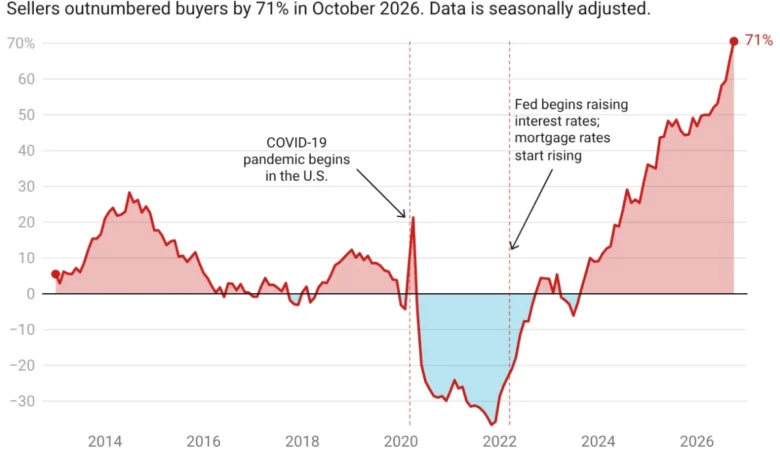
The United States real estate market finds itself at a complex economic crossroads, leaving homeowners who are considering putting their properties on the market this fall to weigh a series of unprecedented challenges. For much of the year, the housing landscape has tilted heavily in favor of purchasers. Driven by a surge in new listings, inventory has steadily climbed, shifting market leverage away from sellers. Yet, even with an abundance of choices, high borrowing costs and broad economic pressures have suppressed overall buyer demand. With typical monthly mortgage payments lingering above the $2,700 threshold and stubborn inflation eroding household purchasing power, many prospective buyers have adopted a cautious wait-and-see approach.
This dynamic has resulted in a sluggish transaction environment characterized by elevated supply and subdued absorption rates. External macroeconomic pressures—ranging from escalating energy costs and geopolitical tensions in the Middle East to anxieties surrounding artificial intelligence sector spending and bond market volatility—have kept mortgage rates stubbornly above the 7% mark since September. For homeowners pondering whether to list their properties ahead of the winter lull or hold out for a potential shift in 2027, understanding the interplay of regional supply trends, macroeconomic indicators, and expert forecasts is crucial for making an informed financial decision.
Economic Pressures and Mortgage Rate Volatility
The contemporary housing market cannot be viewed in isolation from broader macroeconomic conditions. Throughout 2026, the U.S. economy has experienced a series of crosscurrents that directly influence consumer borrowing and spending behavior. While the national median home sale price dipped to $388,634 as of October 2026—representing a modest 0.4% decline compared to the previous year and the first annual drop in three years—this slight correction has not been enough to offset the affordability barriers created by elevated interest rates.
Economists point to several compounding factors driving mortgage rate volatility. Lingering inflationary pressures, fueled in part by fluctuating oil prices, proposed trade tariffs, and rapid capital expenditures in artificial intelligence technologies, have prevented the Federal Reserve from enacting aggressive monetary easing. Consequently, bond yields have experienced heightened turbulence, dragging mortgage rates upward and keeping them elevated.
Chen Zhao, Head of Economics Research at Redfin, noted that these interconnected global events have created a pervasive sense of caution among consumers. According to Zhao, prolonged geopolitical and technological tensions have kept investors and everyday buyers on edge, closely monitoring energy markets and fresh economic data releases. Without a dramatic surge in residential construction or a broader economic downturn, neither buyer activity nor housing affordability is expected to experience a substantial, immediate rebound.
A Decisive Shift Toward a Buyer-Driven Market
Nationwide data underscores the current imbalance between supply and demand. Real estate metrics indicate that there are currently more than 600,000 more active home sellers than active buyers in the United States. While this inventory gap had shown signs of narrowing earlier in the year, subsequent pullbacks by hesitant purchasers have caused the discrepancy to widen once more.
This imbalance forces sellers to adopt flexible pricing strategies and offer financial concessions, such as rate buydowns or closing cost assistance, to remain competitive. Average asking prices have recently slid to their lowest levels in twelve months. In severe cases of market mismatch, some potential participants have chosen to cancel pending contracts entirely, pull their listings, or opt out of entering the market altogether.
However, real estate dynamics remain intensely localized. While major metropolitan areas across the Sun Belt have experienced a prolonged surge in new construction—leading to an oversupply and favorable conditions for buyers—the Midwest and Northeast face persistent inventory shortages. In cities such as Rochester, New York, and Milwaukee, Wisconsin, demand routinely outpaces available housing stock, frequently resulting in competitive bidding wars and rapid transaction timelines.
Expert Insights and Real Estate Forecasts
Analyzing the trajectory of the market requires looking closely at executive commentary from industry leaders. Daryl Fairweather, Chief Economist at Redfin, advises prospective sellers to adjust their expectations to align with the realities of a firm buyer’s market.
Fairweather emphasizes that while elevated inventory grants purchasers unprecedented choice, record-high ownership costs and economic uncertainty have made them exceptionally selective. Because overall affordability has improved only marginally over the past twelve years, those individuals who do enter the market are well-prepared to drive hard bargains and demand fair valuations. While the near-term outlook presents hurdles for both sides of the transaction, industry analysts maintain that viable deals continue to close for motivated participants.
Evaluating the Right Time to Sell: Strategic Indicators
Deciding whether to list a property depends heavily on local market fundamentals, financial preparedness, and individual life circumstances. Historical seasonality suggests that spring remains the optimal window for maximizing sale prices and transaction speeds, with market research indicating that late April typically yields the strongest returns for sellers. Conversely, late summer often provides buyers with the greatest leverage.
To determine whether listing a home makes sense in the current climate, real estate professionals recommend evaluating specific market indicators:
- Low Housing Supply: In regions where inventory remains restricted—particularly across parts of the Midwest and Northeast—sellers can still leverage high demand to command competitive prices and secure fast sales.
- Declining Mortgage Rates: Any measurable reduction in borrowing costs historically triggers a wave of pent-up buyer demand. Sellers monitoring local trends should watch for rate dips that could reignite bidding wars.
- Compelling Personal Circumstances: Life events such as family growth, job relocations, or mandatory downscaling often supersede macro-level market timing. When a move is necessary, partnering with an experienced agent is vital to devise a realistic pricing and marketing strategy.
Conversely, certain conditions suggest that waiting may be the more prudent course of action:
- High Mortgage Rates: Elevated borrowing costs reduce purchasing power, frequently resulting in lower initial offers and stagnant inventory. Sellers who are not under immediate pressure to move may benefit from waiting out periods of peak rate volatility.
- Recent Refinancing: Homeowners who secured historically low mortgage rates prior to 2022 face the "rate-lock" dilemma. Selling soon after refinancing can erode accumulated financial gains once closing costs and higher replacement loan rates are factored into the equation.
- Deferred Maintenance: Properties requiring significant structural or cosmetic repairs face steeper discounts in a buyer’s market. Completing essential updates prior to listing helps avoid severe price concessions.
Transaction Timelines and Market Velocity
The friction in the broader economy is directly reflected in the time it takes to complete a real estate transaction. As of late 2026, the typical single-family home remains on the market for approximately 50 days before finding a buyer. While this duration represents a noticeable slowdown compared to the frenetic pace of the pandemic-era boom—when typical homes sold in less than a month—it remains faster than the historical norms of the early 2010s, which frequently saw properties sit for 60 to 100 days. Sellers must account for these extended timelines, ensuring their properties are priced fairly from day one to avoid becoming stale inventory.
Broader Implications and Outlook for 2027
As the real estate sector moves toward the close of 2026, the overarching narrative is one of calibration rather than collapse. The housing market has transitioned away from the unsustainable price growth of previous years, establishing a more balanced—though currently sluggish—foundation.
For homeowners wondering whether to list their properties now or postpone until 2027, the consensus among economists is that waiting will not necessarily simplify the decision. Economic variables such as inflation, international trade policies, and central bank monetary posture will continue to exert influence well into the next calendar year. Ultimately, success in today’s housing market depends less on perfectly timing macroeconomic cycles and more on individualized financial readiness, realistic pricing, and professional guidance. Homeowners who align their strategies with localized supply conditions and maintain flexibility in negotiations will be best positioned to achieve their real estate goals, regardless of broader market headwinds.