For decades, the standard narrative of an Alaska vacation followed a familiar script: international cruise lines brought millions of visitors to coastal ports, commercial operators controlled the excursions, and the state’s Indigenous populations remained largely on the margins of a multi-billion-dollar tourism economy. While travelers marveled at glaciers, fjords, and snow-capped peaks, the economic benefits frequently bypassed the people who have inhabited these ancestral lands for millennia.
Today, that paradigm is undergoing a profound transformation. Across the Last Frontier, Alaska Native corporations (ANCs)—established under the landmark Alaska Native Claims Settlement Act (ANCSA) of 1971—are taking direct ownership of the state’s tourism infrastructure. By acquiring and developing cruise terminals, historic salmon canneries, motorcoach fleets, deep wilderness lodges, and cultural trails, these for-profit, shareholder-owned companies are redefining modern travel. Rather than simply serving as a colorful backdrop for outside operators, Indigenous communities are now the architects, owners, and primary beneficiaries of Alaska’s tourism sector.
The Evolution of the Alaska Native Claims Settlement Act
To understand the modern economic shift in Alaska’s tourism landscape, one must look back to the legislative milestone that made it possible. In December 1971, President Richard Nixon signed ANCSA into law, extinguishing Native land claims in Alaska in exchange for roughly $962 million and 44 million acres of land.

Unlike the reservation system in the contiguous United States, ANCSA distributed land and financial compensation to more than 200 newly created village corporations and 12 regional corporations. These entities were structured as for-profit corporations owned exclusively by Alaska Native shareholders.
For the first few decades, many of these corporations focused heavily on traditional extractive industries such as timber, commercial fishing, mining, and oil and gas services. However, as global travel demand surged and generations of shareholders sought sustainable, long-term economic models, many corporations recognized that cultural heritage and ecotourism presented powerful avenues for development. Corporations like Huna Totem and Doyon, Limited began pivoting strategically, leveraging their ancestral lands and corporate reach to build vertically integrated tourism networks that protect cultural integrity while driving local job creation.
Reclaiming the Shoreline: The Rise of Indigenous-Owned Infrastructure
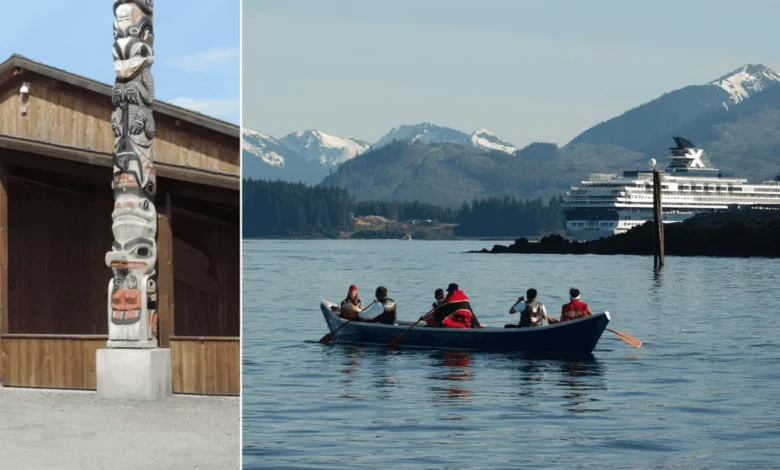
The most visible manifestation of this shift is occurring at the water’s edge, where cruise ships dock and passengers first set foot on Alaskan soil. For years, downtown waterfronts in ports like Juneau were heavily dominated by non-Native commercial interests. That dynamic is shifting through initiatives like the Kootéeyaa Deiý (Totem Pole Trail) project in Juneau, spearheaded by the Sealaska Heritage Institute (SHI).
Since 2023, meticulously carved totem poles have been erected along heavily trafficked shorelines, representing the Tlingit, Haida, and Tsimshian peoples. According to SHI’s Ricardo Worl, the trail serves as an intentional effort to reestablish an Indigenous presence on ancestral lands and educate the more than one million annual cruise visitors about the region’s true history before they scatter to souvenir shops and commercial excursions.

Beyond cultural markers, Native corporations are investing heavily in physical maritime infrastructure. In Hoonah, Huna Totem Corporation developed Icy Strait Point, Alaska’s pioneering private cruise destination. Opened in 2004 around a repurposed 1912 salmon cannery, Icy Strait Point has evolved into a masterclass in community-centric tourism.
The site features two dedicated cruise ship piers positioned roughly a half-mile apart, dispersing foot traffic across a vast network of forested trails, two gondola systems, and thirty distinct excursions. The economic footprint for the surrounding community of approximately 950 residents is staggering. During the peak tourism season, Icy Strait Point employs around 350 people, ensuring that virtually any local resident who desires employment can find it. Furthermore, the development has catalyzed independent local entrepreneurship, enabling residents to launch their own businesses, such as marine mammal and whale-watching tours operating out of nearby Point Adolphus.
Expanding the Corridor: Strategic Partnerships Across Regions
Building on the success in Hoonah, Huna Totem has exported its community-centric model to other strategic locations across Southeast and Southcentral Alaska. In 2024, the corporation opened the Glacier Gateway cruise terminal in Whittier, expanding its reach into Prince William Sound.
In a notable display of cross-regional cooperation, Huna Totem partnered with Doyon, Limited—the regional Native corporation for Interior Alaska, representing primarily Dene communities—and the local Klawock Heenya village corporation to develop a new single-ship cruise port on Klawock Island within Prince of Wales Island. Opened in 2024, the port emphasizes Tlingit culture, local involvement, and sustainable community values, complete with traditional carvers sharing their artistry directly with visitors.

Additionally, Huna Totem and Doyon joined forces to acquire Portage Glacier Cruises and Alaska Coach Tours. This strategic consolidation allows the corporations to control multiple touchpoints along a traveler’s journey, seamlessly bridging the gap from ship to shore, motorcoach to glacier cruise, and excursion to destination.
Looking ahead to 2028, Huna Totem is advancing plans for Aak’w Landing in downtown Juneau. This modern waterfront development and cruise dock aims to eliminate the traditional reliance on tender boats while integrating authentic cultural elements, including the raising of two monumental totem poles from SHI’s Totem Pole Trail. Company leadership describes the overarching philosophy simply: culturally driven, community-centric, and business-focused.
Moving Inland: Connecting the Coast to the Interior
While coastal communities grapple with the influx of millions of cruise passengers, Interior Alaska experiences a different rhythm of travel centered around vast wilderness areas, wildlife viewing, and the northern lights. Doyon, Limited has long been a key player in this arena.
Deep within Denali National Park, Doyon has operated the Kantishna Roadhouse—the park’s sole Indigenous-owned lodge—for three decades. Accessible primarily via backcountry bush planes due to a multi-year road closure caused by a landslide (slated to reopen in 2027), the lodge offers guests an immersive, off-grid experience. Visitors participate in backcountry hiking, learn about Dene beadwork and regalia from Indigenous staff members, and view grizzly bears, moose, and caribou against the backdrop of Denali. Since 2004, Doyon has also partnered with Aramark to manage park bus tours, transit services, and campgrounds.

Jordan Sanford, president of Doyon Tourism, notes that partnering with coastal corporations like Huna Totem is a strategic necessity in a market where more than 60 percent of Alaska visitors arrive via cruise ships.
"If we wanted to grow, we needed to be involved," Sanford explains. Modern travelers, she notes, are increasingly seeking authentic cultural encounters rather than standardized sightseeing packages. By putting Native shareholders to work as cultural ambassadors, these corporations offer a depth of interpretation that non-Native operators simply cannot replicate.
Doyon is also addressing infrastructure gaps in winter tourism. The corporation is currently leading the restoration of the historic 1925 Chatanika Gold Camp near Fairbanks, scheduled to open in 2027 as a dedicated northern lights experience center. Traditionally, aurora viewing in Alaska has been limited to roadside pullovers; the Chatanika project will introduce structured cultural programming and heated comfort facilities, transforming a passive sighting into a comprehensive cultural experience.
Economic Implications and the Future of Alaskan Travel
The systematic expansion of Indigenous-owned infrastructure represents a structural evolution in the global travel industry. By vertically integrating operations—from Native-owned cruise ports and transit lines to local tour companies and wilderness lodges—ANCs are capturing a significantly larger share of tourism revenue.

This financial retention directly impacts the social fabric of rural villages. Reinvested revenues support language preservation programs, cultural heritage centers, scholarship funds, and infrastructure improvements that benefit local residents year-round, long after the cruise ships depart for the winter.
For travelers, the shift promises a radically improved and more ethical tourism product. Instead of viewing Indigenous cultures through the sanitized lens of commercial souvenir shops or external tour operators, visitors engage directly with the descendants of the land’s original stewards.
As Huna Totem, Doyon, and other corporate entities continue to build out their interconnected networks, the vision of an unbroken, Alaska Native-owned tourism corridor moves closer to reality. In this emerging ecosystem, a traveler’s journey—from stepping off a Native-owned dock in Southeast Alaska to riding a Native-owned coach, embarking on a local marine excursion, and resting at an interior wilderness lodge—becomes a masterclass in sovereign economic development and authentic cultural exchange.