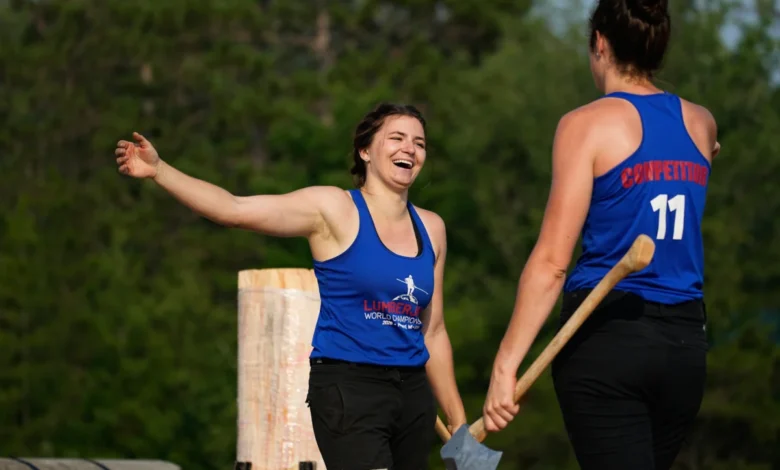
The Lumberjack World Championships (LWC), an iconic annual spectacle of strength, skill, and precision, recently concluded in the small but spirited Wisconsin community of Hayward, delivering a thrilling display of high-powered sawing, chopping, logrolling, speed climbing, and the resounding cheers of "Yo-Ho!" This year’s competition was particularly historic, witnessing the establishment of three new women’s world records, underscoring the remarkable athletic prowess and expanding influence of female competitors in the traditionally male-dominated world of timber sports. The event, held over three intense days and culminating on a recent Saturday, drew a diverse contingent of 66 men and 40 women, representing a broad international spectrum from 16 U.S. states and nine countries, all converging on the historic Lumberjack Bowl to test their mettle against the toughest competitors and the unforgiving resistance of wood.
Record-Breaking Performances Illuminate Women’s Ascendancy
The 2024 championships will be remembered for the extraordinary achievements of two athletes who pushed the boundaries of human performance in their respective disciplines. Karolina Urbanová, a formidable competitor hailing from the Czech Republic, etched her name into the LWC record books not once, but twice. Urbanová demonstrated unparalleled efficiency and power in the Women’s Underhand Chop, a grueling event where competitors stand on a log and chop through it between their feet. She cleaved through an 11-inch (27.9 centimeters) white pine log in an astonishing 21.28 seconds, securing a new world record and first place. Not content with a single triumph, Urbanová went on to dominate the Women’s Standing Chop, an event requiring athletes to chop through a log fixed vertically in a stand. Here, she expertly dispatched a 9-inch (22.8 centimeters) white pine log in a blistering 19.38 seconds, setting her second world record of the competition. Her dual victories not only cemented her status as a global force in timber sports but also highlighted the increasing internationalization of the LWC.
Adding to the wave of record-breaking success was Hayward’s own Meredith Ingbretson, who brought the local crowd to its feet with her exceptional performance in the Women’s Boom Run. This unique event challenges competitors to sprint across a series of free-floating logs (known as a "boom") on water, navigate a turn, and return to the starting point without falling. Ingbretson showcased incredible balance, agility, and speed, conquering eight red cedar logs and the challenging aquatic terrain in a mere 13.78 seconds, establishing a new world record. Her achievement was particularly resonant, representing a hometown hero rising to the pinnacle of her sport on the very waters that have historically defined Hayward’s logging heritage. These three records collectively signal a pivotal moment for women in timber sports, demonstrating not just their participation, but their absolute dominance and capacity for groundbreaking athletic feats.
The Enduring Legacy and Evolution of Women in Timber Sports
The participation of women in the Lumberjack World Championships is a testament to the event’s progressive spirit, even if its initial scope was limited. While the inaugural competition in 1960 saw women primarily competing in logrolling, a sport requiring exceptional balance and core strength, the landscape has dramatically shifted over the decades. Organizers confirm that female competitors now participate in more than 20 distinct timber sports events, a significant expansion that mirrors broader societal trends in sports inclusivity and gender equality. This growth has not been accidental but is the result of persistent advocacy, increasing athlete numbers, and a growing recognition of women’s capabilities.
Veterans of the sport, like Nancy Zalewski, a competitor for an impressive 27 years, vividly recall the early days. "When I started chopping I was chopping with the men," Zalewski stated, highlighting the initial lack of segregated women’s events. Her journey, alongside that of many other pioneering female lumberjacks, paved the way for the dedicated women’s categories seen today. Zalewski has also taken on a mentorship role, training emerging talents such as fellow participant Kate Witkowski, ensuring the legacy of skill and passion is passed down through generations. The expansion of women’s events has created more opportunities for specialized training, fostered a stronger community among female athletes, and undoubtedly contributed to the record-breaking performances witnessed this year. It underscores a fundamental shift from token participation to genuine competitive equity and excellence.
A Storied History: From Logging Camps to World Stage
The Lumberjack World Championships are not merely a modern sporting event; they are a vibrant continuation of a rich historical tradition deeply rooted in the American logging industry. The origins of competitive lumberjacking trace back to the 1890s, when logging camps across North America would host informal contests among lumberjacks. These contests served multiple purposes: to determine who was the strongest, fastest, and most skilled with an axe or saw, to relieve the monotony of arduous labor, and to foster camaraderie and friendly rivalry. What began as practical demonstrations of essential logging skills—felling trees, bucking logs, and maneuvering timber on rivers—gradually evolved into a formalized competitive sport.
Hayward, Wisconsin, with its deep historical ties to the timber industry, proved to be the ideal location for the establishment of a world championship. The competition is fittingly held in the Lumberjack Bowl, an arena specifically designed for these events, nestled on the scenic shores of Lake Hayward. This location itself carries significant historical weight; in decades past, the area had served as a vital holding pond for massive log drives that coursed down the Namekagon River. Millions of board feet of timber, harvested from the vast northern forests, would converge here, awaiting processing at local sawmills. The Lumberjack Bowl thus serves as a powerful reminder of the region’s industrial past, transforming a functional logging infrastructure into a celebrated stage for athletic prowess. This historical context imbues the LWC with an authenticity and depth that few other sporting events can claim, connecting modern athletes to the rugged legacy of their predecessors.
The Global Village of Timber Sports in Hayward
This year’s LWC reinforced its status as a truly international event, drawing participants from across the globe. The presence of 16 U.S. states, from the Pacific Northwest’s logging heartlands to New England’s storied forests, alongside competitors from nine countries including the Czech Republic, Canada, Australia, and New Zealand, speaks volumes about the universal appeal and growing recognition of timber sports. This global convergence transforms Hayward, a town with a population of just over 2,300 residents, into a temporary international hub of athleticism and cultural exchange.
The atmosphere during the three-day competition is electric, a unique blend of intense athletic focus and celebratory community spirit. Spectators, often decked out in lumberjack socks, flannel shirts, and suspenders, embody the theme, creating a vibrant, immersive experience. Brands contribute to the festive mood by handing out blow-up axes and toy chain saws, engaging younger attendees and fostering an early appreciation for the sport. Beyond the competitive arena of the Lumberjack Bowl, the surrounding grounds buzz with activity. Wood-carving demonstrations showcase intricate artistry with chainsaws, while aspiring young lumberjacks can try their hand at logrolling practice, guided by experienced coaches. Live music fills the air, food trucks offer diverse culinary delights, and various axe-themed events further enhance the festival-like ambiance. This multi-faceted approach ensures that the LWC is not just a sporting event but a full-fledged cultural festival that celebrates the heritage and future of timber sports.
The Precision and Power Behind the Gear
A critical, yet often overlooked, aspect of timber sports lies in the specialized equipment wielded by the athletes. Competitors take their gear with an almost religious seriousness, understanding that the difference between victory and defeat can often come down to the quality and meticulous maintenance of their tools. Custom-built chain saws, engineered for maximum power, speed, and reliability, are a staple, often costing thousands of dollars for top-tier models. These are not off-the-shelf tools but highly customized machines, tuned to individual athlete specifications and event requirements.
Axes, the primal tool of the lumberjack, are equally critical. Each axe is carefully selected, balanced, and sharpened to an incredibly fine edge, capable of biting deep into dense wood with minimal resistance. The sharpening process itself is an art form, often performed by master grind ers who understand the nuances of steel and edge geometry. Perhaps the most striking example of this dedication to equipment is the single buck saw. These formidable, two-person saws, designed for speed and efficiency, can cost upward of $400 just for a professional sharpening service. This exorbitant cost reflects the precision required: a dull or improperly sharpened saw can add precious seconds to a race, potentially costing a world record or a championship title. The commitment to such high-performance, meticulously maintained gear underscores the professionalization of timber sports, where athletes invest significant resources to gain a competitive edge. This level of investment is comparable to other elite sports, highlighting the serious nature of the competition and the dedication of its athletes.
Camaraderie and Community: The Heart of Timber Sports
Beyond the fierce competition and the pursuit of world records, the Lumberjack World Championships are characterized by an extraordinary sense of camaraderie among its participants. Kate Witkowski, a competitor and mentee of Nancy Zalewski, articulated this unique aspect beautifully: "The culture of it I think is really wonderful. I don’t know any other sports where the athletes support each other like we do here because it’s such a niche sport and because the gear is so hard to come by that we’re all just trying to get better." This sentiment resonates deeply within the timber sports community. Unlike many mainstream sports where rivalries can be intense and sometimes divisive, lumberjack athletes often share knowledge, techniques, and even tools.
This mutual support stems from several factors. Firstly, the "niche" nature of the sport means that the community is relatively small and interconnected. Many competitors know each other from various regional and national circuits, fostering a sense of extended family. Secondly, the highly specialized and expensive nature of the gear means that athletes often rely on each other for advice on maintenance, sourcing, and even borrowing equipment in a pinch. This collaborative spirit ensures that the focus remains on individual improvement and pushing the boundaries of the sport as a whole, rather than solely on individual victory at any cost. It creates an environment where seasoned veterans mentor newcomers, and competitors cheer for each other’s successes, even when they are direct rivals. This unique blend of fierce competition and genuine support is a defining characteristic that sets timber sports apart.
Broader Implications and Future Outlook
The success of the 2024 Lumberjack World Championships, particularly the setting of three new women’s world records, carries significant implications for the future of timber sports. The increasing visibility of elite female athletes like Karolina Urbanová and Meredith Ingbretson serves as a powerful inspiration for younger generations, particularly girls, to explore and engage with these dynamic and challenging disciplines. This visibility is crucial for broadening the sport’s appeal beyond its traditional demographics, potentially leading to increased participation at grassroots levels and further professionalization of women’s categories.
For Hayward, the annual LWC is more than just a sporting event; it is a cornerstone of its cultural identity and a vital economic driver. The influx of hundreds of competitors, their support teams, and thousands of spectators injects significant revenue into the local economy through accommodation, dining, retail, and other services. It showcases the community’s hospitality and its deep connection to its logging heritage, reinforcing Hayward’s reputation as the "Lumberjack Capital of the World." The event’s consistent success and growing international profile enhance its tourism appeal, drawing attention to the natural beauty and recreational opportunities of northern Wisconsin.
Looking ahead, the momentum generated by this year’s championships suggests a bright future for timber sports. The blend of historical tradition with modern athletic rigor, coupled with a welcoming and supportive community, positions the LWC for continued growth and innovation. As the sport continues to evolve, embracing new technologies and training methodologies while preserving its core heritage, it is poised to captivate new audiences and inspire a fresh generation of lumberjack athletes, both male and female, ensuring that the echoes of "Yo-Ho!" will continue to ring out from the Lumberjack Bowl for decades to come. The record-breaking performances of 2024 are not just individual triumphs; they are a testament to the enduring spirit, evolving landscape, and bright global future of timber sports.
Related posts: