Decoding the Blueprint: How Real Estate Floor Plans Reveal a Home’s True Functionality Beyond Listing Photos

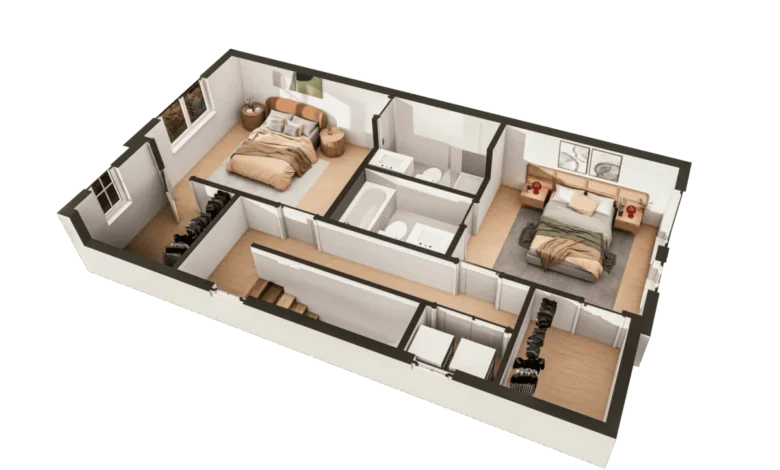
When prospective home buyers scroll through online real estate listings, they are typically greeted by a curated visual gallery designed to showcase a property in its most flattering light. Professional listing photographs employ strategic staging, optimal natural lighting, and wide-angle lenses to make spaces appear bright, expansive, and welcoming. However, while these images excel at capturing aesthetics, finishes, and interior design trends, they fundamentally fail to answer a critical question for any serious buyer: Does the actual layout work for daily life?
Determining whether bedrooms are situated in close proximity to bathrooms, evaluating whether a kitchen feels genuinely open-concept or claustrophobically boxed off, and figuring out if a family’s existing furniture will physically fit through the doors are spatial challenges that flat photographs cannot solve. To bridge this gap between visual appeal and practical reality, real estate experts increasingly point buyers toward an indispensable architectural tool: the floor plan.
Understanding the Anatomy of a Real Estate Floor Plan
At its core, a floor plan is a scaled, overhead diagram that maps out the architectural layout of a residential property. Viewed from a bird’s-eye perspective, it delineates structural boundaries, including interior and exterior walls, load-bearing pillars, entryways, doors, windows, staircases, and the specific geometric relationships between connected rooms.
Modern real estate listings frequently offer varied formats of these diagrams. Two-dimensional (2D) floor plans provide clean, technical line drawings marked with precise room dimensions, architectural symbols, and clear labels. Three-dimensional (3D) floor plans elevate this data by introducing perspective, shadows, and depth, allowing prospective buyers to visualize spatial volume without stepping foot inside the property. Additionally, comprehensive listing packages sometimes incorporate site plans, which chart the home’s precise footprint in relation to the surrounding lot, boundary lines, topography, and exterior amenities such as detached garages, patios, and landscaping.
According to Kochai Becerra, CEO and owner of Floor Plan Visuals, these schematics offer an entirely distinct vantage point compared to traditional media. "Floor plans give homebuyers a proportionately scaled representation of a property, offering a perspective that photos or even an in-person walkthrough may not provide," Becerra explains. "By acting as a map of the home, they make it easier to understand the layout, room relationships, and overall flow. When paired with a site plan, buyers can also understand the property as a whole, including the lot and outdoor features."
The Limitations of Photography Versus the Precision of Architecture
The evolution of real estate marketing has shifted dramatically toward digital platforms, where high-resolution photography, virtual tours, and drone footage dominate. While these technological advancements have made remote home shopping more accessible than ever, industry professionals caution against relying on visuals alone.
Shrawan Singh Gohil, an SEO analyst at Archdraw Outsourcing, emphasizes the disconnect between visual staging and spatial utility. "Listing photos show what a room looks like. What they don’t show is how a home actually works — whether the bedrooms are close enough to the bathrooms, whether the kitchen opens up into the living room or feels boxed off, whether you’ll be doing laps around the dining table just to get to the back door. Floor plans answer those questions."
Peter Suchomski, a Sales Executive at Floor Plan Imaging, echoes this sentiment, noting that psychological and emotional responses to well-staged photographs can occasionally cloud practical judgment. "Listing photos can capture a buyer’s attention, but they don’t always show what it would be to live in the home," Suchomski states. "A clear, well-designed 2D or 3D floor plan helps buyers quickly see how spaces can be used in daily life; what furniture can fit, where they would sleep, cook, and do family activities."

By synthesizing photographs with technical floor plans, buyers construct a comprehensive evaluation matrix that accounts for both the sensory experience of a home and its mechanical functionality.
Methodology for Analyzing a Floor Plan Like a Professional
Interpreting a floor plan requires more than a casual glance at room labels; it demands a systematic review of circulation, dimensions, and architectural features. Real estate agents and residential designers recommend several key evaluation steps for buyers navigating the housing market.
Tracing Daily Circulation and Traffic Flow
Traffic flow refers to the natural paths people take as they move from room to room. When evaluating a schematic, buyers should mentally trace their morning and evening routines. Does the layout create bottlenecks in narrow hallways? Is the path from the primary bedroom to the kitchen interrupted by awkward architectural angles? Efficient traffic patterns minimize congestion, particularly in high-traffic zones like entryways, kitchens, and main corridors.
Evaluating Bedroom and Bathroom Placement
The spatial arrangement of private quarters plays a crucial role in household harmony. Floor plans reveal whether secondary bedrooms are clustered near the primary suite—an arrangement favored by parents with young children—or separated across different levels or wings for added privacy. Furthermore, analyzing the proximity of plumbing fixtures ensures that guests or family members do not have to traverse public living spaces to access a restroom.
Analyzing Natural Light and Fenestration
While a floor plan cannot measure the exact brightness of a room, it charts the location, count, and approximate scale of windows and doors. Rob Jones, owner of Virtual Real Estate Marketing, notes the importance of this data. "By analyzing dimensions, window placements, and room locations, you can easily map out your furniture and visualize how natural light fills the space," Jones observes. Buyers must cross-reference these window schematics with the home’s geographical orientation (such as south-facing exposure) to gauge how daylight will interact with the interior throughout the seasons.
Assessing Kitchen Integration and Open-Concept Utility
The kitchen often functions as the social nucleus of modern homes. Reviewing a floor plan helps determine whether a kitchen is isolated behind closed partitions or integrated seamlessly into an open-concept living and dining area. "Checking the open-concept flow highlights a highly functional kitchen, showing exactly how appliances and storage integrate into your daily routine," Jones explains. Furthermore, diagrams reveal whether counter islands allow for adequate clearance space on all sides to prevent traffic jams during meal preparation.
Solving the Furniture Fit Equation
One of the most common pitfalls for new homeowners is discovering on moving day that a cherished sectional sofa, king-size bed, or executive desk cannot physically fit into the designated room. Floor plans mitigate this risk by providing precise square footage and wall lengths. By measuring large furniture pieces in advance and comparing them against scaled room dimensions, buyers can preemptively identify spatial conflicts. Crucially, buyers must also account for immovable obstacles identified on the blueprint, such as heating vents, electrical outlets, built-in shelving, and the swing radius of interior doors.
Accounting for Doors, Circulation, and Storage
Door swing directions—the arcs indicating whether a door opens inward or outward, to the left or to the right—are frequently overlooked details on blueprints. An improperly placed door can collide with another door, block access to a closet, or render a specific wall unusable for furniture placement. Beyond living quarters, meticulous buyers examine utility and storage spaces, including pantries, linen closets, laundry rooms, and garages. The strategic placement of storage relative to where items are actually used—such as a coat closet positioned immediately adjacent to the front entry—greatly enhances day-to-day operational efficiency.
Unlocking Future Potential and Adapting to Life Changes
Beyond evaluating a property’s immediate utility, a floor plan serves as a strategic forecasting document. As family dynamics, remote work requirements, and lifestyle preferences evolve over time, the spatial versatility of a home becomes paramount.

Hugo Ramirez, an international architect and CEO of Rendimension, highlights the predictive power of architectural diagrams. "A clear floor plan can help buyers identify a property’s potential by showing how spaces might be furnished, adapted, or improved before they ever visit the home."
Sarah Ashley Slack, a real estate professional with Madison & Company, concurs, emphasizing that forward-thinking buyers utilize layouts to future-proof their investments. "A well-designed floor plan can also help buyers recognize a home’s potential and determine whether it will continue to meet their needs as their lifestyle changes," Slack notes. For instance, a secondary bedroom that currently serves as a guest suite may easily transition into a dedicated home office, a children’s nursery, or an arts and crafts room, provided the room’s dimensions and access points support those alternative functions.
Nevertheless, experts urge caution when assessing structural adaptability. While a floor plan highlights superficial layout options, it cannot independently verify structural integrity. Load-bearing walls, electrical wiring, plumbing stacks, local zoning laws, and municipal building codes can heavily restrict the scope of future home renovations, requiring professional architectural or contractor assessments before any structural alterations are undertaken.
The Comparative Advantage in Competitive Housing Markets
In dynamic real estate markets—ranging from high-demand urban centers like Seattle, Washington, to sprawling suburban and metropolitan markets like Miami, Florida—homebuyers frequently find themselves evaluating multiple properties simultaneously. In these high-stakes scenarios, the analytical clarity provided by floor plans becomes an invaluable differentiator.
When comparing competing houses or condominiums, side-by-side reviews of scaled layouts strip away the emotional bias introduced by staging and photography. One property may boast high-end cosmetic finishes yet suffer from an inefficient, choppy floor plan, while another might require minor aesthetic updates but offer superior spatial distribution, enhanced privacy, and better traffic flow.
"A floor plan’s different perspective can provide instant clarification about how a home is configured and whether it fits a buyer’s needs," reiterates Becerra.
Ramirez underscores this comparative utility, concluding that "floor plans make it easier to compare room dimensions, furniture possibilities, privacy, and how comfortably the home can support a buyer’s daily routine."
Conclusion: Synthesizing Media for Informed Decision-Making
While a floor plan is not a substitute for an in-person physical walkthrough, it functions as an essential investigative instrument in the modern home-buying process. By combining the visual inspiration of listing photographs with the rigorous architectural data of a scaled floor plan, buyers gain a holistic understanding of a property before committing time, energy, and financial resources. As consumers navigate the complexities of the housing market, leveraging these technical schematics ensures that the search for a new home is grounded not just in how a space looks, but in how it truly lives.