Anthropic IPO Marks Largest Initial Public Offering in Stock Market History Amidst Widespread Market Volatility

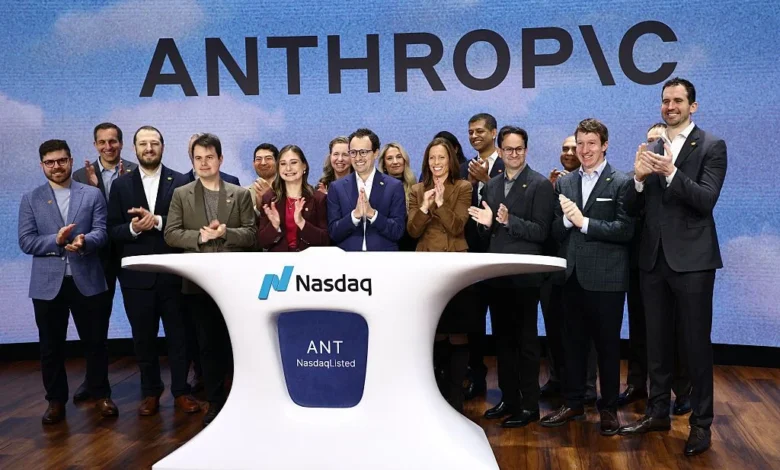
The initial public offering of Anthropic (ANT) has officially become the largest in United States stock market history, representing a watershed moment for the artificial intelligence sector and the broader financial landscape. Despite the massive scale of the debut, which initially triggered a gap-up opening for major equity indexes, the broader market failed to sustain momentum, closing lower on Thursday as investors grappled with mounting skepticism surrounding the long-term profitability of AI infrastructure investments.
Anthropic, a developer of large language models (LLMs), priced its shares at $83, comfortably exceeding its initial target range of $70 to $78. The offering successfully raised $81.3 billion through the issuance of approximately 980 million shares, culminating in a valuation of $1.3 trillion. On its inaugural trading day, the stock surged 35% to hit an intraday high of $111.50 before moderating to close at a 17.1% gain. This performance places the company in an elite tier of market capitalization, yet the broader indices struggled to maintain their footing in the face of macroeconomic headwinds and sector-specific scrutiny.
Chronology of the Trading Day and Market Reversal
The trading session on Thursday was characterized by a sharp intraday reversal that underscored the fragility of current market sentiment. The S&P 500, which reached gains of 1.3% early in the day, ultimately surrendered those gains to close down 2.0% at 7,175. This performance marked the most significant intraday reversal for the index since November 20, 2025. Similarly, the Dow Jones Industrial Average fell 2.2% to 49,097, while the Nasdaq Composite shed 2.3% to settle at 23,879.
The volatility was not limited to the technology sector. While Anthropic’s debut was intended to serve as a catalyst for growth, the market’s reaction was dampened by poor performances from established industry heavyweights. Chevron stood as a rare exception, closing up 0.4% as crude oil prices rose, with West Texas Intermediate futures gaining 0.9% to reach $83.06 per barrel. Conversely, UnitedHealth Group acted as a primary drag on the Dow, falling 5.6% following intensified scrutiny over Medicare Advantage payment audits.
The Landscape of AI Valuation: Anthropic vs. SpaceX
To understand the magnitude of the Anthropic offering, one must consider the historical context of high-profile IPOs. SpaceX, which held the previous title for the largest offering, went public in June with a valuation of $75 billion based on the sale of 556 million shares at $135 each. While SpaceX did not provide a formal target price range prior to its debut, its valuation has since climbed to $1.9 trillion, trading at approximately 92 times trailing sales at the time of its entry.
In contrast, Anthropic enters the public markets trading at roughly 40 times trailing 12-month sales. While this multiple is lower than that of SpaceX at the time of its debut, analysts remain divided on whether these valuations are sustainable. According to Renaissance Capital, the investment thesis for Anthropic hinges on its expanding enterprise business and its capacity to convert rapid AI adoption into robust operating margins. However, the firm also cautioned that investors are inheriting significant risks, including massive infrastructure obligations, an ultra-competitive landscape, and an unconventional corporate governance structure that restricts the influence of minority shareholders.
Strategic Implications for Corporate Stakeholders
The debut of Anthropic did not provide the expected lift for its two primary corporate backers. Alphabet, which maintains a stake of approximately 1.8 billion shares in the company, saw its stock decline by 3.5% on Thursday. Amazon, which holds 1.9 billion shares and maintains debt exposure to the firm, fared even worse, with its shares retreating 3.9%.
Analysts suggest that the lack of upward movement for these tech giants reflects a broader reassessment of AI-related capital expenditure. Nvidia, often considered the bellwether of the AI boom, experienced intense volatility throughout the session, trading between $145.71 and $158.13 before closing down 3.3%. This volatility highlights the "AI capex dilemma": while companies continue to pour billions into infrastructure, the market is becoming increasingly sensitive to the timeline for seeing a return on these investments.
The "Bank of AMD" Controversy and Semiconductor Risk
Compounding the day’s volatility was a targeted short-selling report concerning Advanced Micro Devices (AMD). The stock fell as much as 11.2% following allegations by Hunterbrook Capital that the company’s startup firmware was being utilized by IEIT Systems, a Chinese server manufacturer currently on the U.S. government’s export blacklist.
The report, which relies on findings from affiliate Hunterbrook Media, suggests that AMD’s exposure to the Chinese market remains a significant liability. Sam Koppelman, writing for Hunterbrook, famously drew a comparison between the semiconductor firm and the collapsed Silicon Valley Bank, labeling AMD the "Silicon Valley Bank of AI." The central argument is that while AMD’s balance sheet currently appears healthy, its reliance on financing the growth of AI customers creates a precarious position. Should those customers experience a slowdown in spending, AMD could find itself burdened with billions in financial commitments while simultaneously facing a contraction in chip demand. This, coupled with the threat of further U.S. regulatory restrictions on sales to Asia, has created a significant overhang for the stock.
Market Outlook and Expert Sentiment
The overarching sentiment among analysts is that the Anthropic IPO serves as a confirmation that the "AI capital spigot" remains open, but the flow is no longer as aggressive as it was during the initial fervor of the cycle. Luke Lango, a prominent tech analyst, noted that while the IPO is sufficient to sustain short-term interest in AI-related equities, it does not possess the inherent power to reverse the current sell-off in the sector.
The broader market’s failure to rally despite a record-breaking IPO suggests that investors are shifting their focus from top-line growth and market debuts to bottom-line profitability and fiscal discipline. The transition from a period of "growth at any cost" to a period of "sustainable profitability" is creating friction, particularly for companies that have historically relied on rapid, debt-fueled expansion.
Conclusion and Future Considerations
As the dust settles on the Anthropic IPO, the financial community is left to contemplate the long-term implications of such massive liquidity events. The company’s ability to navigate its complex governance structure and satisfy the demands of public shareholders will be the primary test in the coming quarters. Meanwhile, the market’s reaction to the news—characterized by a lack of enthusiasm for parent companies and a sharp, negative response to potential regulatory risks for hardware suppliers like AMD—suggests that the "AI halo effect" may be waning.
Investors are now entering a phase where the novelty of AI, regardless of its transformative potential, is no longer sufficient to override traditional valuation metrics. Future performance for the technology sector will likely be dictated by transparent communication of enterprise adoption rates, the resolution of global regulatory challenges, and the ability of firms to generate consistent, scalable revenue from their infrastructure investments. For now, the record-breaking nature of the Anthropic IPO serves as both a testament to the scale of the AI revolution and a cautionary tale regarding the limits of market optimism.
Related posts: