Alphabet’s Strategic AI Investments Bear Fruit as Google Cloud Revenue Surges, Easing Investor Concerns Amid Record Profits.

The latest earnings report from Alphabet, the parent company of Google, has provided a significant source of reassurance for investors who had publicly expressed concerns regarding the company’s colossal spending on artificial intelligence initiatives. The financial results, particularly the stellar performance of Google Cloud, indicate that these strategic investments are beginning to yield substantial returns, marking a pivotal moment in the tech giant’s "AI-first" transformation. This quarter’s figures not only exceeded market expectations but also underscored the accelerating adoption of enterprise AI solutions across various industries, solidifying Alphabet’s position at the forefront of the AI revolution.
A Strategic Payoff: Google Cloud Leads the Charge
At the heart of Alphabet’s robust financial performance lies the extraordinary growth of its Google Cloud division. The segment reported a staggering revenue spike of 82% year-over-year, climbing to an impressive $24.8 billion. This figure represents a substantial acceleration from the previous quarter’s already generous 63% year-over-year growth, which saw revenue reach $20 billion. More critically, it handily surpassed Wall Street analysts’ consensus expectation of $22.46 billion for the quarter, demonstrating a stronger-than-anticipated demand for Google’s cloud infrastructure and AI-powered services.
This remarkable surge in Google Cloud’s revenue was primarily attributed to the burgeoning adoption of enterprise AI solutions and AI infrastructure. Businesses are increasingly turning to Google Cloud to leverage advanced AI capabilities, from generative AI models to specialized machine learning tools, to enhance their operations, drive innovation, and improve efficiency. The company highlighted that this demand extends across various sectors, indicating a broad-based embrace of AI technologies facilitated by its cloud platform.
Beyond immediate revenue, Google Cloud’s future prospects also appear exceptionally strong. The company revealed that its backlog of cloud contracting work – representing services committed but not yet converted into revenue – had climbed to an astounding $514 billion. This massive backlog provides a clear indicator of sustained demand and a robust pipeline for future growth, offering long-term revenue visibility that further assuages investor anxieties about the sustainability of its AI strategy. It signals strong client commitment to multi-year cloud and AI partnerships with Google, positioning the company for continued dominance in the enterprise segment.
Alphabet’s Financial Powerhouse: Beyond Cloud Computing
While Google Cloud stole the spotlight, Alphabet’s overall financial health remained exceptionally strong across its diverse portfolio. The company reported a consolidated profit of $112.1 billion, a massive jump from the $28.1 billion recorded in the same period last year. This quadruple increase in profit underscores not only the success of its core businesses but also the operational leverage gained from its strategic investments. Alphabet’s overall revenue grew 24% year-over-year during the past quarter, reaching $119.8 billion. This substantial growth demonstrates a healthy expansion across its various segments, far exceeding the pace of many established tech giants.
Google Services, which encompasses its dominant search engine, YouTube, Android, and other consumer-facing products, also contributed significantly to the positive results. This segment saw its revenue jump 15% to $94.5 billion, reflecting continued strength in advertising revenue and user engagement across its platforms. The consistent performance of Google Services provides a stable and profitable foundation that allows Alphabet the financial flexibility to invest heavily in futuristic technologies like AI.
This marks Alphabet’s 12th consecutive quarter of double-digit revenue growth, a testament to its enduring market leadership and diversified business model. However, even by its own high standards, this quarter stands out as a particularly bountiful period, signaling an acceleration in growth trajectory fueled by its successful AI integration. The consistency of these results provides a powerful counter-narrative to any lingering doubts about the company’s ability to innovate and expand at scale.
The Genesis of AI Investment: A Contextual Deep Dive
The recent positive earnings report arrives against a backdrop of considerable investor scrutiny and market volatility surrounding the burgeoning field of artificial intelligence. For many months, Alphabet investors, alongside those in the broader tech sector, had voiced concerns that the company’s "massive AI spending" might not justify the immense capital outlay. The perceived "AI bubble" narrative, fueled by aggressive investment cycles and the high cost of developing and deploying advanced AI models, led to skepticism regarding the return on investment for such significant expenditures. Reports of Alphabet’s plans to raise upwards of $80 billion to fund its AI buildout further amplified these concerns, prompting questions about the long-term profitability and sustainability of such an aggressive strategy.
This investor apprehension was not without precedent. The tech industry, particularly in periods of rapid technological advancement, has often witnessed cycles of exuberant investment followed by periods of consolidation or correction. The sheer scale of Alphabet’s investment in data centers, specialized AI chips (like its Tensor Processing Units, or TPUs), research and development, and top-tier AI talent meant a substantial drain on immediate profitability. Analysts and shareholders alike sought concrete evidence that these expenditures would translate into tangible revenue growth and market leadership, rather than becoming a costly arms race with competitors like Microsoft, Amazon, and NVIDIA.
Google’s journey in AI, however, is not a recent phenomenon. For decades, the company has been a pioneer in AI research, with groundbreaking contributions ranging from its search algorithms to DeepMind’s advancements in reinforcement learning and the revolutionary Transformer architecture that underpins much of today’s generative AI. When the generative AI boom ignited with the public launch of ChatGPT in late 2022, Google, despite its foundational research, faced a perception challenge in rapidly bringing its innovations to market. This led to a strategic pivot, with CEO Sundar Pichai emphasizing an "AI-first" approach across all Google products and services. The current earnings report serves as a powerful validation of this strategic shift, demonstrating that Google is effectively translating its deep research capabilities into commercial success.
The Competitive Arena: Cloud Wars and AI Dominance
The cloud computing market, dominated by Amazon Web Services (AWS), Microsoft Azure, and Google Cloud, has become the primary battleground for AI dominance. Enterprises are increasingly looking to cloud providers not just for scalable infrastructure but for comprehensive AI platforms that offer everything from foundational models to specialized industry solutions. Google Cloud’s performance is particularly noteworthy given its position as the third-largest player in this intensely competitive market. Its rapid growth rate, significantly outstripping its rivals in this particular quarter, suggests that its focused investment in AI capabilities is paying off by attracting new enterprise clients and expanding existing relationships. The ability to offer cutting-edge AI services, coupled with robust, scalable infrastructure, is proving to be a critical differentiator. This strong showing is likely to intensify the competition among the hyperscalers, driving further innovation and investment in AI infrastructure and services across the industry.
The Engine of Innovation: Gemini’s Ascendant Trajectory
Beyond enterprise solutions, Google’s commitment to consumer-facing AI is also demonstrating significant traction. Gemini, Google’s advanced AI chatbot, is experiencing rapid adoption, underscoring the company’s ability to scale AI innovations to a massive user base. The company announced that Gemini currently enjoys 950 million monthly active users (MAU), a substantial increase from the 750 million users reported in Q4 2025. This growth of 200 million users in a single quarter highlights the escalating public interest and utility of conversational AI, and Google’s success in capturing a significant portion of this emerging market.
Gemini’s increasing user base is a critical component of Alphabet’s broader AI strategy. It serves as a direct interface for consumers to interact with Google’s most advanced AI models, providing a feedback loop that helps refine and improve the underlying technology. Furthermore, the widespread adoption of Gemini across various Google products, from Search to Workspace, allows the company to embed AI capabilities seamlessly into the daily digital lives of billions. This dual-front strategy – catering to both enterprise and consumer AI needs – creates a powerful synergy, where advancements in one area often inform and accelerate progress in the other. The success of Gemini also positions Google favorably in the race for AI platform dominance, as user engagement and data become crucial assets in the continuous improvement of AI models.
Executive Vision and Strategic Outlook
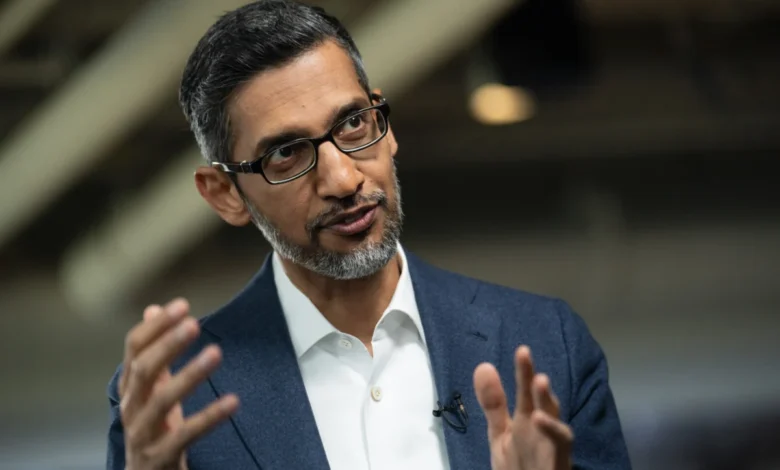
During Wednesday’s earnings call, Google CEO Sundar Pichai articulated a clear vision for the company’s AI-driven future, expressing immense confidence in the trajectory set by current investments. "Our AI investments are redefining what’s possible across every part of our business," Pichai stated, emphasizing the transformative impact of AI on everything from search algorithms to cloud services and consumer applications. He added, "We have exciting momentum across the board," a sentiment that resonates strongly with the reported financial figures.
However, the significant capital expenditures (CapEx) remained a key point of discussion for analysts. With estimated CapEx for the year ranging between $180 billion and $190 billion – dedicated to building data centers, acquiring advanced chips, and expanding critical infrastructure – analysts pressed Pichai for clearer timelines on when these massive investments would fully materialize into profits. The scale of this spending reflects the intense competition for AI leadership and the necessity of building the foundational hardware and software to support next-generation AI models.
Pichai addressed these concerns with a forward-looking perspective, indicating that the full impact of compute capacity investments would likely be realized by 2027. He reassured investors by citing "strong demand indicators, including long-term deals," as evidence of the market’s appetite for Google’s AI offerings. "I think, if anything, the dynamics look healthier than where we were about a year ago, so that’s what gives us the confidence to undertake those investments," he concluded. This statement suggests that the company is observing not just a fleeting trend but a fundamental shift in enterprise demand for AI, justifying the long-term strategic investments. These investments are not merely about acquiring generic hardware; they involve procuring specialized AI accelerators, like NVIDIA’s latest GPUs, and further developing Google’s custom-designed Tensor Processing Units (TPUs), which are optimized for AI workloads. They also encompass the complex and energy-intensive construction of hyper-scale data centers, increasingly powered by renewable energy sources, to support the vast computational demands of AI training and inference.
Broader Implications: Reshaping the Tech Landscape
Alphabet’s latest earnings report carries significant implications not just for the company itself but for the broader technology landscape and the global economy. The validation of its "AI-first" strategy provides a powerful signal to the industry that large-scale, strategic investments in AI are indeed capable of generating substantial financial returns. This success could further accelerate the pace of AI adoption across various sectors, as businesses gain confidence in the tangible benefits demonstrated by leading tech firms.
For the cloud computing industry, the report underscores that AI capabilities are rapidly becoming the ultimate differentiator. Cloud providers that can offer the most advanced, scalable, and secure AI platforms are poised to capture a larger share of the enterprise market. This will likely intensify the "cloud wars," pushing competitors to ramp up their own AI investments and innovations, ultimately benefiting customers with a wider array of sophisticated AI services. The massive backlog in Google Cloud also highlights a growing trend of enterprises committing to long-term digital transformation initiatives powered by cloud and AI.
Economically, the successful commercialization of AI by giants like Alphabet could contribute significantly to productivity growth across industries. As AI tools become more integrated into business processes, they have the potential to optimize operations, drive new product development, and create entirely new markets. This could translate into broader economic benefits, fostering innovation and competitiveness on a global scale.
However, challenges remain. The rapid advancement of AI also brings heightened scrutiny regarding regulatory frameworks, ethical considerations, and the societal impact of intelligent systems. Questions surrounding data privacy, algorithmic bias, and job displacement will continue to be prominent. Furthermore, the sustainability of such massive capital expenditures, particularly in terms of energy consumption and environmental impact, will require ongoing innovation in efficiency and renewable energy solutions. Despite these complexities, Alphabet’s recent performance paints a compelling picture of a company successfully navigating a transformative technological era, converting ambitious AI investments into concrete financial gains and cementing its leadership position in the global tech arena.
Conclusion: A New Era of Growth for Alphabet
In summary, Alphabet’s latest earnings report marks a triumphant moment, demonstrating that its aggressive pivot towards an "AI-first" strategy is paying off handsomely. The extraordinary growth of Google Cloud, fueled by enterprise AI adoption, coupled with robust performance across its core businesses and the surging popularity of Gemini, provides irrefutable evidence that the company is effectively capitalizing on the AI revolution. While capital expenditures remain substantial, CEO Sundar Pichai’s confident outlook, supported by strong demand indicators and a massive cloud backlog, suggests a clear path to sustained future returns. This quarter’s results not only alleviate immediate investor concerns but also signal a new era of growth for Alphabet, positioning it firmly at the vanguard of AI innovation and commercialization, poised to reshape the digital landscape for years to come.
Related posts: