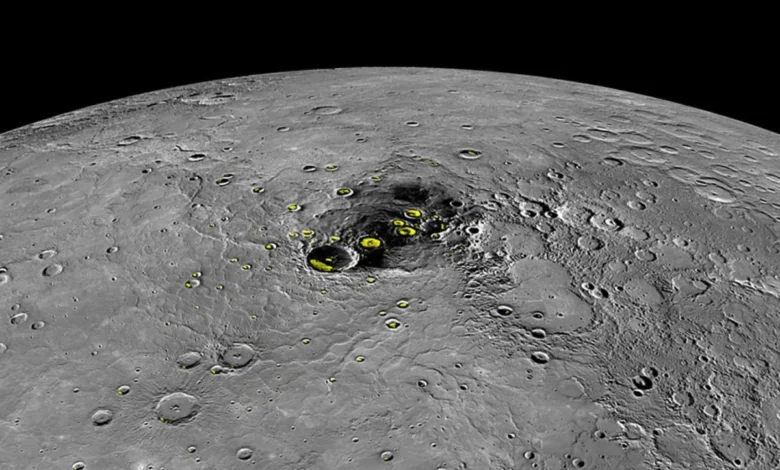
Around 100 million years ago, a profound transformation reshaped the surface of Mercury. Prior to this pivotal event, the innermost planet of our solar system was characterized by a stark, arid landscape, largely devoid of ice. This arid condition was unsurprising given Mercury’s proximity to the Sun, where surface temperatures can soar to an astonishing 430 degrees Celsius (806 degrees Fahrenheit) during the day. However, within the span of a single Mercurian day – which lasts approximately 176 Earth days – this ancient dryness was irrevocably altered, leading to the presence of significant ice deposits in its polar regions, a discovery that has long puzzled scientists.
The key to this mystery lies within Mercury’s poles, specifically in the perpetually shadowed craters that never receive direct sunlight. These "permanently shadowed regions" (PSRs) have been confirmed by NASA’s Messenger spacecraft, which meticulously orbited the planet between 2011 and 2015. Messenger’s observations revealed substantial ice deposits, some several meters deep, nestled within these frigid, sunless environments. The presence of such a substantial amount of water ice in such an extreme environment has been a significant scientific enigma, prompting extensive research into its origins.
A New Theory Emerges: The Grand Impact Scenario
While previous hypotheses have proposed that Mercury’s ice might have been delivered by smaller, comet-like bodies impacting the planet over vast geological timescales, new research spearheaded by Parvathy Prem at the Johns Hopkins Applied Physics Laboratory in Maryland, in collaboration with her colleagues, offers a compelling alternative. Their sophisticated simulations suggest that the ice may, in fact, be the remnant of a single, monumental impact event involving a much larger, albeit slower-moving, celestial body. This new model provides a detailed, start-to-finish visualization of the process, offering unprecedented insight into how Mercury acquired its polar ice.
"We’ve known for a while that Mercury’s poles have ice," stated Prem in a recent discussion. "The idea that those ice deposits might have been laid down by an impactor is also not new, but this is the first time we’ve really modelled that process and visualised what might have gone on from the start to the end. It’s the first time we’ve looked in detail at how exactly the movie plays out."
This dramatic "movie" begins with a colossal chunk of ice and rock colliding with Mercury. The sheer force of this impact would have been immense, capable of excavating the vast Hokusai crater, a prominent feature on the planet’s surface today. The impactor, upon striking the Mercurian surface, would have vaporized almost instantaneously. This vaporization would have released an enormous quantity of water vapor, creating a transient, yet significant, atmosphere around the planet.
"If we just looked at Mercury with our own eyes, this would have been probably too thin to see," Prem elaborated. "But look at it in the right wavelengths and, briefly, the planet might have been glowing." This temporary, water-rich atmosphere, though incredibly tenuous and likely imperceptible to the naked eye, would have played a crucial role in the distribution of water.
The Journey of Water to the Poles
While the relentless solar radiation, characteristic of Mercury’s extreme environment, would have rapidly eroded most of this newly formed atmosphere, the researchers’ simulations revealed a surprising resilience for a portion of the water vapor. Their models indicate that over one-fifth of the water vapor generated by the impact could have successfully migrated towards Mercury’s poles. There, it would have found refuge in the permanently shadowed regions, where the frigid temperatures would allow it to condense and accumulate as ice.
This retention rate is significantly higher than predicted by many earlier calculations, aligning more closely with the ice quantities observed by the Messenger spacecraft. Prem emphasized that a larger impactor, delivering its payload at a slower velocity than previously theorized, would be even more effective at trapping water on the planet’s surface, further supporting their hypothesis.
A Day of Unprecedented Change
The temporal scale of this event is as astonishing as its magnitude. If the researchers’ model is accurate, this entire process – from the initial impact to the deposition of water vapor at the poles – would have unfolded within a single Mercurian day, equating to 176 Earth days.
Emily Costello, a researcher at the University of Hawaiʻi, who was not directly involved in this specific simulation but studies Mercury’s geology, remarked on the profound implications of such an event. "This would certainly have been the most eventful day in the last billion years of Mercury’s history," she stated. The sheer dynamism of this single day would have fundamentally altered the planet’s long-term geological and atmospheric evolution.
Answering Age-Old Questions and Illuminating Solar System History
The implications of this new understanding extend far beyond Mercury itself. It offers a potential solution to a long-standing comparison between Mercury and Earth’s Moon. Despite their striking similarities in many respects, including their arid surfaces and lack of significant water, the Moon does not possess the abundant ice deposits found on Mercury.
"Mercury recently experienced a large-scale water delivery. The moon didn’t," explained Costello, highlighting the crucial difference. This suggests that the delivery mechanisms for water to inner solar system bodies may not be uniform and that significant, localized events can play a dominant role.
Furthermore, this research could provide invaluable clues about the broader question of how and when water first arrived in the inner solar system, including our own planet, Earth. Mercury’s polar ice deposits, in this context, are not merely curious geological features but act as a unique archival record.
"Mercury’s polar ice deposits are this interesting geological record of how and when water came to be in the inner solar system, and now we’re reading that record and trying to understand what it’s telling us," Prem articulated. Deciphering this record is crucial for piecing together the early history of our solar system and the conditions that allowed for the emergence of life.
The ongoing BepiColombo mission, a joint venture between the European Space Agency and the Japan Aerospace Exploration Agency, which launched in 2018 and is set to enter orbit around Mercury later this year, is poised to significantly advance our understanding. Its sophisticated instruments will undoubtedly provide more detailed data on Mercury’s surface composition, magnetic field, and exosphere, potentially corroborating or refining the findings of this new impact hypothesis. The mission’s observations will be instrumental in further unraveling the complex story of water in the inner solar system.
Background Context: Mercury’s Extreme Environment and the Messenger Mission
Mercury, the smallest planet in our solar system and the closest to the Sun, presents a uniquely challenging environment for scientific study. Its diminutive size and proximity to the Sun’s intense gravitational pull and radiation have historically made it a difficult target for spacecraft. However, the Messenger mission marked a significant milestone, being the first spacecraft to orbit Mercury.
During its four-year orbital mission, Messenger provided unprecedented global coverage of Mercury’s surface, revealing a geologically diverse world marked by extensive plains, massive impact craters, and peculiar hollows – regions that appear to be actively receding. The spacecraft’s instruments were able to map the planet’s elemental composition, study its exosphere (a very thin atmosphere), and analyze its magnetic field. It was Messenger’s data that definitively confirmed the presence of water ice in the permanently shadowed regions of Mercury’s poles, a discovery that challenged existing assumptions about the planet’s aridity.
The existence of these ice deposits, stable despite the extreme temperatures experienced elsewhere on the planet, had long been a subject of scientific debate. Theories ranged from the continuous, albeit slow, delivery of water by comets and asteroids over billions of years to the possibility of internal water sources or even trapped primordial water. The Messenger mission provided the observational evidence to confirm the presence of ice, shifting the scientific focus to understanding its origin and preservation mechanisms.
Supporting Data and Chronology
- Pre-Impact Mercury: Characterized by an extremely hot, dry, and arid surface. Daytime temperatures routinely exceed 430°C (806°F).
- The Impact Event (Approximately 100 Million Years Ago):
- A large celestial body, estimated to be significantly larger than previously hypothesized impactors and moving at a slower velocity, strikes Mercury.
- The impact excavates the Hokusai crater.
- The impactor vaporizes, releasing a substantial amount of water vapor, forming a temporary, water-rich atmosphere.
- Atmospheric Evolution:
- Intense solar radiation begins to erode the tenuous atmosphere.
- Approximately 20% of the water vapor successfully migrates to Mercury’s polar regions.
- Ice Deposition:
- Water vapor condenses and accumulates as ice in permanently shadowed regions (PSRs) at the poles.
- Ice deposits form, some several meters deep.
- Post-Impact Mercury: The planet retains significant ice deposits in its polar craters, while the rest of the surface remains arid.
- Messenger Mission (2011-2015): Orbits Mercury, confirms the presence and depth of polar ice deposits, providing key observational data.
- New Simulation Research (Parvathy Prem et al.): Utilizes sophisticated modeling to propose a single, large, slow impact as the primary source of Mercury’s polar ice.
- BepiColombo Mission (Launched 2018, entering orbit soon): Expected to provide further data to refine our understanding of Mercury’s composition, geology, and potential water sources.
Broader Implications: The Origins of Water in the Inner Solar System
The discovery of how Mercury may have acquired its ice has profound implications for our understanding of the early solar system. The distribution of water is a fundamental factor in the development of planetary habitability. While the inner solar system, including Earth, is generally considered to be too hot for water to have been readily available during its formation, the findings for Mercury suggest that significant water delivery events, even to planets close to the Sun, may have occurred.
This research contributes to a larger scientific narrative that includes:
- The Late Heavy Bombardment: A period in the early solar system where many planets and moons were subjected to intense asteroid and comet impacts. The proposed Mercurian impact could be a remnant or a significant event within this broader period.
- Water Delivery Models: Understanding how water was transported to rocky planets is crucial. While some theories focus on volatile-rich comets and asteroids from the outer solar system, the Mercurian scenario suggests that impacts from bodies originating closer to the Sun, or larger, more substantial impactors, could also be significant water sources.
- Comparative Planetology: By studying Mercury, we gain insights into the extreme conditions that can shape planetary evolution. The contrast between Mercury’s ice-laden poles and its scorching equator provides a unique laboratory for understanding the interplay of solar radiation, impact dynamics, and atmospheric retention.
The ongoing scientific endeavor to understand Mercury’s ice deposits underscores the dynamic and often surprising nature of our solar system. Each new piece of data and every innovative simulation brings us closer to a complete picture of how these celestial bodies formed and evolved, and crucially, how water, the essential ingredient for life as we know it, came to be distributed across the cosmos.