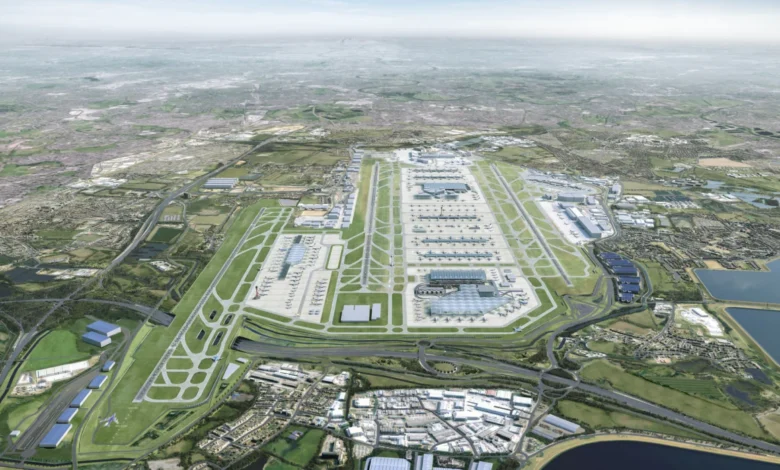
The ongoing debate surrounding the potential expansion of London Heathrow Airport has reached a critical juncture, placing the aviation industry on a direct collision course with the United Kingdom’s legally binding climate commitments. As policymakers weigh the economic benefits of increased global connectivity against the escalating urgency of the climate crisis, a growing chorus of environmental experts and government advisors has introduced a provocative proposition: the only way to reconcile a larger Heathrow with net-zero emissions is to artificially cap or throttle passenger demand.
This tension underscores a fundamental paradox in modern infrastructure policy. While airports serve as vital arteries for international trade, tourism, and diplomacy, the carbon footprint generated by commercial aviation remains stubbornly difficult to abate. With the UK Climate Change Committee (CCC) leading the charge, critics argue that expanding the world’s busiest international hub without a fail-safe mechanism to control flight volumes will render the nation’s climate targets unattainable.
The Core Dilemma: Growth Versus Decarbonization
At the heart of the controversy is the expansion blueprint that has haunted British politics for decades: the construction of a third runway at Heathrow. Proponents of the expansion argue that failing to grow the airport’s capacity will cause the UK to lose its competitive edge against continental European hubs like Frankfurt, Amsterdam, and Paris. Proponents point to job creation, increased trade routes with emerging markets, and enhanced global mobility as indispensable pillars of post-Brexit economic strategy.
Conversely, climate scientists and policy analysts emphasize that aviation is one of the hardest sectors to decarbonize. Unlike ground transport, which is rapidly transitioning to electrification, commercial aviation relies heavily on liquid hydrocarbon fuels. While Sustainable Aviation Fuels (SAFs) offer a pathway toward lower emissions, their current production scale is minuscule, and widespread adoption remains decades away.
Without immediate and drastic interventions, expanding Heathrow will inevitably lead to a surge in flight frequencies, higher fuel consumption, and an overall increase in greenhouse gas emissions. This trajectory directly undermines the UK’s Climate Change Act, which mandates a 78% reduction in emissions by 2035 compared to 1990 levels, and a complete achievement of net-zero emissions by 2050.
Warnings from the Climate Change Committee
The debate gained renewed momentum following stark warnings issued by the UK government’s official climate advisor, the Climate Change Committee. Nigel Topping CMG, chair of the committee, delivered a blunt assessment of the situation, highlighting the absence of a viable roadmap to offset the environmental toll of commercial flights.
“Emissions from flying are projected to rise, even without Heathrow expansion, and the UK does not currently have a credible plan to bring them down. That poses a serious challenge to our climate commitments,” Topping stated.
Going a step further, Topping declared that the proposed Heathrow expansion is “not currently compatible with the UK’s Net Zero target.” He emphasized that the financial and environmental burden of decarbonization cannot be absorbed by the public sector or left to chance. Instead, the aviation industry must be held fully accountable for its environmental impact.
“Government needs to ensure that the aviation industry takes responsibility for the emissions it creates and bears the costs of decarbonisation. Those conditions do not exist today,” Topping added.
Historical Chronology of the Heathrow Expansion Saga
To understand the gravity of the current impasse, it is essential to examine the protracted history of the Heathrow expansion debate, which has spanned multiple decades and administrative changes.
- 2003: The UK government publishes a white paper on the future of air transport, first signaling the need for additional runway capacity in the South East of England, with Heathrow and Gatwick as primary candidates.
- 2009: The Labour government under Gordon Brown officially approves plans for a third runway at Heathrow, triggering widespread protests and legal challenges from local residents, environmental groups, and local authorities.
- 2010: Following a change in government, the incoming Conservative-Liberal Democrat coalition officially scraps the third runway plan, fulfilling a key pre-election promise.
- 2012–2015: Recognizing the deepening capacity crisis, the government establishes the Airports Commission, chaired by Sir Howard Davies. In 2015, the commission unanimously recommends expanding Heathrow by building a third runway.
- 2018: Parliament votes overwhelmingly in favor of a National Policy Statement supporting the Heathrow expansion, setting the stage for a formal planning application.
- 2020: In a landmark legal victory for environmentalists, the Court of Appeal rules that the government’s approval of the third runway was unlawful because ministers failed to properly account for the UK’s commitments under the Paris Agreement.
- 2020 (Later in the year): The Supreme Court overturns the Court of Appeal’s decision, ruling that the government’s policy framework was legally sound, thereby reviving the project’s prospects while leaving the final planning hurdles intact.
- 2021–Present: The project faces continuous delays driven by the COVID-19 pandemic, shifting economic conditions, and mounting pressure from climate advisory bodies regarding net-zero alignment.
Supporting Data and the Global Context
Aviation accounts for approximately 2.5% of global carbon dioxide emissions, a figure that rises significantly when accounting for non-CO2 warming effects, such as the formation of condensation trails (contrails) and cirrus clouds, which trap heat in the atmosphere. Within the UK, aviation represents a disproportionate share of the national carbon budget, contributing roughly 7% of total UK greenhouse gas emissions prior to the pandemic.
Projections from the Department for Transport indicate that passenger demand will continue to rebound and grow steadily over the coming decades. Even with modest improvements in aircraft fuel efficiency, total emissions from UK departing flights are projected to exceed the government’s carbon budgets for the aviation sector unless deliberate demand-management policies are enacted.
Industry representatives argue that technological advancements, fleet modernization, and the integration of SAFs will eventually decouple aviation growth from carbon emissions. However, independent analysts point out that SAF production currently accounts for less than 0.1% of global jet fuel consumption. Scaling this industry requires massive capital investments, long-term policy mandates, and secure feedstock supply chains—elements that are not yet established at the necessary scale.
Official Responses and Stakeholder Positions
The conflict over Heathrow expansion exposes deep ideological divisions among industry stakeholders, economic planners, and environmental advocates.
The Aviation Industry Perspective
Airlines and airport operators maintain that capping passenger demand is a regressive policy that would harm the broader economy, restrict travel access for everyday citizens, and export aviation emissions to other jurisdictions rather than reducing them. Heathrow management has consistently argued that the airport can achieve net-zero operations through a combination of airspace modernization, zero-emission aircraft development, and carbon offsetting schemes. Representatives emphasize that modernizing infrastructure allows for more efficient flight paths, reducing fuel burn per passenger mile.
Environmental and Community Organizations
Environmental NGOs, local resident associations, and climate legal groups reject the notion that technological fixes alone can resolve the crisis. Organizations such as Greenpeace and Friends of the Earth argue that any expansion of airport capacity directly contradicts scientific consensus. They advocate for alternative measures, such as frequent flyer levies, the introduction of a kerosene tax (from which international aviation is traditionally exempt), and restrictions on domestic short-haul flights where viable rail alternatives exist.
Government and Regulatory Dilemma
For successive UK administrations, the Heathrow dilemma represents a classic political trap: balancing local environmental degradation and global climate targets against national economic growth and international competitiveness. While regulatory bodies like the Climate Change Committee provide objective risk assessments, final decisions rest with government ministers who must navigate intense lobbying from both corporate giants and civil society coalitions.
Broader Economic and Geopolitical Implications
The policy debate surrounding Heathrow is not isolated to the United Kingdom; it reflects a broader global reckoning within the aviation sector. As international pressure mounts under the Paris Agreement and the International Civil Aviation Organization’s (ICAO) Carbon Offsetting and Reduction Scheme for International Aviation (CORSIA), traditional models of unchecked airport growth are facing unprecedented scrutiny.
If the UK government chooses to heed the warnings of the Climate Change Committee and effectively halts or restricts Heathrow expansion, it could set a powerful precedent for other major economies grappling with similar infrastructure demands. Such a decision would signal that national climate commitments take precedence over sectoral growth, potentially redefining the future of global mobility.
Conversely, permitting the expansion without enforceable demand-management mechanisms risks undermining the credibility of the UK’s climate leadership on the international stage, particularly as the nation promotes green industrial policies at global climate summits.
Conclusion
The path forward for London Heathrow Airport remains fraught with uncertainty. As climate impacts intensify and emissions trajectories outpace reduction strategies, policymakers can no longer treat aviation expansion as a purely commercial decision. Whether through explicit caps on passenger demand, stringent carbon-pricing mechanisms, or groundbreaking technological leaps, the fundamental equation governing airport growth must change. The warning from the Climate Change Committee serves as a stark reminder: without aligning physical infrastructure with ecological limits, the goal of a net-zero future remains out of reach.