SNL U.K. Weekend Update delivers scathing satire on global politics and industry leaders in latest broadcast

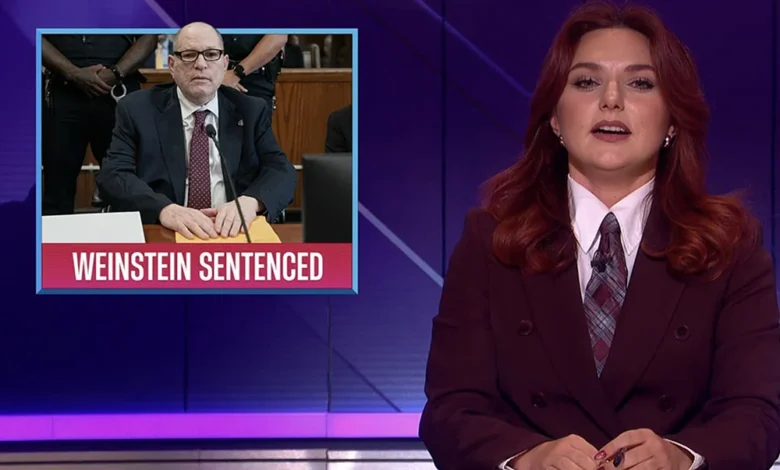
The most recent episode of Saturday Night Live U.K. featured a Weekend Update segment that leaned heavily into the tradition of biting political satire, directing sharp criticism at a spectrum of figures including U.S. President Donald Trump, OpenAI CEO Sam Altman, and convicted former film mogul Harvey Weinstein. Through a series of rapid-fire jokes delivered by co-anchors Ania Magliano and her co-host, the program navigated the intersection of high-stakes international diplomacy, the ethics of emerging artificial intelligence, and the ongoing legal fallout of the #MeToo movement.
The Diplomatic Lens and Satirical Commentary
The segment opened with a focus on recent high-level diplomatic exchanges, specifically the meeting between President Trump and Chinese President Xi Jinping. The writers utilized visual puns regarding the leaders’ attire to frame the encounter, juxtaposing the symbolic color palettes chosen by both heads of state. Beyond the aesthetic commentary, the broadcast touched upon the complexities of U.S.-China relations, a relationship defined by trade tensions, geopolitical competition, and fluctuating levels of cooperation.
The satire also extended to a fictionalized or stylized encounter between President Trump and U.K. Prime Minister Andy Burnham. By framing these interactions within a comedic framework, the show highlights the ongoing public discourse surrounding the age, health, and cognitive performance of global leaders—a recurring theme in modern political commentary that transcends national borders. This approach reflects a broader trend in late-night television where the performance of leadership is scrutinized as intensely as the policies themselves.
AI Ethics and the Sam Altman Paradox
The broadcast pivoted from traditional politics to the technological frontier, targeting OpenAI CEO Sam Altman. The segment mocked Altman’s recent testimony and public appearances regarding the rapid advancement of generative artificial intelligence. By highlighting the tension between Altman’s role as the architect of transformative technology and his public warnings regarding the potential existential risks of that same technology, the show tapped into a growing sense of public anxiety surrounding AI regulation.
This critique mirrors the real-world discourse occurring at the United Nations and other international bodies, where leaders are grappling with how to govern a technology that is evolving faster than current legislative frameworks can accommodate. The juxtaposition of corporate promotion and catastrophic warnings remains a point of contention among technologists, ethicists, and government regulators worldwide.
The Legal and Cultural Fallout of the Weinstein Case
A significant portion of the segment was dedicated to the recent legal developments concerning Harvey Weinstein. Following his sentencing in New York, the show confronted the gravity of his crimes and the cultural shifts necessitated by the #MeToo movement. By addressing the use of private intelligence firms to suppress victims, the broadcast underscored the institutional power dynamics that allowed such behavior to persist for decades.
The mention of the "nuanced" approach to such conflicts—mocking the tendency of some public figures to avoid taking firm stances on clear-cut cases of abuse—served as a commentary on the difficulty of maintaining public accountability in an era of polarized media. The audience reaction, noted by the program, suggests that the topic remains deeply sensitive and central to the ongoing dialogue regarding workplace safety and systemic justice.
Chronology of Recent Political and Industry Developments
To understand the context of the SNL U.K. segments, one must look at the timeline of the events referenced:
- September 2023: Global leaders converged at the United Nations General Assembly in New York, an event that served as the backdrop for much of the week’s political friction, including the walkout during Benjamin Netanyahu’s address.
- Late 2023/Early 2024: Harvey Weinstein’s legal proceedings continued to make headlines as the judiciary finalized sentencing and appeals processes related to his various convictions.
- Ongoing: OpenAI’s ChatGPT continues to dominate the tech cycle, with Sam Altman frequently appearing before congressional committees and international forums to discuss AI safety protocols.
These events, while distinct in nature, are linked by the theme of public perception versus private reality. Whether it is a leader’s cognitive state, the hidden dangers of an algorithm, or the systemic silencing of victims, the program’s writers focused on the "cracks in the facade" of modern power structures.
Institutional Reactions and the Role of Satire
While the targets of the humor—ranging from heads of state to corporate executives—rarely provide official responses to late-night comedy sketches, the impact of such broadcasts is measurable in the cultural zeitgeist. Satire serves as a pressure valve in democratic societies, allowing the public to process complex or distressing information through a lens of irony.
From a sociological perspective, the decision by SNL U.K. to cover these specific stories confirms that the audience for such programs expects a blend of news aggregation and editorial critique. The show does not merely report the news; it interprets the news for a viewership that is increasingly inundated with information. By categorizing the actions of leaders and executives into comedic tropes, the show provides a form of social shorthand, making dense policy issues more accessible to the average viewer.
Broader Implications of Global Political Satire
The implications of this style of journalism-as-entertainment are significant. As traditional news outlets face skepticism regarding their neutrality, comedy programs often step into the void to provide a critical, albeit subjective, view of current affairs. The focus on Benjamin Netanyahu’s UN speech and the subsequent walkouts represents a broader trend of international dissatisfaction with current geopolitical strategies. By simplifying these complex diplomatic ruptures into a quick punchline, the show underscores the global perception of isolationism and the fracturing of traditional alliances.
Furthermore, the critique of the Weinstein case serves as a reminder that the #MeToo movement is not a closed chapter but an ongoing process of legal and cultural adjustment. When a comedy show references the specific tactics of private intelligence firms hired by powerful individuals to intimidate victims, it reinforces the narrative that justice is often hindered by wealth and institutional influence. This type of coverage ensures that these stories do not fade from public memory as quickly as they might in a 24-hour news cycle that prizes novelty over continuity.
Fact-Based Analysis of the Current Landscape
In analyzing the effectiveness of the satire presented, it is clear that the writers of SNL U.K. prioritize the "personality" of the news over the technicalities of the policy. This is a common strategy in late-night television, designed to maximize engagement. However, beneath the humor lies a series of facts that remain central to current discourse:
- AI Regulation: The debate over whether AI should be treated as a public utility or a private asset remains unresolved, with Sam Altman’s public statements often serving as the focal point for this tension.
- Legal Accountability: The sentencing of high-profile offenders like Weinstein continues to test the strength of legal systems and the resilience of witness testimony in the face of immense pressure.
- Diplomatic Fragility: The walkouts at the UN and the performative nature of state visits demonstrate the strain on current international relations, where symbolic gestures (like the color of a necktie) are scrutinized as heavily as formal communiqués.
Conclusion: The Future of Political Commentary
As we move further into a digital-first media environment, the boundaries between hard news and entertainment will likely continue to blur. Programs like SNL U.K. fulfill a dual function: they inform the public about the events of the week, and they provide a moral or humorous framework for interpreting those events. While critics may argue that such segments trivialize serious issues, proponents suggest that this form of engagement is essential for maintaining a healthy skepticism of those in power.
The latest episode demonstrates that the core mission of political satire remains unchanged: to hold the powerful to account, to highlight the absurdities of the status quo, and to provide a space where the most uncomfortable truths can be voiced, provided they are accompanied by a laugh. Whether the subject is the nuances of international trade or the ethical implications of the next generation of software, the Weekend Update format continues to be a vital, if unorthodox, pillar of modern media.
Related posts: