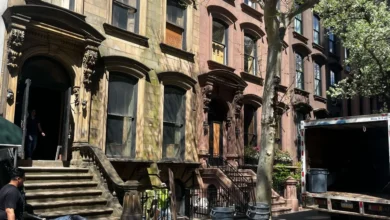
At first glance, 281 Greene Avenue in Brooklyn’s Clinton Hill neighborhood appears to be a modest, unassuming structure, especially when juxtaposed against the ornate 19th-century mansions that define the area’s historic aesthetic. Its brick facade lacks the intricate scrollwork or neoclassical flourishes common to the neighborhood’s residential architecture, and from the street level, the building’s narrow 25-foot frontage suggests a cramped, prewar tenement. However, crossing the threshold reveals an architectural secret: a sprawling, expansive interior featuring 90-foot-deep floor plates and 12-foot ceilings, entirely devoid of the intrusive supporting columns typical of New York City industrial architecture. This rare spatial configuration is a relic of the building’s origins as a pharmaceutical powerhouse, a testament to the industrial evolution of Brooklyn that has, over the course of a century, transitioned from a center of manufacturing to a haven for artists and, eventually, a high-end residential rarity.
A Pharmaceutical Legacy: From Labs to Lofts
The building at 281 Greene Avenue was not originally designed for domestic life. By 1912, it served as a vital component of a sprawling complex managed by the pharmaceutical giant Bristol-Myers. The company, which had relocated its headquarters to this section of Brooklyn in 1899, maintained a significant footprint in the area, operating labs, offices, and distribution centers across the northern side of Greene Avenue. The scale of their operations was so vast that the company famously secured municipal permission to construct a tunnel beneath nearby Clifton Place to facilitate the movement of goods and personnel between their various properties.
This industrial era, however, was relatively short-lived. By the 1920s, Bristol-Myers had moved on, leaving behind a series of industrial structures that would eventually be repurposed. While neighboring addresses like 277 and 279 Greene Avenue were converted into conventional apartment buildings, 281 Greene Avenue underwent a more unconventional evolution. Following the departure of the pharmaceutical company, the building saw use as a warehouse and a hub for moving and architectural supply companies, including Kilroy Architectural Windows, which notably provided the glass for the restoration of the Statue of Liberty.
The Artist-Led Preservation Movement
The preservation of 281 Greene Avenue’s interior is largely credited to a succession of artist owners who valued the raw, industrial character of the space over modern, sanitized renovations. In 1992, abstract painter Julio Mateo and his wife, Raquel Wiltbank-Mateo, acquired the property. At the time, the building was a shell; it had been abandoned for roughly a decade, with broken windows, stripped plumbing, and accumulated debris.
The Mateos, who moved to the neighborhood as part of a wave of creatives drawn to the Pratt Institute area, embarked on the difficult task of stabilizing the structure. They installed modern electrical and plumbing systems, effectively saving the building from further decay. Their tenure transformed the site into a multi-purpose sanctuary: the ground floor served as a painting studio, while the third floor functioned as a family home. The second floor, meanwhile, was leased to a rotating cast of tenants, including a DJ whose legendary, all-night gatherings became part of the building’s local lore.
When artist and builder Kris Krohn purchased the building in 1998 for $289,000, he described the experience of entering the space as stepping into "the time zone of Pompeii." Krohn, who had spent years working on high-end Manhattan renovations and building installations for Soho galleries, recognized the architectural rarity of the I-beam steel structure. Unlike the cast-iron lofts of downtown Manhattan, which often required heavy columns, the concrete-and-steel construction at 281 Greene allowed for a level of open-plan flexibility that is nearly impossible to replicate today.
Architectural Nuance and Adaptive Reuse
Krohn’s approach to the building was one of meticulous conservation mixed with adaptive reuse. He was particularly drawn to the industrial details that remained: dark mahogany baseboards, fluted wooden finials, and the original steel rosettes adorning the staircase. He preserved the original plaster walls, choosing to celebrate the layers of paint and history rather than stripping them away.

Throughout the 2000s, as the Clinton Hill neighborhood experienced rapid gentrification—marked by the arrival of trendy eateries like Speedy Romeo—Krohn continued to refine the property. He converted the ground-floor workshop into an art gallery and later a yoga studio, while focusing on his own residential unit on the top floor. His work included the addition of salvaged stained glass and the installation of a rooftop garden inspired by the principles of Frank Lloyd Wright.
By the mid-2020s, the building had undergone its final transformation: a comprehensive code-compliance project that modernized the structure while maintaining its aesthetic heritage. This included the addition of fire-safety systems and a structural modification that cut a light-well between the second and third floors, creating a unified, sun-drenched duplex.
Market Implications: The "Unicorn" Listing
Today, 281 Greene Avenue is listed for $6.95 million with Douglas Bowen and Zia O’Hara of Douglas Elliman. In the context of the Brooklyn real estate market, the property represents a unique asset class. According to Bowen, the building is a "unicorn"—a rare residential conversion that has successfully navigated the city’s rigorous certificate of occupancy requirements for a single-family home with an integrated commercial space.
The market for such properties is driven by high-net-worth buyers who seek the "downtown loft" experience—characterized by expansive, open-air living—within the established, residential context of brownstone Brooklyn. The inclusion of a private, structurally reinforced roof deck and a basement sauna further elevates the property’s value, catering to a buyer profile that prioritizes both historical integrity and modern luxury.
Broader Economic and Neighborhood Context
The trajectory of 281 Greene Avenue mirrors the broader socio-economic shifts within Clinton Hill. Once defined by its industrial utility and proximity to early 20th-century pharmaceutical manufacturing, the area has transitioned into one of Brooklyn’s most desirable residential enclaves. The preservation of such buildings serves as a critical bridge between these two eras.
Urban planning experts note that the successful adaptive reuse of industrial buildings is essential to maintaining the architectural diversity of neighborhoods like Clinton Hill. By allowing buildings to evolve from manufacturing sites to creative studios and eventually to bespoke residences, the city retains the character of its industrial past while accommodating the density and demand of a modern metropolis. However, the high price point of such conversions often limits access to these spaces to the ultra-wealthy, raising ongoing questions about the democratization of living space in historically creative districts.
As the building awaits its next owner, its history remains etched in its walls—from the peeling plaster that tells the story of its decades of neglect to the meticulously restored mahogany and steel that speak to the care of its artist stewards. For the buyer, 281 Greene Avenue offers not just a home, but a curated artifact of Brooklyn’s industrial evolution, a project that took 30 years to reach its current state of refined, turn-key luxury.