Physicist Emma Chapman embarks on a cosmic journey through her latest book, "Radio Universe: How to Explore Space Without Leaving Earth" (published as "The Echoing Universe" in the US), a compelling exploration of how humanity deciphers the universe’s secrets using radio telescopes. Drawing inspiration from Albert Einstein’s thought experiments, Chapman doesn’t aim to travel at the speed of light, but rather to understand the profound messages carried by electromagnetic waves. Her work illuminates how humans have become fluent in the universe’s language of light, particularly through the lens of radio astronomy.
The Unseen Symphony of the Cosmos
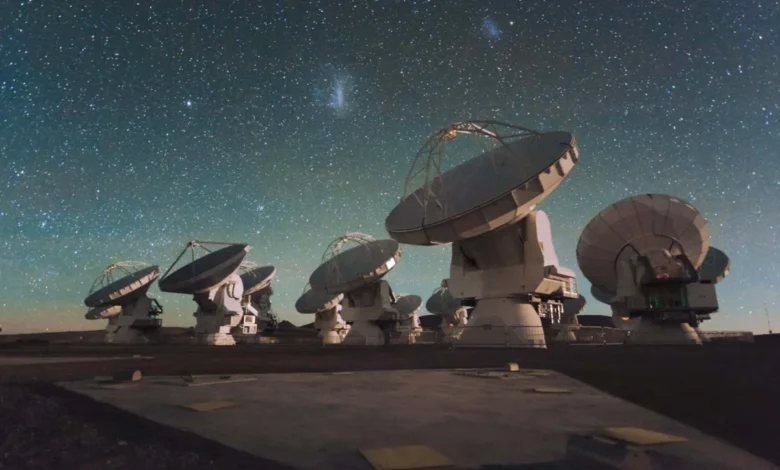
Light, as a form of electromagnetic radiation, encompasses a vast spectrum of wavelengths. While visible light, with its relatively compact wavelengths, allows us to perceive the immediate universe, radio waves occupy the opposite end of this spectrum. These waves are characterized by their immense wavelengths, sometimes stretching several meters between peaks. This expansive nature grants radio waves a remarkable ability to traverse vast cosmic distances, enabling radio telescopes to probe deeper into the universe than their optical counterparts. Furthermore, unlike visible light telescopes that are confined to observations during clear nights, radio telescopes can operate around the clock, significantly maximizing observational time. Chapman emphasizes their astonishing versatility, showcasing how these instruments have unlocked mysteries from our moon to the potential abodes of extraterrestrial civilizations.
The book thoughtfully organizes this exploration into three sections: Our Solar System, Our Galaxy, and Our Universe. This structure mirrors the journey of a radio signal, from its terrestrial origins to the furthest reaches of the cosmos. In the initial chapters, Chapman reveals that humanity’s first touch of the Moon was not a physical landing, but a radio wave. Contemporary radio astronomy continues to play a crucial role in unraveling the Moon’s origin and geological history.

The inhospitable environment of Venus, where most light-based observation techniques falter, is another testament to the power of radio waves. Chapman highlights their "superpower" – the ability to communicate with and reveal information about otherwise inaccessible environments. This capability is particularly critical for understanding the thick, opaque atmospheres of planets like Venus, where visible light cannot penetrate.
Moving beyond our immediate solar neighborhood, Chapman delves into how radio data has been instrumental in generating the most iconic images of black holes. These celestial behemoths, invisible to optical telescopes, leave detectable imprints on the surrounding spacetime that radio waves can capture. The book also recounts how radio astronomers provided the first indirect evidence of gravitational waves, the ripples in spacetime predicted by Einstein’s theory of general relativity, detected through observations of binary pulsars. Moreover, radio waves played a pivotal role in the discovery of some of the earliest exoplanets, planets orbiting stars beyond our Sun.
The Search for Extraterrestrial Intelligence
Chapman dedicates a significant portion of "Radio Universe" to the potential role of radio astronomy in the search for alien civilizations. She posits that a contact with extraterrestrial intelligence is far more likely to occur via a radio signal than through any form of physical invasion. This perspective underscores the fundamental nature of radio waves as a medium for long-distance communication across the cosmos, irrespective of the specific characteristics of any hypothetical alien world, such as its sky color, number of moons, or even the physiology of its inhabitants. This line of reasoning forms the bedrock of projects like SETI (Search for Extraterrestrial Intelligence), which continuously scan the skies for artificial radio signals.
Unraveling Dark Matter and Dark Energy
The final chapters of "Radio Universe" tackle two of the most profound enigmas in modern physics: dark matter and dark energy. These mysterious substances constitute the vast majority of the universe’s mass-energy content, yet their exact nature remains elusive, partly due to the difficulty in their direct detection. Chapman illustrates how radio telescopes offer crucial avenues for investigation. For instance, by detecting radiation emitted by interstellar hydrogen gas, astronomers can infer the distribution of dark matter in galaxies and galaxy clusters, providing indirect but vital clues about its presence and behavior. The faint radio signals from distant hydrogen atoms act as cosmic tracers, mapping the unseen scaffolding of the universe.

A Journey of Accessible Discovery
Throughout the book, Chapman’s writing style is consistently accessible, imaginative, and captivating. Her descriptions, such as the speed of Mercury’s orbit around the Sun, which complicates physical landings but not radio signal investigations, create a vivid mental map of the solar system. Her explanation of the asteroid belt is likened to a masterclass, delivered not by a formal lecturer but by an exceptionally knowledgeable and engaging friend. The author’s genuine passion for radio astronomy is palpable on every page, interspersed with moments of humor that further enhance the reader’s engagement. The inclusion of an appendix listing visitable radio telescopes adds a practical dimension for enthusiasts eager to experience these instruments firsthand.
Reflections on the Future of Space Exploration
While the book largely excels in its scientific exposition and enthusiastic tone, it touches upon themes of space exploration that warrant deeper consideration. Chapman’s acknowledgment of the "second space age" sparked by tech billionaires and her discussion of potential lunar mining and Mars colonization present a somewhat uncritical view of the commercialization of space. The reviewer notes a missed opportunity for the author, an ardent astronomer, to advocate for a more democratic and egalitarian future for space exploration and research, questioning whether the current trajectory of private enterprise is the only or best path forward.
Furthermore, while the narrative spotlights several prominent American and British radio astronomers, the contributions of researchers from other global regions, particularly those operating major radio telescopes in places like Puerto Rico and Chile, receive less detailed attention. This omission, though perhaps unintentional, leaves a gap in the comprehensive portrayal of international radio astronomy efforts.
The Universe is Anything But Quiet
Despite these minor critiques, Chapman’s overarching message is powerfully delivered: the universe is far from silent. "Wherever you are, you are surrounded by radio waves," she eloquently states. These signals, originating from phenomena as diverse as escaping black holes and the echoes of asteroids, and even carrying remnants from the era of the first stars, are constantly reaching us. The invitation to "just close our eyes, and listen" serves as a profound reminder of the invisible universe waiting to be heard. This evocative suggestion is likely to resonate with readers long after they have finished the book, prompting a new awareness of the cosmic chatter that permeates our existence.

Recommended Reading: Expanding the Cosmic Perspective
For readers captivated by the vastness of space and the frontiers of physics, two other notable books offer complementary perspectives:
Fear of a Black Universe: An Outsider’s Guide to the Future of Physics by Stephon Alexander
Stephon Alexander, a working cosmologist, presents a unique and deeply personal exploration of the universe’s history and future. Blending mathematical rigor with inspirations drawn from Zen Buddhism and the art world, Alexander offers a narrative that is both scientifically insightful and artistically resonant. The book is characterized by its examination of how personal experiences and cultural influences intersect with complex scientific concepts, providing a rich tapestry of understanding for readers.
The Disordered Cosmos: A Journey into Dark Matter, Spacetime & Dreams Deferred by Chanda Prescod-Weinstein
Chanda Prescod-Weinstein, a regular columnist for New Scientist, delivers a potent fusion of scientific inquiry and social commentary. Her work provides detailed explanations of phenomena such as dark matter, while also offering a critical analysis of the sociopolitical landscape that has shaped our understanding of modern physics. Prescod-Weinstein notably addresses the ethical considerations surrounding the placement and operation of telescopes, emphasizing that scientific discovery can and should be conducted with a strong sense of social responsibility and consent, extending beyond the mere collection and analysis of light.