Maximizing Urban Living: Professional Strategies for Enhancing Spatial Perception in Small-Scale Residential Environments

The global trend toward urbanization has fundamentally altered the residential landscape, leading to a proliferation of smaller living spaces in major metropolitan hubs. As housing costs continue to rise and the availability of large-scale urban plots diminishes, renters and homeowners alike are increasingly navigating the complexities of "micro-living" or small-footprint residences. Data from the last decade indicates that while the average size of a new single-family home in the United States has fluctuated, the square footage of urban apartments has seen a consistent downward trend, particularly in high-density markets such as New York City, San Francisco, and Seattle. In these environments, the challenge for residents is no longer just finding a location, but effectively managing the psychological and functional limitations of limited square footage. Real estate experts and interior designers suggest that the perceived size of an apartment is often independent of its actual measurements, relying instead on strategic design choices that optimize light, flow, and utility.
The Context of the Modern Rental Market and Spatial Constraints
The shift toward smaller residential units is driven by a combination of economic necessity and demographic shifts. According to recent census data and real estate market reports, the "renter generation"—comprising both young professionals and downsizing retirees—is prioritizing proximity to urban centers over large interior spaces. In cities like San Diego, CA, and Richmond, VA, the demand for one-bedroom and studio apartments remains high, even as square footage becomes a premium commodity. This phenomenon has birthed a new discipline within the interior design and property management industries: the science of spatial perception.
Historically, apartment design relied on distinct partitions to separate living functions—cooking, sleeping, and socializing. However, the modern architectural response to small-scale living has moved toward the "open concept" model. This evolution reflects a broader change in lifestyle where the boundaries between work and home have blurred, necessitating a more fluid approach to interior layouts. To address these challenges, industry leaders have identified several key strategies that transform a confined footprint into a functional and seemingly expansive home.
Structural Foundations: The Primacy of Open Floor Plans
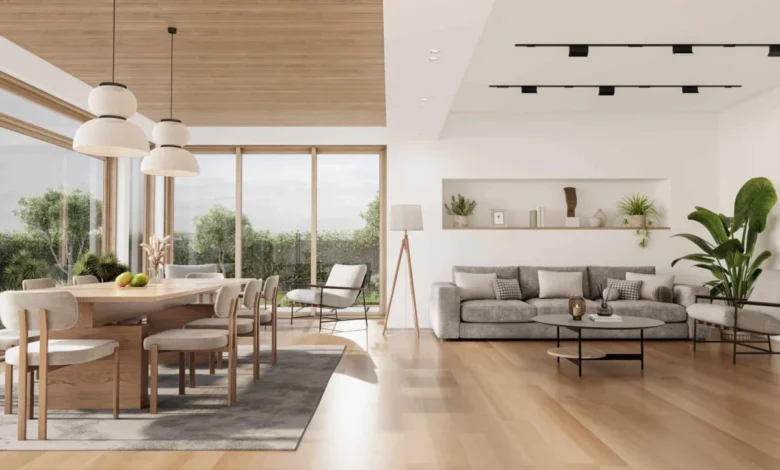
A fundamental tenet of modern small-space design is the prioritization of open floor plans. The removal of non-structural walls and the integration of diverse living zones into a single cohesive area is widely regarded as the most effective way to increase perceived volume. Goldmark Property Management, based in Fargo, ND, emphasizes that an open layout connecting the kitchen and living area is crucial for smaller apartments. By eliminating the visual interruptions created by walls, the sightlines of the apartment are extended, making the space appear more seamless.
This sentiment is shared by developers at The Q Topanga in Woodland Hills, CA, who argue that the effectiveness of an open floor plan is amplified when paired with high ceilings and abundant natural light. Their latest development, The Q De Soto, exemplifies this approach by utilizing high-set windows and strategic storage solutions to keep floor space clear. The objective is to create a "breathable" environment where the eye can travel across the room without being stopped by heavy architectural barriers. This structural strategy is particularly effective in high-density areas where natural light may be limited by neighboring buildings; by opening the floor plan, the light that does enter can penetrate deeper into the residence.
The Rise of Multi-Functional and Intentional Furnishing
In the context of limited square footage, the selection and placement of furniture transition from purely aesthetic choices to critical logistical decisions. Ezra Gershanok, Co-founder of Ohana Housing Co., a prominent subletting marketplace in New York City, notes that the most successful small apartments are those characterized by a "less is more" philosophy. Having observed hundreds of high-density living situations, Gershanok highlights that clutter is the primary enemy of spatial perception.
The solution lies in the adoption of multi-use furniture. This market segment has seen significant growth, with global sales of "transformable" furniture—such as Murphy beds, nesting tables, and sofa-desks—projected to rise as urban density increases. Gershanok advocates for versatile items, such as a television mounted on a swivel that can serve both the living area and the bedroom, thereby reducing the need for multiple electronic setups.
Furthermore, the intentionality of furniture placement is vital for defining "zones" within a single room. Stage & Fold, a New York-based staging firm, explains that well-scaled furniture helps define the function of a space without overcrowding it. Professional stagers often use rugs or lighting to demarcate a dining area from a lounge area in a studio apartment, creating the illusion of multiple rooms within a single open space. This psychological partitioning allows residents to feel a sense of transition as they move through their home, which is essential for long-term comfort in small environments.
Aesthetic Editing and the Psychology of "Visual Weight"
Designers at Month2Month suggest that managing a small space requires a rigorous process of "editing." This involves evaluating furniture and decor based on their "visual weight"—the degree to which an object appears to occupy space. For instance, a solid, dark-colored media console has a high visual weight and can make a room feel cramped. Conversely, a slim wooden tripod stand or a glass-topped coffee table allows the eye to see through or under the object, maintaining the floor’s visual continuity.
Strategic placement of mirrors is another evidence-based technique for expanding a room’s perceived boundaries. By leaning a full-length mirror against a wall opposite a window, daylight is reflected throughout the room, effectively "doubling" the light source. This technique also creates a "false window" effect, providing a sense of depth that tricks the brain into perceiving more distance than actually exists.
Verticality and Uniformity: Drawing the Eye Upward
When horizontal space is limited, designers look to the vertical plane to create a sense of grandeur. Kimberly Sektnan of Performance Properties in Portland, OR, recommends drawing the eye toward the ceiling to emphasize height. This can be achieved by hanging curtains several inches above the actual window frame and extending them to the floor. This vertical line suggests a larger window and a higher ceiling than what may be present.
Uniformity in flooring is another professional secret for spatial expansion. When a single flooring material—whether hardwood, laminate, or tile—runs uninterrupted from the entryway through the kitchen and into the living area, it prevents the "chopped up" look that occurs when different zones have different finishes. This continuity suggests a larger, singular expanse. According to data from real estate staging studies, homes with uniform flooring across small footprints tend to stay on the market for less time and command higher rental prices because they present a cleaner, more organized aesthetic.
The Role of Layered Lighting in Spatial Depth
Lighting is often an overlooked component of apartment design, yet it remains one of the most cost-effective ways to alter the feel of a room. Standard overhead lighting, often referred to as "boob lights" in rental units, tends to cast harsh shadows and flatten the dimensions of a space. To counter this, experts suggest a "layered" approach to illumination.
By utilizing a combination of floor lamps, table lamps, and wall-mounted sconces at different heights, residents can create "pockets" of light. These overlapping layers add depth and dimension, drawing the eye to the corners of the room and making the boundaries feel less restrictive. In a small apartment, the goal of lighting should be to eliminate dark corners, which visually shrink a room, and replace them with warm, diffused light that encourages the eye to explore the entire volume of the space.
Broader Implications and the Future of Urban Design
The strategies outlined by these industry experts reflect a broader shift in how society views residential success. As the "minimalist" movement gains traction, driven by both environmental concerns and economic realities, the ability to live comfortably in smaller spaces is becoming a valued skill. For developers, these design principles are no longer optional; they are essential for tenant retention and satisfaction.
The long-term implications of these trends are significant. Urban planners are increasingly looking at "modular" apartment designs that allow for flexible living, while the furniture industry continues to innovate with smart, space-saving technology. Ultimately, the transformation of a small apartment into a spacious-feeling home is a testament to the power of intentional design. By balancing functionality with light and flow, residents can maximize every square foot, proving that the quality of a living space is defined not by its dimensions, but by its design.
As the rental markets in cities like San Diego, Richmond, and Fargo continue to evolve, the demand for these spatial solutions will only grow. The synthesis of architectural layout, multi-functional furnishing, and strategic aesthetic choices provides a roadmap for modern urbanites to thrive in the compact landscapes of the 21st century. Through these methods, the challenge of small-space living is reimagined as an opportunity for creative and efficient residential design.