The Ultimate Guide to Answer Engine Optimization and Selecting the Right AEO Checker for Your Brand

The digital landscape is undergoing its most significant transformation since the invention of the search engine. For decades, the primary objective of web marketing was to secure a position on a list of blue links. However, the rise of generative AI—specifically tools like ChatGPT, Perplexity, and Google’s AI Overviews—has fundamentally shifted user behavior. Today, a growing segment of the global population asks questions and consumes synthesized answers directly within the interface, often never clicking through to an external website. This "zero-click" reality has rendered traditional search engine optimization (SEO) necessary but insufficient. To maintain visibility, brands must now master Answer Engine Optimization (AEO).
An AEO checker serves as the primary diagnostic tool in this new environment. It monitors whether your brand is being cited, mentioned, or ignored by AI models that curate information for users. As these engines synthesize data from multiple sources to provide immediate, concise answers, the visibility that once defined a website’s success is increasingly migrating into the "black box" of AI responses.
![AEO checker tools that measure answer engine visibility [2026]](https://53.fs1.hubspotusercontent-na1.net/hubfs/53/aeo-checker-1-20260903-3858273.webp)
The Evolution of Search: From Links to Synthesis
The shift toward answer-first technology began in earnest with the rapid adoption of Large Language Models (LLMs). In May 2024, Google solidified this transition by launching AI Overviews (AIO) globally. This move signaled that the world’s most powerful search engine was no longer content merely indexing the web; it intended to interpret it.
Historically, SEO relied on keywords, backlinks, and technical health to climb the ranks of Google Search. AEO, by contrast, focuses on "entity authority." It prioritizes how clearly a brand can define its value proposition so that an AI engine—when tasked with answering a user’s complex query—deems the brand a trustworthy source. When a user asks, "What is the best CRM software for a mid-sized agency?" the AI does not just present a list; it constructs a narrative. If your brand is not part of that narrative, it effectively ceases to exist for that user.
Why Manual Checking is No Longer Sufficient
While initial forays into AEO can be conducted manually, the volatility of AI responses makes such efforts labor-intensive and prone to error. AI models are non-deterministic; they can return different answers to the same question within minutes, depending on the session history, user location, or current data ingestion.
![AEO checker tools that measure answer engine visibility [2026]](https://no-cache.hubspot.com/cta/default/53/9dd5e54b-fbef-4dd0-bc44-1689feb1ea18.png)
To perform a manual check, marketers must:
- Define a query list: Identify the core informational and transactional questions relevant to their industry.
- Execute incognito searches: To avoid personalization bias, all queries must be run in clean, browser-isolated environments.
- Audit the output: Manually verify if the AI provides a citation (a direct link) or merely a mention (a brand name reference), and note whether the tone is favorable or neutral.
As of late 2026, even major search platforms have struggled to provide comprehensive visibility metrics. While Google began rolling out generative AI performance reporting in June 2026, these reports are limited in scope and often aggregate data in ways that obscure specific citation trends. Consequently, enterprise-grade AEO checkers have emerged to provide the consistent, automated monitoring that manual processes cannot sustain.
Criteria for Evaluating AEO Software
Choosing the right AEO checker requires an understanding of your organization’s specific needs. A robust tool should provide more than just a list of citations; it must offer actionable intelligence. When evaluating platforms, consider the following metrics:
![AEO checker tools that measure answer engine visibility [2026]](https://53.fs1.hubspotusercontent-na1.net/hubfs/53/aeo-checker-2-20260903-852936.webp)
- Citation Velocity: The speed at which your brand’s presence changes in response to content updates.
- Competitor Benchmarking: Real-time analysis of which rivals are capturing the "answer share" for your primary keywords.
- Sentiment and Contextual Analysis: Understanding not just if you were mentioned, but how you were described.
- Technical Readiness: Ensuring that your website’s schema markup is optimized for AI crawlers, which read data differently than traditional search bots.
Landscape of Leading AEO Tools
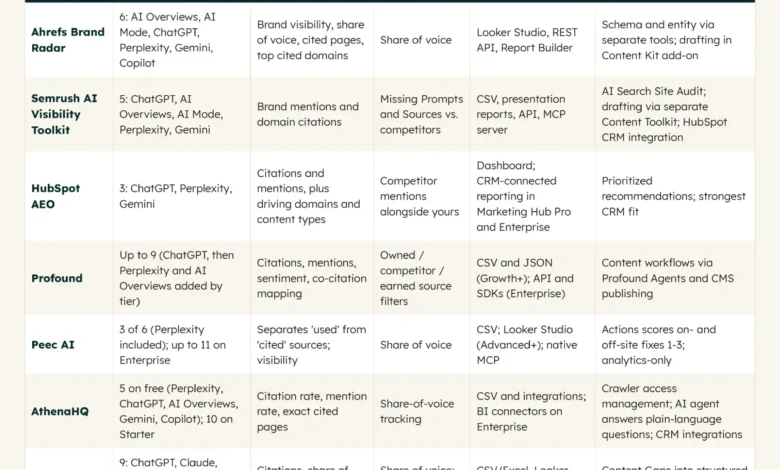
The market for AEO software is currently segmented based on the specific strengths of each provider. Organizations should align their selection with their existing tech stack and primary search targets.
Tools for AI Overviews (AIO) Tracking:
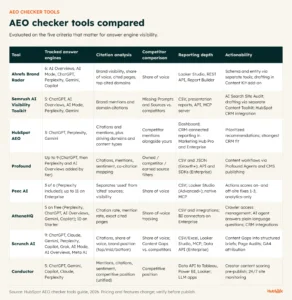
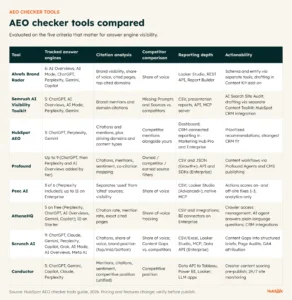
- Ahrefs Brand Radar: Known for its deep integration with search query data, this tool excels at monitoring the largest index of AI Overview results, making it ideal for brands focused on Google-centric traffic.
- Semrush AI Visibility Toolkit: By linking its organic research database to AI triggers, Semrush allows teams to identify which of their existing high-ranking pages are most likely to be pulled into AI summaries.
Tools for Citation Detection (ChatGPT & Perplexity):
![AEO checker tools that measure answer engine visibility [2026]](https://53.fs1.hubspotusercontent-na1.net/hubfs/53/aeo-checker-3-20260903-8904553.webp)
- HubSpot AEO: As a leader in the CRM-integrated marketing space, HubSpot provides a unique advantage by connecting AI visibility data directly to leads and revenue. It allows teams to see which AI citations are driving actual business results rather than just "vanity" visibility.
- Profound: This tool is noted for its sophisticated sentiment scoring, providing a qualitative view of how AI represents a brand in the wild.
Specialized Monitoring:
- Peec AI & AthenaHQ: These platforms are increasingly popular for their specific focus on Perplexity, a growing engine for research-intensive queries.
- Scrunch & Conductor: These solutions emphasize the "readiness" side of the equation, ensuring that a brand’s technical infrastructure is compatible with the evolving requirements of AI crawlers.
Implications for the Digital Marketing Funnel
The adoption of AEO necessitates a fundamental change in how marketing teams measure success. Traditional metrics like "click-through rate" (CTR) are becoming less reliable as indicators of overall brand health. If an AI provides a perfect summary that satisfies the user’s intent without them ever visiting your site, the conversion potential remains, but the path to that conversion is invisible to standard analytics.
Marketing leaders are now looking toward "assisted conversion" models. In this framework, traffic referred from AI tools is treated as a high-intent segment. By integrating AEO data with a CRM, companies can track the lifecycle of a user who first encountered the brand through an AI answer. This helps bridge the gap between "visibility" and "revenue."
![AEO checker tools that measure answer engine visibility [2026]](https://53.fs1.hubspotusercontent-na1.net/hubfs/53/aeo-checker-4-20260903-6212698.webp)
The Strategic Path Forward
Moving from measurement to action is the ultimate goal of any AEO strategy. Simply knowing you are not being cited is of little value unless you know why.
For many firms, the next phase of development involves the use of "Content Agents." These AI-driven assistants, increasingly available in enterprise software suites, can take the diagnostic report from an AEO checker and automatically generate content updates. If the checker reports that a competitor is being cited for a specific technical question because their content is more structured, the Content Agent can rewrite your existing material to include the necessary schema, clear headings, and concise, authoritative answers that AI models prefer.
This process is not a one-time fix. Because AI models are constantly updating their training data and preferences, AEO must be treated as a continuous loop: Measure, Diagnose, Prioritize, Optimize, and Report.
![AEO checker tools that measure answer engine visibility [2026]](https://53.fs1.hubspotusercontent-na1.net/hubfs/53/aeo-checker-5-20260903-8938354.webp)
Conclusion
The transition to an AI-first search environment is not a threat to be feared but an opportunity to be managed. While the era of "blue link" dominance is fading, the era of "authoritative answers" has begun. Brands that prioritize clarity, structural integrity, and consistent monitoring will find that they can command the same level of influence in the age of AI as they did in the age of search engines. By integrating AEO into the broader marketing strategy, organizations can ensure that when the next generation of users asks a question, their brand is the one the machine chooses to answer. As the tools for measurement become more refined, the gap between those who adapt to this new era and those who cling to legacy SEO will only continue to widen.
Related posts: